Layer 2 Blockchain Solutions: How They Work and Why They Matter
Blockchains like Bitcoin and Ethereum are powerful, but their limited throughput makes mass adoption a challenge. Layer 2 solutions are protocols built on top of existing blockchains that dramatically increase transaction speed and reduce costs. Learn how technologies like rollups, state channels, and sidechains are scaling crypto without compromise.
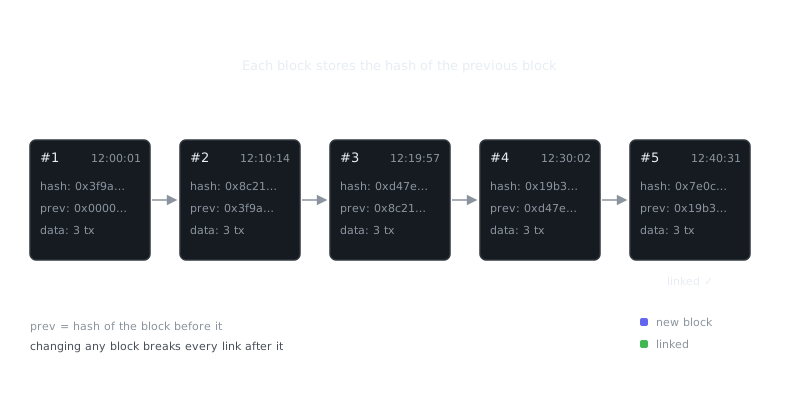
Try it: change one character and watch the chain break
Each block stores the hash of the previous one. Edit any block's data: its hash changes, so every later block no longer matches and turns red.
0000…0000…0000…0000…0000…0000…0000…0000…On this page
Blockchains like Bitcoin and Ethereum are secure and decentralized, but they hit a wall when it comes to speed. Bitcoin processes roughly 7 transactions per second. Ethereum manages around 15-30. Visa handles tens of thousands. That gap between what blockchains can do and what global adoption actually requires is called the scalability problem. Layer 2 solutions are the engineering answer — systems built on top of existing blockchains that inherit their security while dramatically increasing speed and cutting costs.
What Is a Layer 2 Solution?
A Layer 2 (L2) is a secondary protocol that runs on top of a base blockchain (Layer 1). The core idea is to move most transaction activity off the main chain, settle it efficiently, and only touch the base chain for final dispute resolution or periodic checkpointing.
This design preserves the two things developers care most about: the security guarantees of Layer 1 (Bitcoin's fundamentals are rooted in proof-of-work and cryptographic finality), and the ability to scale to millions of users without bloating the base chain.
Layer 2 isn't a single technology — it's a category. The most prominent implementations are payment channels, state channels, rollups, and sidechains, each with different tradeoffs worth understanding before you pick one.
Payment Channels and the Lightning Network
How Payment Channels Work
A payment channel lets two parties transact an unlimited number of times without touching the blockchain for each one. They open a channel by locking funds in a multi-signature smart contract on Layer 1. From there, they exchange signed balance updates off-chain. When they're done, they broadcast the final state to the blockchain, which settles the net result.
The Lightning Network is Bitcoin's most widely deployed payment channel network. Here's what opening a channel actually looks like:
# Using lnd (Lightning Network Daemon)
# Open a channel with a peer
lncli openchannel --node_key=<peer_pubkey> --local_amt=500000

# Send a payment through the network
lncli sendpayment --pay_req=<invoice_string>

# Close the channel and settle on-chain
lncli closechannel --funding_txid=<txid> --output_index=0
Instead of sending every coffee payment to the Bitcoin base chain, you open a channel with a coffee shop, make hundreds of purchases off-chain, and settle once. Transaction fees drop to fractions of a cent. Confirmation is instant.
Real-World Adoption
Lightning isn't theoretical anymore. Strike, River, and Wallet of Satoshi all use it for consumer payments. El Salvador's Chivo wallet relies on Lightning for everyday Bitcoin spending. Litecoin and other payment-focused cryptocurrencies have explored similar channel-based constructions, given their shared focus on fast, low-cost transfers.
State Channels
State channels take the payment channel concept further — beyond just money. Any state, whether a game score, a vote tally, or a financial position, can be updated off-chain between participants and finalized on-chain only when needed.
The Ethereum ecosystem explored state channels through projects like Raiden Network and Connext. They work well when the same participants interact repeatedly and both are online. The catch is that state channels are bilateral or require pre-defined participant sets, which makes them less suitable for open, permissionless interactions like decentralized exchanges.
Rollups: The Dominant Ethereum L2 Architecture
Rollups move execution off-chain but post transaction data — or proofs — back to Ethereum. That means Ethereum validators can verify what happened without processing every transaction themselves.
Optimistic Rollups
Optimistic rollups assume all transactions are valid by default and post them to Layer 1 without immediate proof. There's a challenge window (typically 7 days) during which anyone can submit a fraud proof if a transaction is invalid. If no challenge is raised, the batch is considered final.
Examples: Arbitrum, Optimism (OP Stack), Base
The tradeoff is withdrawal delay. Moving funds from an optimistic rollup back to Ethereum mainnet takes up to a week unless you use a liquidity bridge.
“In the future, I think there will be more countries that use crypto.”
— Vitalik Buterin
ZK-Rollups
ZK-rollups use zero-knowledge proofs to cryptographically prove that every transaction in a batch was valid. The proof is verified on-chain instantly, so there's no challenge window and withdrawals are fast.
Examples: zkSync Era, StarkNet, Polygon zkEVM, Scroll
// Simplified: a ZK-rollup verifier contract on Ethereum
function verifyBatch(
    uint256[] calldata publicInputs,
    bytes calldata proof
) external returns (bool) {
    return zkVerifier.verify(publicInputs, proof);
    // If this passes, the entire batch of transactions is accepted
}
ZK-rollups have higher computational overhead on the prover side but offer faster finality and stronger security guarantees. As ZK proof generation gets cheaper through hardware acceleration and better algorithms, they're increasingly the preferred choice for new deployments.
Layer 2 Comparison
| Solution | Finality | Security Model | Best For | Examples |
|---|---|---|---|---|
| Payment Channels | Instant | On-chain settlement | Micropayments, high-frequency bilateral transfers | Lightning Network |
| State Channels | Instant | On-chain settlement | Repeated interactions between known parties | Raiden, Connext |
| Optimistic Rollup | ~7 days (to L1) | Fraud proofs | General smart contracts, DeFi | Arbitrum, Base, Optimism |
| ZK-Rollup | Minutes | Validity proofs | Payments, DEXs, complex apps | zkSync, StarkNet |
| Sidechain | Varies | Independent consensus | High throughput apps | Polygon PoS |
Sidechains deserve a mention here. They're separate blockchains with their own consensus mechanisms that connect to a main chain via a bridge. Polygon PoS is technically a sidechain, not a rollup, though the distinction gets blurred in marketing. Sidechains offer more flexibility but inherit less security from Layer 1 — that's the fundamental tradeoff.
Cross-Layer Interactions and Atomic Swaps
Here's a practical question that comes up fast: when assets sit on different Layer 2 systems or across different blockchains entirely, how do you exchange them without trusting a centralized intermediary?
That's where atomic swaps come in. They use hash time-locked contracts (HTLCs) to ensure that either both sides of a trade execute or neither does. The same mechanism underpins Lightning Network payments that route through intermediate nodes — each hop is an atomic commitment.
Alice (BTC on Lightning) <--HTLC--> Routing Node <--HTLC--> Bob (LTC on Litecoin)Cross-chain atomic swaps between Lightning and Litecoin have been demonstrated in practice, enabling trustless exchange without a centralized exchange. The main challenge is liquidity — both parties need channels funded in the right assets.
As the L2 ecosystem matures, interoperability protocols like LayerZero, Across, and the Optimism Superchain are building more generalized bridges between rollups, reducing friction for cross-layer capital movement.
Why Layer 2 Matters for Real Adoption
The economic case is pretty clear. During Ethereum's peak congestion in 2021, a single on-chain swap could cost $50-200 in gas fees. On Arbitrum or Optimism today, that same swap costs cents. On zkSync or StarkNet, even less.
For Bitcoin, Lightning makes the "digital cash" use case actually viable. Sending $0.50 on-chain is impractical when the fee is $1.00. Over Lightning, that same payment settles in milliseconds for less than a satoshi.
These improvements aren't hypothetical. Arbitrum regularly processes more transactions per day than Ethereum mainnet. Lightning's network capacity exceeds 5,000 BTC. Real applications — games, DEXs, payroll systems, social platforms — are running on L2 infrastructure right now.
Key Takeaways
Layer 2 solutions solve blockchain's scalability ceiling by moving computation and transaction volume off the base chain while anchoring security back to it. The major approaches — payment channels, state channels, optimistic rollups, and ZK-rollups — each make different tradeoffs between finality speed, security assumptions, and developer flexibility.
Worth remembering: Layer 2 is a category, not a single technology. Choose based on your use case. Lightning for micropayments, ZK-rollups for general smart contracts where fast finality matters, optimistic rollups if you need broad EVM compatibility today and can tolerate the withdrawal delay. The right answer depends on what you're actually building.
Frequently Asked Questions
What is a Layer 2 solution and why does it exist?
A Layer 2 solution is a secondary network built on top of a main blockchain (Layer 1) like Ethereum or Bitcoin to help it handle more transactions faster. The main blockchain can get congested and expensive when too many people use it at once, so Layer 2 offloads most of the work and only settles the final results back on the main chain. Think of it like an express lane that keeps traffic moving without rebuilding the entire highway.
Is my money safe on a Layer 2 network?
Layer 2 solutions are generally considered secure because they inherit the security guarantees of the underlying Layer 1 blockchain they settle on. Your funds are protected by the same cryptographic rules, and most Layer 2 designs allow you to withdraw back to the main chain even if the Layer 2 network goes offline. That said, each Layer 2 has its own trust assumptions, so it's worth understanding the specific one you're using before moving large amounts.
What is the difference between rollups, sidechains, and state channels?
These are three different approaches to scaling: rollups bundle many transactions together and post compressed data back to Layer 1, making them highly secure; sidechains are separate blockchains with their own consensus rules that run alongside the main chain but don't fully inherit its security; and state channels let two parties transact privately off-chain and only record the final outcome on Layer 1, which works great for repeated interactions like micropayments. Rollups (like Optimism and Arbitrum) are currently the most popular Layer 2 approach in the Ethereum ecosystem.
Video Resources
Sources & Further Reading
- Ethereum.org — Official Ethereum documentation and learning hub.
- Ethereum.org: DeFi — Official introduction to decentralised finance on Ethereum.
- Bitcoin Whitepaper — Satoshi Nakamoto's original nine-page design of Bitcoin.
- Bitcoin.org — Community-maintained introduction, wallet guidance and developer docs.
- CoinGecko — Market data, exchange listings and asset profiles.
- Messari Research — Research reports and asset fundamentals.
- Bitcoin Wiki — Long-running technical wiki covering protocol details.