Ethereum and Smart Contracts: How Programmable Blockchain Works
Ethereum took Bitcoin's decentralization concept further by introducing a programmable blockchain where developers can deploy self-executing smart contracts. Launched in 2015 by Vitalik Buterin, it became the foundation for DeFi, NFTs, and decentralized apps. This guide breaks down how it all works in plain language.
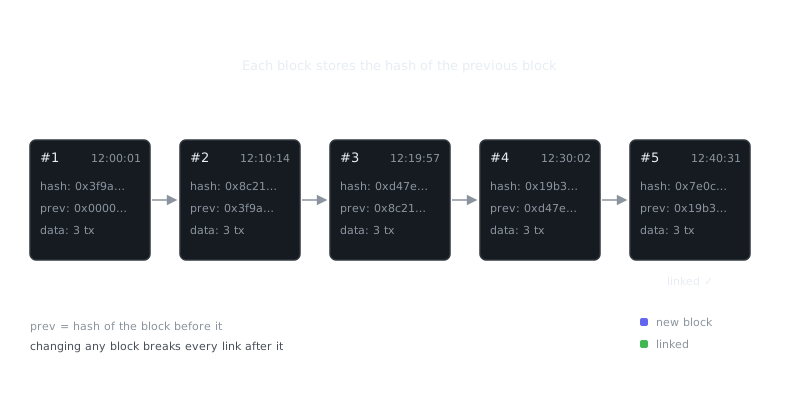
Try it: change one character and watch the chain break
Each block stores the hash of the previous one. Edit any block's data: its hash changes, so every later block no longer matches and turns red.
0000…0000…0000…0000…0000…0000…0000…0000…On this page
Beyond Digital Currency
Bitcoin proved that a decentralized network could transfer value without a central authority. Ethereum took that idea further by asking a different question: what if a blockchain could actually run code?
Launched in 2015 by Vitalik Buterin, Ethereum introduced a programmable blockchain — a platform where developers can deploy self-executing programs called smart contracts. That's what separates it from Bitcoin at a fundamental level. Bitcoin is optimized to be a store of value and payment network. Ethereum is a general-purpose computation platform that happens to have a native currency (Ether, or ETH).
To really get Ethereum, you need to understand two things together: the blockchain infrastructure that makes it trustworthy, and the smart contract layer that makes it useful.
How Ethereum Works
The Ethereum Virtual Machine
At the core of Ethereum sits the Ethereum Virtual Machine (EVM), a sandboxed runtime environment that executes smart contract code across every node in the network. When a smart contract runs, every participating node executes the same code and reaches the same result. That redundancy is what makes execution trustless.
Developers write smart contracts primarily in Solidity, a statically typed language designed for the EVM. The code gets compiled into bytecode and deployed to the blockchain at a specific address.
// SPDX-License-Identifier: MIT
pragma solidity ^0.8.0;

contract SimpleStorage {
    uint256 private storedValue;

    function set(uint256 value) public {
        storedValue = value;
    }

    function get() public view returns (uint256) {
        return storedValue;
    }
}
This contract stores a number on-chain. Anyone can write to it by calling set(), and anyone can read from it by calling get(). No server, no database, no administrator — just code on a shared ledger.
Gas: The Cost of Computation
Every operation on Ethereum costs gas, a unit measuring computational effort. Users pay gas fees in ETH to compensate validators for processing their transactions. This mechanism prevents abuse: running infinite loops or bloated contracts becomes prohibitively expensive.
Gas prices fluctuate based on network demand. During high-traffic periods, fees spike. This has been a persistent criticism of Ethereum and a key driver behind Layer 2 scaling solutions.
What Smart Contracts Actually Do
A smart contract is an agreement encoded in software. The terms are written in code, deployed to the blockchain, and executed automatically when predefined conditions are met. No intermediary can alter the outcome.
Real-World Applications
Decentralized Finance (DeFi) Protocols like Uniswap use smart contracts to handle token swaps without an order book or central exchange. Liquidity providers deposit assets into a contract-managed pool, and a pricing algorithm handles trades automatically. Billions of dollars flow through these contracts every day.
NFTs (Non-Fungible Tokens) An NFT is a smart contract that records ownership of a unique asset on-chain. The ERC-721 token standard defines a common interface so wallets and marketplaces can interact with any compliant NFT contract. When you buy an NFT, you're executing a contract function that transfers ownership to your wallet address.
DAOs (Decentralized Autonomous Organizations) A DAO governs itself through smart contracts. Token holders vote on proposals, and approved changes execute automatically. MakerDAO, which manages the DAI stablecoin, operates this way — protocol parameters are adjusted through governance votes, not company decisions.
Supply Chain Verification Companies use Ethereum-based contracts to record product provenance. Each step in a supply chain (manufacturing, shipping, customs) gets logged as an on-chain transaction, creating an immutable audit trail.
Ethereum vs. Bitcoin: A Direct Comparison
Both networks are decentralized and secured by cryptography, but they serve different purposes.
| Feature | Bitcoin | Ethereum |
|---|---|---|
| Primary purpose | Store of value / payments | Programmable platform |
| Native currency | BTC | ETH |
| Smart contracts | Limited (Script) | Full (Solidity, Vyper) |
| Block time | ~10 minutes | ~12 seconds |
| Consensus mechanism | Proof of Work | Proof of Stake (post-Merge) |
| Annual issuance | Fixed, halving schedule | Variable, deflationary post-EIP-1559 |
| DeFi ecosystem | Minimal | Extensive |
| Developer activity | Lower | Higher |
The 2022 "Merge" was a landmark event. Ethereum transitioned from Proof of Work to Proof of Stake, cutting its energy consumption by roughly 99.95%. Validators now stake ETH as collateral instead of burning electricity, which also changed ETH's issuance model and made it periodically deflationary.
Interacting with Ethereum
Wallets and Accounts
Every Ethereum account is a public/private key pair. Your wallet address (derived from your public key) is where you receive ETH and tokens. Your private key signs transactions, and whoever controls that key controls the account.
“In the future, I think there will be more countries that use crypto.”
— Vitalik Buterin
MetaMask is the most common browser wallet. For interacting with contracts programmatically, developers reach for libraries like ethers.js or web3.py.
# Install ethers.js in a Node.js project
npm install ethers

# Install web3.py for Python
pip install web3
const { ethers } = require("ethers");
// Connect to Ethereum mainnet via a provider
const provider = new ethers.JsonRpcProvider("https://mainnet.infura.io/v3/YOUR_KEY");
// Read ETH balance of an address
const balance = await provider.getBalance("0xYourAddress");
console.log(ethers.formatEther(balance), "ETH");Testnets for Development
Before deploying to mainnet (where mistakes cost real money), developers use testnets like Sepolia or Holesky. These networks run on worthless test ETH and mirror mainnet behavior closely enough to catch most issues.
# Deploy a contract to Sepolia testnet using Hardhat
npx hardhat run scripts/deploy.js --network sepolia
Acquiring and Managing ETH
To use Ethereum, you need ETH. Centralized exchanges like Coinbase and Kraken are the most accessible entry points, with KYC verification and fiat on-ramps built in. Decentralized exchanges like Uniswap let you swap tokens directly from your wallet without an account, but you'll need ETH already to cover gas.
For portfolio management, ETH is typically treated as a core holding because it plays a dual role: it's the gas currency for the entire Ethereum ecosystem and a productive asset you can stake to earn yield. Staking ETH currently returns around 3–4% annually, which sets it apart from non-yielding assets like Bitcoin.
Risks and Limitations
Smart contracts are only as good as the code behind them. Bugs are permanent — once deployed, a contract can't be patched unless it was built with an upgradeable proxy pattern. The 2016 DAO hack exploited a reentrancy vulnerability and drained $60 million worth of ETH before the community voted to hard fork the chain.
Worth knowing before you dive in:
Code vulnerabilities — Reentrancy attacks, integer overflows, and access control flaws have caused hundreds of millions in losses across the ecosystem.
Oracle manipulation — Smart contracts that rely on external price feeds can be exploited if the oracle is compromised.
Scalability constraints — Ethereum mainnet processes roughly 15–30 transactions per second. During congestion, fees can reach hundreds of dollars.
Regulatory uncertainty — Depending on your jurisdiction, certain tokens and DeFi activities may face regulatory scrutiny.
Layer 2 networks like Arbitrum, Optimism, and zkSync tackle the scalability problem by batching transactions off-chain and settling proofs on mainnet. They inherit Ethereum's security while offering dramatically lower fees and higher throughput.
Key Takeaways
Ethereum extended the blockchain model from a payment ledger to a programmable platform. Smart contracts replace intermediaries with code, letting financial applications, digital ownership, and decentralized governance operate transparently without any controlling authority.
A few things worth remembering:
Ethereum runs the EVM across a decentralized node network, making smart contract execution trustless and verifiable. Smart contracts are immutable by default — that permanence is both their biggest strength and a real source of risk when bugs slip through. And ETH isn't just a currency; it's the fuel and economic backbone of the entire ecosystem, which gives it a fundamentally different profile than Bitcoin.
Frequently Asked Questions
What is Ethereum and how is it different from Bitcoin?
Ethereum is a blockchain platform that lets developers build and run decentralized applications, not just transfer money. While Bitcoin was designed primarily as a digital currency, Ethereum's main value is its programmable blockchain, which powers a wide ecosystem of apps, tokens, and services.
What is a smart contract?
A smart contract is a self-executing program stored on the blockchain that automatically carries out an agreement when predefined conditions are met. Think of it like a vending machine — you put in the right input, and it delivers the output without needing a middleman.
Do I need to know how to code to use smart contracts?
No, most people interact with smart contracts through apps called dApps without writing any code. You just need a crypto wallet like MetaMask to connect and use them, similar to how you use a website without knowing its underlying code.
Video Resources
Sources & Further Reading
- Ethereum.org — Official Ethereum documentation and learning hub.
- Ethereum.org: DeFi — Official introduction to decentralised finance on Ethereum.
- Bitcoin Whitepaper — Satoshi Nakamoto's original nine-page design of Bitcoin.
- Bitcoin.org — Community-maintained introduction, wallet guidance and developer docs.
- CoinGecko — Market data, exchange listings and asset profiles.
- Messari Research — Research reports and asset fundamentals.
- Bitcoin Wiki — Long-running technical wiki covering protocol details.