Bitcoin Fundamentals: How the World's First Cryptocurrency Actually Works
Bitcoin is a decentralized digital currency that runs without banks or central authorities. This guide breaks down how Bitcoin works — from the blockchain and mining to wallets and transactions — so you can understand the technology behind the world's most valuable cryptocurrency.
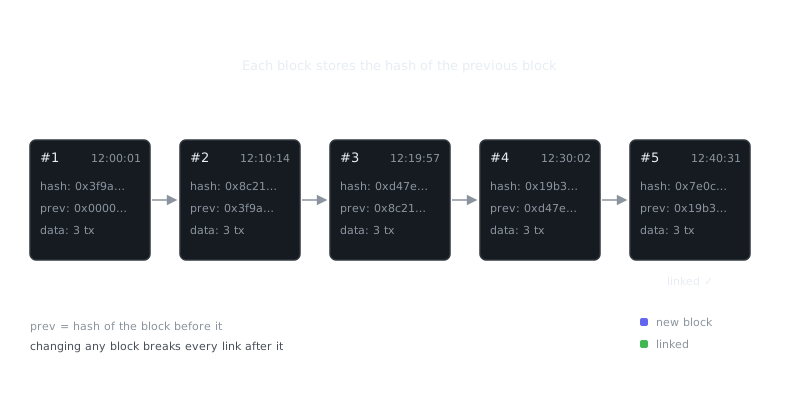
Try it: change one character and watch the chain break
Each block stores the hash of the previous one. Edit any block's data: its hash changes, so every later block no longer matches and turns red.
0000…0000…0000…0000…0000…0000…0000…0000…On this page
Bitcoin is a decentralized digital currency with no central bank, no CEO, and no single point of control. Since Satoshi Nakamoto launched it in 2009, it's grown from an obscure cryptography experiment into a global financial asset worth trillions of dollars. Understanding how it actually works — not just what it is — gives you a real foundation for thinking about the broader crypto landscape, from Ethereum and smart contracts to cross-chain interoperability and long-term questions like cryptocurrency inheritance planning.
“Blockchain is to trust what the internet was to communication.”
— Unknown
The Blockchain: Bitcoin's Core Data Structure
Every Bitcoin transaction gets recorded on a public ledger called the blockchain. This ledger isn't stored in one place. Thousands of nodes around the world each hold a complete copy and independently verify new data. If one node goes down or tries to cheat, the others carry on without it.
Blocks and Chains
A block is essentially a bundle of recent transactions. Each one contains a list of validated transactions, a timestamp, a cryptographic hash of the previous block, and a nonce used during mining.
That hash of the previous block is what creates the "chain." Alter any historical block and its hash changes, which breaks every block that came after it. To rewrite history, you'd need to recalculate all the following blocks faster than the rest of the network keeps adding new ones. In practice, that's computationally impossible on a network Bitcoin's size.
Nodes and Consensus
Full nodes download the entire blockchain and enforce the protocol rules. They reject invalid blocks regardless of who produced them — it doesn't matter if you're a large mining pool or a solo operator. This distributed validation is what makes Bitcoin resistant to censorship and single points of failure. There's no server to shut down.
Cryptographic Keys and Wallets
Bitcoin ownership runs on public-key cryptography. When you create a wallet, you generate two mathematically linked numbers: a private key (a 256-bit secret you must never share) and a public key derived from it, which generates your Bitcoin address.
Your Bitcoin address is what you give to someone who wants to pay you. Spending requires signing a transaction with your private key, which proves ownership without actually revealing the key.
# Generate a Bitcoin private key using OpenSSL (for educational purposes)
openssl ecparam -name secp256k1 -genkey -noout -out private_key.pem

# Extract the public key
openssl ec -in private_key.pem -pubout -out public_key.pem
Bitcoin uses the secp256k1 elliptic curve for this — the same curve Ethereum and many other networks later adopted.
Hot vs. Cold Wallets
A hot wallet stays connected to the internet: mobile apps, exchange accounts, browser extensions. A cold wallet stores keys offline, either on a hardware device like a Ledger or Trezor, or even printed on paper. For any significant amount of Bitcoin, cold storage is the standard approach. Private keys that never touch the internet can't be remotely stolen.
Mining and Proof of Work
Bitcoin uses Proof of Work (PoW) to decide who adds the next block and to protect the network against fraud.
How Mining Works
Miners compete to find a nonce that, when combined with the block's data and run through SHA-256, produces an output below a specific target value. There's no clever shortcut here — it's brute-force trial and error. The difficulty adjusts every 2,016 blocks (roughly two weeks) to keep the average block time at 10 minutes, no matter how much mining power joins or leaves the network.
Whoever finds the valid hash broadcasts the block, collects the current block reward of 3.125 BTC (since the April 2024 halving), and earns every transaction fee in that block.
SHA-256("Hello, Bitcoin!") =
-> 3b5a93... (doesn't meet difficulty target, try again)

SHA-256("Hello, Bitcoin!4829") =
-> 000000a3f... (meets target, block accepted)
The Halving
Every 210,000 blocks, the block reward gets cut in half. This schedule is baked directly into Bitcoin's code and can't be changed without consensus from the entire network. It's what enforces Bitcoin's hard cap of 21 million coins — a rule no miner, developer, or government can override unilaterally.
| Event | Block Height | Reward (BTC) | Approximate Year |
|---|---|---|---|
| Genesis | 0 | 50 | 2009 |
| 1st Halving | 210,000 | 25 | 2012 |
| 2nd Halving | 420,000 | 12.5 | 2016 |
| 3rd Halving | 630,000 | 6.25 | 2020 |
| 4th Halving | 840,000 | 3.125 | 2024 |
| Estimated cap | ~6,929,999 | ~0 | ~2140 |
Transactions: How Value Moves
A Bitcoin transaction is a signed message that transfers ownership of UTXOs — Unspent Transaction Outputs. Your wallet balance isn't a running total like a bank account. It's a collection of discrete UTXOs, each tied to a previous transaction.
The UTXO Model
When you receive 1 BTC, that amount becomes a UTXO locked to your address. When you spend it, you consume that UTXO as an input and create new outputs — one going to the recipient, one returning change to yourself. Ethereum takes a different approach and tracks account balances directly, but Bitcoin's UTXO model makes parallel transaction validation cleaner and enables certain privacy techniques more naturally.
Transaction Fees
Fees aren't fixed. You set them yourself, and they function as a bid for block space. When network demand spikes, fees climb as users compete to get confirmed faster. Tools like mempool.space let you watch current fee rates in real time so you can calibrate what you're willing to pay.
Bitcoin vs. Other Cryptocurrencies
Bitcoin's design reflects a specific set of priorities: security, decentralization, and predictable monetary supply. Other networks make different tradeoffs, and it's worth understanding them side by side.
| Feature | Bitcoin | Ethereum |
|---|---|---|
| Primary use | Store of value / payments | Smart contract platform |
| Consensus | Proof of Work | Proof of Stake |
| Block time | ~10 minutes | ~12 seconds |
| Supply cap | 21 million | No hard cap |
| Turing completeness | No (Script) | Yes (EVM) |
| Transaction throughput | ~7 TPS | ~15-30 TPS (L1) |
Ethereum introduced programmable money — contracts that execute automatically on-chain without needing a middleman. Bitcoin intentionally keeps its scripting language limited to shrink the attack surface. It's a deliberate choice: less flexibility in exchange for a simpler, harder-to-break system.
That difference is also why cross-chain bridges exist. Moving value between Bitcoin and Ethereum requires trusted intermediaries or cryptographic constructs like atomic swaps and wrapped tokens (WBTC is the most common example). Neither chain natively speaks the other's language. These bridges are active development areas, and they carry real risk — several have been exploited for hundreds of millions of dollars.
Practical Considerations for Bitcoin Holders
Custody and Security
If your Bitcoin sits on an exchange, the exchange holds the private keys. You hold an IOU. The saying "not your keys, not your coins" isn't just a slogan — exchange insolvencies and hacks have wiped out real people's real savings. Self-custody with a hardware wallet shifts that risk to your own key management, which is a different kind of responsibility, but one you actually control.
Cryptocurrency Inheritance Planning
Self-custody creates a genuine estate planning problem that most people ignore until it's too late. Unlike a bank account, there's no account recovery process if you die or become incapacitated. Lose the private key, and the funds are gone permanently.
Good cryptocurrency inheritance planning means storing your seed phrase (the 12- or 24-word wallet backup) in a physically secure location, considering a multisignature setup so no single key loss is catastrophic, and leaving clear documented instructions for your heirs — potentially with a lawyer or a dedicated crypto estate service. This isn't hypothetical. Researchers estimate that somewhere between 3 and 4 million BTC are permanently lost, a significant share because holders died without leaving any recovery instructions.
Summary and Key Takeaways
Bitcoin works through a combination of cryptographic signatures, distributed consensus, and economic incentives that push participants toward honest behavior. No single entity controls it. Its rules are enforced by thousands of independent nodes worldwide, and its monetary policy is set in code rather than by committee.
A few things worth keeping in mind:
- The blockchain is an append-only ledger secured by cryptographic hashing and spread across thousands of nodes
- Ownership is proven through private key signatures — lose your key and you lose your funds, with no recovery path
- Mining through Proof of Work creates new Bitcoin and secures the network, with the reward halving on a fixed schedule until the 21 million coin cap is reached around 2140
Frequently Asked Questions
What is Bitcoin?
Bitcoin is a digital currency that exists entirely online, with no physical coins or bills. It runs on a decentralized network called the blockchain, meaning no bank or government controls it. Anyone with an internet connection can send or receive Bitcoin directly, without a middleman.
How does Bitcoin actually work?
Bitcoin transactions are recorded on a public ledger called the blockchain, which is maintained by thousands of computers around the world. When you send Bitcoin, the network verifies the transaction and adds it to the chain permanently. This process makes transactions transparent and very difficult to fake or reverse.
Where does Bitcoin come from?
New Bitcoin is created through a process called mining, where powerful computers compete to solve complex math problems. The first computer to solve the problem gets to add a new block of transactions to the blockchain and earns a Bitcoin reward. There will only ever be 21 million Bitcoin in existence, which is built into its code.
Video Resources
Sources & Further Reading
- Bitcoin Whitepaper — Satoshi Nakamoto's original nine-page design of Bitcoin.
- Bitcoin.org — Community-maintained introduction, wallet guidance and developer docs.
- Mastering Bitcoin (open book) — Andreas Antonopoulos's free technical book on how Bitcoin works.
- Bitcoin Wiki — Long-running technical wiki covering protocol details.
- Ethereum.org — Official Ethereum documentation and learning hub.
- CoinGecko — Market data, exchange listings and asset profiles.
- Messari Research — Research reports and asset fundamentals.