Monero Explained: How the Leading Privacy Coin Keeps Transactions Hidden
Unlike Bitcoin and most cryptocurrencies, Monero (XMR) is built from the ground up for financial privacy. Using advanced cryptographic techniques like ring signatures and stealth addresses, Monero makes transactions untraceable and wallet balances invisible. This deep dive covers how it works, why it matters, and what sets it apart.
On this page
Introduction
Most cryptocurrencies run on transparent blockchains where anyone can trace transaction histories, wallet balances, and fund flows. Bitcoin is pseudonymous — your identity might not be directly attached to an address, but every transaction you make sits permanently visible on a public ledger. Monero (XMR) was built to fix that. Launched in 2014, it's a privacy-focused cryptocurrency that makes transactions untraceable and unlinkable by default, not as some opt-in feature you have to remember to turn on. If you're serious about financial privacy in the digital age, understanding how Monero works is worth your time.
“Blockchain is to trust what the internet was to communication.”
— Unknown
How Monero Achieves Privacy
Three cryptographic technologies work together under the hood. Each one targets a different piece of the transparency problem.
Ring Signatures
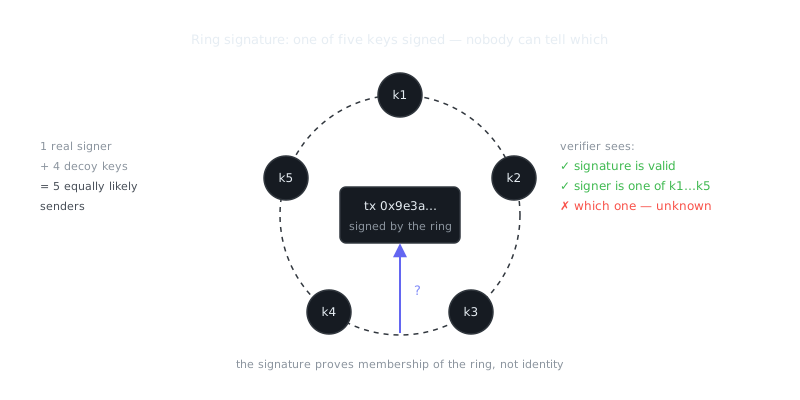
When you send Monero, your transaction gets signed not just by your key, but by a group of other keys pulled from the blockchain — called "decoys." An outside observer can see that one key in the ring signed the transaction, but can't tell which one. Your identity as the sender gets obscured without needing a trusted third party involved.
Stealth Addresses
Every time someone sends you XMR, the sender generates a one-time address derived from your public key. Funds land at this temporary address, and only you can detect and spend them using your private key. Even if someone knows your public Monero address, scanning the blockchain won't reveal your incoming transactions.
RingCT (Ring Confidential Transactions)
Introduced in 2017, RingCT hides the transaction amount. Before this, ring signatures masked sender identity but the amounts were still visible to anyone watching. RingCT uses Pedersen commitments — a cryptographic scheme that lets nodes verify a transaction is valid (inputs equal outputs) without ever seeing the actual values involved.
Put all three together and you get sender anonymity, recipient anonymity, and amount confidentiality running simultaneously. That's fundamentally different from something like Zcash, where shielded transactions are optional and most users end up transacting in the clear anyway.
Monero vs. Other Privacy Approaches
Comparing Monero against the alternatives makes its design philosophy much clearer.
| Feature | Bitcoin | Zcash (ZEC) | Monero (XMR) |
|---|---|---|---|
| Sender privacy | None | Optional (z-addr) | Always on |
| Recipient privacy | None | Optional (z-addr) | Always on |
| Amount privacy | None | Optional (z-addr) | Always on |
| Privacy by default | No | No | Yes |
| Transparent transactions | Yes | Yes (mostly) | No |
| Blockchain analysis possible | Yes | Partially | Highly limited |
| Fungibility | Low | Low | High |
The "always on" part matters more than it might seem. When privacy is optional, choosing to use a private transaction is itself a signal — it tells observers you wanted to hide something. Monero cuts that distinction off entirely. Every transaction looks identical on the network.
Fungibility is worth understanding here too. A currency is fungible when every unit is interchangeable with any other. Bitcoin has a real fungibility problem: coins that passed through flagged addresses can get blacklisted by exchanges. With Monero, that's effectively impossible since transaction histories can't be reliably traced back to any given coin.
Running and Using Monero
Setting Up a Node
Running your own Monero node gives you the strongest privacy guarantees. When you rely on a third-party server to validate your transactions, you're trusting that operator not to correlate your activity.
# Download the Monero CLI tools from getmonero.org
# Verify the download with GPG before extracting

tar -xjf monero-linux-x64-v0.18.x.x.tar.bz2
cd monero-x86_64-linux-gnu-v0.18.x.x

# Start the daemon (syncs the blockchain, ~170GB as of 2024)
./monerod --detach

# Check sync status
./monerod status
# Once synced, open the CLI wallet
./monero-wallet-cli
# Or restore from a seed phrase
./monero-wallet-cli --restore-deterministic-walletWallet Options
The Monero GUI wallet is the most accessible starting point for newcomers. On mobile, Monerujo (Android) and Cake Wallet (iOS/Android) are both well-regarded. For maximum privacy, pair whichever wallet you choose with your own node rather than a remote one — otherwise the node operator can correlate your IP address with your wallet activity.
Acquiring Monero
Because of Monero's privacy properties, many centralized exchanges have delisted it under regulatory pressure — Bittrex, Kraken in certain regions, and others. Your remaining options are P2P platforms, atomic swaps, or mining.
Atomic swaps let you trade Bitcoin for Monero trustlessly using the COMIT protocol, with no exchange involved at all. Mining is also still viable for ordinary CPUs thanks to the RandomX algorithm, which was specifically designed to resist ASIC dominance.
# Mine Monero with XMRig (CPU miner)
./xmrig -o pool.supportxmr.com:3333 -u YOUR_WALLET_ADDRESS -p x
Real-World Applications
Legitimate Privacy Use Cases
Your bank balance isn't publicly visible — financial privacy is a baseline expectation in traditional banking. Monero extends that same expectation to digital payments. Businesses use it when they don't want competitors seeing their payment flows or supplier relationships. Employees sometimes prefer their salary isn't broadcast on a public ledger. Journalists, whistleblowers, and people donating to sensitive causes in repressive environments have real reasons to value untraceable transactions. So do people in regions dealing with capital controls or unstable banking systems.
Regulatory and Compliance Considerations
Monero's privacy has made it a target for regulators. The IRS contracted Chainalysis and CipherTrace to develop tracing tools, though results have been limited compared to what's possible with Bitcoin. Several jurisdictions prohibit exchanges from listing it entirely.
There's an important tax point here that trips people up. In most countries, including the United States, Monero is treated as property for tax purposes — same as Bitcoin or any other cryptocurrency. Capital gains apply when you sell or exchange XMR. The IRS has specifically added questions about privacy coins on tax forms. Private transactions aren't tax-exempt transactions. Since the blockchain can't serve as an auditable record the same way Bitcoin can, keeping detailed personal records of your XMR activity is entirely your responsibility.
Monero in the Broader Crypto Ecosystem
Comparison with NFTs and Transparent Chains
NFTs make for an interesting contrast. One of the core features anyone learning about NFTs encounters early on is public provenance — the entire ownership history of an NFT lives on-chain and anyone can verify it. That transparency is the point; it's what proves authenticity and scarcity. Monero inverts that philosophy entirely. The tradeoff is real: Monero's privacy makes proof-of-ownership or proof-of-payment more complex. You'd need tools like transaction keys, which can be selectively disclosed to auditors without exposing your full transaction history.
The RandomX Algorithm
Monero's proof-of-work algorithm, RandomX, is optimized for general-purpose CPUs. That was a deliberate choice to keep mining decentralized — ASIC manufacturers can't build specialized hardware that outcompetes commodity machines by orders of magnitude. In practice, your ordinary computer can actually participate in mining, which supports a more distributed network than you'd get otherwise.
Summary and Key Takeaways
Monero stands apart from most cryptocurrencies by treating privacy as the default rather than an afterthought. Ring signatures, stealth addresses, and RingCT work together to deliver meaningful anonymity at the protocol level — for senders, recipients, and amounts alike.
A few things worth keeping in mind as you explore it further. Monero's privacy is structural and always active, with no transparent mode, which is what makes every transaction fungible and unlinkable by default. Running your own node is the strongest setup; remote nodes leak IP-level metadata. Centralized exchange delistings have made acquiring XMR harder, pushing most users toward P2P platforms and atomic swaps. Tax obligations apply regardless of transaction privacy, so keep your own records. And the tradeoffs are real — privacy limits auditability, complicates exchange listings, and draws ongoing regulatory scrutiny.
Frequently Asked Questions
What makes Monero more private than Bitcoin?
Monero uses three privacy technologies by default: stealth addresses (hiding the recipient), ring signatures (obscuring the sender), and RingCT (concealing the transaction amount). Unlike Bitcoin, where all transactions are publicly visible on the blockchain, Monero transactions are private by default for every user.
Is Monero illegal to own or use?
Monero is not illegal in most countries — it is legal to own and use just like other cryptocurrencies. However, some exchanges have delisted it due to regulatory pressure around its strong privacy features, which can make it harder to buy compared to Bitcoin or Ethereum.
Can Monero transactions be traced by governments or law enforcement?
Monero is designed to be extremely difficult to trace, and its privacy features have resisted most blockchain analysis tools used on other coins. While no system is perfectly unbreakable, Monero is widely considered the strongest privacy coin available today, which is why some agencies have offered bounties to crack it.
Video Resources
Sources & Further Reading
- Monero Documentation — Official Monero user guides and privacy explanations.
- Bitcoin Whitepaper — Satoshi Nakamoto's original nine-page design of Bitcoin.
- Bitcoin.org — Community-maintained introduction, wallet guidance and developer docs.
- Ethereum.org — Official Ethereum documentation and learning hub.
- CoinGecko — Market data, exchange listings and asset profiles.
- Messari Research — Research reports and asset fundamentals.
- Bitcoin Wiki — Long-running technical wiki covering protocol details.