Multisignature Wallets: How They Work and Why They Matter
Multisignature wallets require multiple cryptographic approvals before any transaction executes, making them one of the most secure ways to store cryptocurrency. They eliminate single points of failure caused by lost keys or compromised devices. This guide covers how multisig works, common configurations, and when to use one.
On this page
Losing access to your crypto isn't like forgetting a password. There's no recovery email, no support ticket, no bank to call. One compromised device or a single lost private key can wipe out everything permanently. Multisignature wallets exist to solve exactly that problem — by making sure no single key can move your funds alone.
“Blockchain is to trust what the internet was to communication.”
— Unknown
What Is a Multisignature Wallet?
A multisignature wallet requires a minimum number of private key signatures before any transaction goes through. You'll see this written as an M-of-N scheme: M is how many signatures you need, N is how many keys exist total.
Take a 2-of-3 wallet. Three private keys exist, spread across three devices or people, and any two of them can authorize a transaction. A 3-of-5 scheme works the same way but requires three approvals from five possible signers.
It's not a new idea. Joint bank accounts, corporate treasuries that need dual authorization, board votes — they all follow the same logic. The difference is that multisig enforces these rules cryptographically. No institution needed, no trust required.
How Multisig Works Technically
The Signing Process
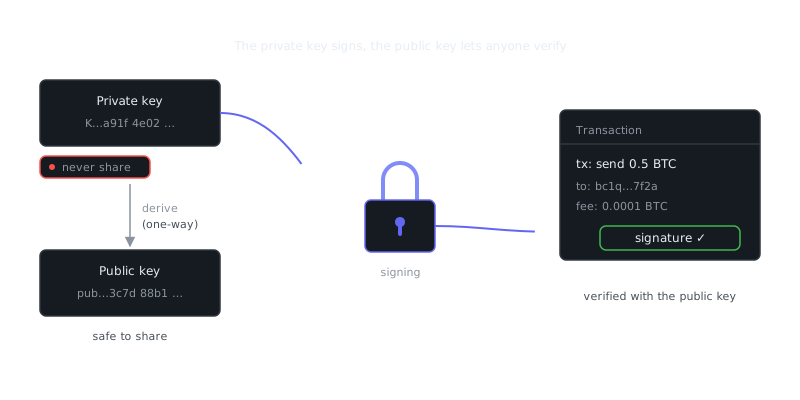
Each private key in a multisig setup is completely independent. When someone initiates a transaction, it gets passed to the required keyholders, each of whom signs with their own key. Once enough valid signatures are collected, the transaction broadcasts to the blockchain and confirms.
On Bitcoin, multisig runs through P2SH (Pay-to-Script-Hash) or P2WSH (Pay-to-Witness-Script-Hash) address types. On Ethereum, it's handled through smart contracts — Gnosis Safe being the most widely used.
A basic Bitcoin multisig redeem script looks like this:
OP_2
<pubkey_A>
<pubkey_B>
<pubkey_C>
OP_3
OP_CHECKMULTISIG
This defines a 2-of-3 policy directly on-chain. Funds can only move when two of the three listed public keys produce valid signatures.
Setting Up a Multisig Wallet with Bitcoin Core
# Generate three key pairs (simplified example)
bitcoin-cli getnewaddress "" legacy   # key 1
bitcoin-cli getnewaddress "" legacy   # key 2
bitcoin-cli getnewaddress "" legacy   # key 3

# Create a 2-of-3 multisig address
bitcoin-cli createmultisig 2 '["pubkey1", "pubkey2", "pubkey3"]'

# Output includes the multisig address and redeemScript
# Store the redeemScript — it is required to spend funds
Don't overlook the redeemScript. Every party needs to keep a copy, because losing it makes those funds permanently unspendable — even if you still have enough private keys.
Common Multisig Configurations and Their Use Cases
| Configuration | Required Signatures | Total Keys | Best For |
|---|---|---|---|
| 1-of-2 | 1 | 2 | Shared access, convenience |
| 2-of-2 | 2 | 2 | Escrow, two-party agreements |
| 2-of-3 | 2 | 3 | Personal security with backup |
| 3-of-5 | 3 | 5 | Company treasuries, DAOs |
| 5-of-7 | 5 | 7 | High-value institutional funds |
For most individuals, 2-of-3 is the right starting point. Keep one key on a hardware wallet, a second on a separate device or with someone you trust, and a third in secure offline storage. Lose one key? The other two still get you in.
3-of-5 is the go-to for organizations. A DAO managing a protocol treasury might distribute keys across five core contributors and require three to sign before any funds move. This connects directly to tokenomics fundamentals — how a project controls its treasury is a core governance question, and multisig is what actually enforces those policies on-chain.
Real-World Applications
Organizational Treasury Management
Gnosis Safe (now just "Safe") dominates multisig on Ethereum and EVM-compatible chains. Uniswap, Aave, and hundreds of other DeFi protocols use it to control upgrade keys, collect fees, and manage grant disbursements. Non-technical signers can review and approve transactions through a web UI while the underlying smart contract handles the M-of-N enforcement.
Escrow and Peer-to-Peer Transactions
A 2-of-3 escrow involves three parties: buyer, seller, and an arbitrator. Funds lock in the multisig address. Under normal conditions, buyer and seller co-sign to release payment. If a dispute comes up, the arbitrator signs alongside either party to resolve it. No single participant can steal the funds alone — not even the arbitrator.
NFT and Digital Asset Custody
NFTs have moved well beyond speculative trading into real estate tokenization, intellectual property licensing, and event ticketing. That shift has brought real institutional custody needs with it. Multisig is the standard for securing high-value NFT collections, making sure no single team member can unilaterally transfer or sell assets held by a project.
Cryptocurrency Inheritance Planning
Cryptocurrency inheritance planning doesn't get enough attention. Standard wallets create a binary problem: either someone has your seed phrase and has full access, or they don't and the funds are gone forever. A 2-of-3 multisig lets you distribute keys to an estate attorney, a family member, and a trusted friend, with instructions that any two can collaborate to recover funds after your death. It prevents both premature access and permanent loss. Casa offers structured multisig inheritance products built around exactly this pattern.
Multisig vs. Other Security Approaches
Multisig vs. Single-Signature with Hardware Wallet
A hardware wallet protects your private key from online threats, but it's still a single point of failure. If the device is lost or destroyed and your seed phrase backup is also gone, so are your funds. Multisig spreads that risk across multiple independent keys in multiple locations.
Multisig vs. MPC (Multi-Party Computation)
MPC wallets take a different approach to the same problem. Instead of collecting multiple signatures, MPC splits key generation so no single party ever holds a complete private key. The resulting transaction looks like a normal single-signature transaction on-chain, which means better privacy and lower fees.
The tradeoff is trust. MPC relies on cryptographic protocols running off-chain, which introduces different assumptions about what you're trusting and why. With multisig, the rules live on the blockchain itself — fully auditable, fully transparent.
| Feature | Multisig | MPC |
|---|---|---|
| On-chain enforcement | Yes | No |
| Transaction privacy | Lower (visible M-of-N) | Higher (looks like standard tx) |
| Fee overhead | Higher (multiple signatures) | Lower |
| Auditability | Full | Limited |
| Smart contract support | Native (Ethereum) | Varies by implementation |
Limitations and Risks Worth Knowing
Multisig reduces risk. It doesn't eliminate it.
Coordination overhead — Every transaction now needs action from multiple people. In time-sensitive situations, that's a real bottleneck.
Redeemscript loss (Bitcoin) — Losing the redeemScript makes funds unspendable even when you have enough keys. Every participant needs a secure copy.
Smart contract risk (Ethereum) — EVM-based multisig wallets like Safe are smart contracts. Bugs in contract logic, or a compromised upgrade mechanism, are attack vectors that simple key custody doesn't have.
Social engineering — Multisig raises the bar for theft significantly, but a patient attacker may go after the humans holding keys rather than the cryptography itself. Think carefully about who holds keys and what relationships exist between them.
Quorum loss — In a 3-of-5 setup, losing three keys makes funds permanently inaccessible. Define your recovery process before you distribute keys, not after.
Summary and Key Takeaways
Frequently Asked Questions
What is a multisignature wallet and how is it different from a regular crypto wallet?
A multisignature (multisig) wallet requires multiple private keys to authorize a transaction, instead of just one. For example, a 2-of-3 multisig wallet means 2 out of 3 designated key holders must approve before any funds can be moved. This makes it much harder for a single point of failure — like a stolen key — to result in lost funds.
Why would I use a multisig wallet instead of a standard wallet?
Multisig wallets add a layer of security that's especially useful for storing large amounts of cryptocurrency or managing shared funds. They protect against theft, accidental loss of a single key, and even insider threats in a business setting. Many crypto users think of them as the equivalent of a bank vault that requires two employees to open.
Do I need technical experience to set up a multisignature wallet?
Basic multisig wallets can be set up through user-friendly apps like Casa, Electrum, or Gnosis Safe without deep technical knowledge. The setup process involves creating or importing multiple keys and defining how many are required to sign a transaction. That said, it's worth taking time to understand the backup and recovery process before storing significant funds.
Video Resources
Sources & Further Reading
- Bitcoin Whitepaper — Satoshi Nakamoto's original nine-page design of Bitcoin.
- Bitcoin.org — Community-maintained introduction, wallet guidance and developer docs.
- Ethereum.org — Official Ethereum documentation and learning hub.
- CoinGecko — Market data, exchange listings and asset profiles.
- Messari Research — Research reports and asset fundamentals.
- Bitcoin Wiki — Long-running technical wiki covering protocol details.
- Mastering Bitcoin (open book) — Andreas Antonopoulos's free technical book on how Bitcoin works.