MEV (Miner Extractable Value): The Hidden Tax on Your DeFi Transactions
Every DeFi transaction you make is subject to a silent competition among validators and bots racing to extract value from your trades. Known as Miner Extractable Value (MEV), this mechanism shapes how transactions are ordered on-chain. Understanding MEV is key to navigating DeFi more safely and efficiently.
On this page
The Hidden Tax on Blockchain Transactions
Every time you swap tokens on Uniswap, liquidate a position on Aave, or touch any DeFi protocol, a silent competition kicks off in the background. Validators and sophisticated bots race to extract value from your transaction before, during, or after it settles. This is called Miner Extractable Value — or more accurately these days, Maximal Extractable Value (MEV).
MEV is the profit that block producers (miners in proof-of-work, validators in proof-of-stake) can capture by controlling which transactions get included in a block and in what order. It's not a bug or a hack. It's a structural feature of how public blockchains work, and if you're operating in DeFi — whether you're building protocols, managing a portfolio, or just swapping tokens — you need to understand it.
How MEV Works
When you submit a transaction, it lands in the mempool, a public waiting room where pending transactions sit before getting included in a block. That mempool is visible to anyone. Validators can see exactly what you're trying to do before your transaction finalizes.
Block producers have three levers to work with. They choose the sequence of transactions within a block. They decide which transactions make it in at all. And they can insert their own transactions at any position they want.
That's where the opportunity comes from. A validator who sees a large ETH buy order can front-run it by buying ETH first, let your order push the price up, then sell immediately after. The profit comes directly from the price impact your transaction caused.
The Mempool as a Battleground
Specialized actors called searchers run bots that continuously monitor the mempool. They simulate pending transactions against the current chain state to find profitable opportunities. When they find one, they package an exploit transaction and submit it with higher gas fees — or through private channels — to land it in exactly the right position. Searchers typically split profits with validators through direct payments or MEV infrastructure like Flashbots.
The Three Main MEV Strategies
1. Arbitrage
This is the most common form of MEV, and honestly the most defensible. When a large trade on one DEX moves a token's price, arbitrage bots immediately rebalance prices across other exchanges. That actually helps the ecosystem by keeping prices consistent across venues. The profit still comes at the original trader's expense, but the side effect is useful.
Example flow:
1. Large ETH/USDC swap on Uniswap shifts price to $2,050
2. Binance and Coinbase still show $2,000
3. Arbitrage bot buys ETH on Uniswap at $2,000, sells on CEX at $2,020
4. Price realigns across venues
2. Sandwich Attacks
This one is a direct extraction from your transaction. A bot spots your pending swap, front-runs it with a buy that pushes the price up, waits for your transaction to settle at the worse price, then immediately sells. You get worse execution; the bot keeps the difference.
The cost to you is called slippage beyond tolerance. Setting a tight slippage tolerance — somewhere between 0.1% and 0.5% — helps defend against this, though it does raise the chance your transaction reverts entirely.
3. Liquidations
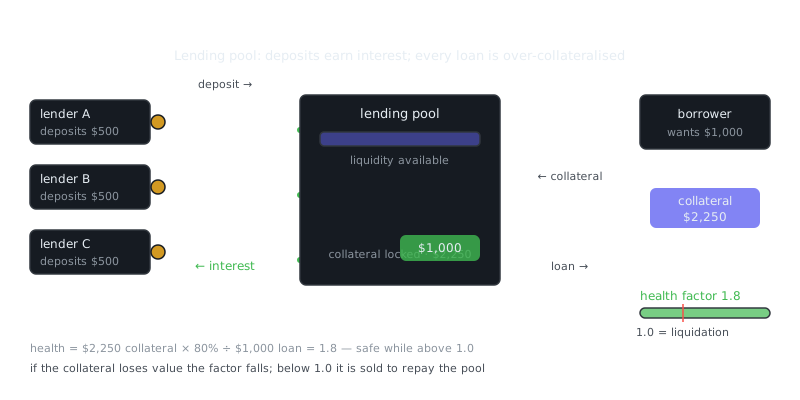
DeFi lending protocols like Aave use liquidation mechanisms to keep loans collateralized. When a position goes undercollateralized, anyone can call the liquidation function and pocket a bonus, typically 5–10% of the liquidated amount. MEV bots race constantly to be first. If you've ever read through an Aave protocol guide and wondered why liquidations settle so fast, this is why — dozens of bots are competing for that bonus in real time.
| MEV Strategy | Who Pays | Who Benefits | Impact on Ecosystem |
|---|---|---|---|
| Arbitrage | Traders (indirect) | Searchers, validators | Positive (price efficiency) |
| Sandwich Attack | Target trader | Searchers, validators | Negative (direct value extraction) |
| Liquidation Racing | Borrowers | Liquidators, validators | Neutral to positive (protocol health) |
| Time-bandit attacks | All users | Attacking validator | Highly negative (chain reorgs) |
The Scale of MEV
The numbers aren't small. Since 2020, over $1.38 billion in MEV has been extracted on Ethereum alone, according to Flashbots' MEV-Explore dashboard. On high-activity days during volatile markets, daily extraction can top $10 million.
“DeFi is the most exciting thing happening in crypto right now.”
— Vitalik Buterin
It's not evenly distributed either. Roughly 60–70% of extracted MEV comes from DEX arbitrage, with sandwich attacks and liquidations making up most of the rest. If you're tracking positions across multiple protocols using DeFi portfolio tools, knowing when you're most exposed — large swaps, positions near liquidation thresholds — helps you time and structure transactions more defensively.
MEV on Layer 2 and How the Ecosystem Is Responding
MEV on Layer 2
Layer 2 protocols like Arbitrum, Optimism, and zkSync have different MEV dynamics than Ethereum mainnet. Most L2s run a single sequencer that orders transactions, which technically centralizes MEV extraction but also creates one place where fairness policies can actually be enforced. Some sequencers run first-in-first-out (FIFO) ordering, which kills reordering attacks — though it doesn't stop the sequencer itself from front-running.
As L2s decentralize their sequencer sets, MEV dynamics will likely start looking more like Ethereum's. Projects like Espresso Systems and Based Sequencing are building shared sequencer infrastructure with MEV mitigation baked in at the protocol layer.
Flashbots and MEV-Boost
Flashbots is the most widely used MEV infrastructure on Ethereum. It introduced a separate channel — the MEV-Boost relay — where searchers submit transaction bundles directly to validators, bypassing the public mempool. That reduced the gas wars where competing bots were bidding up priority fees and inflating costs for everyone.
Post-Merge, over 90% of Ethereum blocks get built through MEV-Boost. The separation of block building from block proposing (proposer-builder separation, or PBS) is now a formal part of Ethereum's roadmap.
// Simplified example: a Flashbots bundle submission structure
{
  "jsonrpc": "2.0",
  "method": "eth_sendBundle",
  "params": [
    {
      "txs": ["0x...", "0x..."],       // ordered transaction list
      "blockNumber": "0x...",           // target block
      "minTimestamp": 0,
      "maxTimestamp": 1800000000,
      "revertingTxHashes": []           // allow specific txs to revert
    }
  ]
}
What You Can Do Right Now
You don't have to wait for protocol-level solutions. Private RPCs like Flashbots Protect, MEV Blocker, and 1inch Fusion route your transactions through private mempools so searchers can't see them coming. Keeping slippage settings tight reduces the profit window for sandwich attacks. MEV competition is also lower during off-peak hours when fewer bots are active, so timing matters more than most people realize. DEX aggregators like CoW Protocol take a structural approach, using batch auctions to settle trades at uniform prices in a way that front-running can't exploit.
MEV and Protocol Design
MEV isn't just a user problem — it shapes how protocols get built. Uniswap v4's hooks system lets liquidity pools implement custom logic that can detect and respond to manipulative ordering. TWAP oracles (time-weighted average price) exist partly to resist price manipulation from within a single block.
Protocol designers now treat MEV as a first-class concern. The question isn't whether MEV will exist; it's whether it can be internalized — captured by the protocol or its users — rather than siphoned off by outside parties. CoW Protocol and auction-based DEXs are trying to redirect MEV back to liquidity providers and traders instead of letting it bleed out to searchers.
Key Takeaways
MEV is one of those topics that sounds abstract until you've been sandwiched on a swap or watched a liquidation bot beat you by a single block. It's real, it's measurable, and it costs DeFi users hundreds of millions of dollars a year. Understanding how it works doesn't just satisfy curiosity — it changes how you structure transactions, choose protocols, and think about the economics underneath every on-chain interaction.
Frequently Asked Questions
What is MEV and why does it matter in DeFi?
MEV (Miner Extractable Value) is the profit that block producers — miners or validators — can extract by controlling which transactions get included in a block and in what order. In DeFi, this matters because it can affect the prices you get on trades, cause your transactions to fail, or result in you paying more than expected. It's essentially an invisible tax on DeFi users that most beginners don't know exists.
How does MEV actually affect me as a regular DeFi user?
The most common way you feel MEV is through 'sandwich attacks,' where a bot sees your pending swap, places a trade right before and after yours to profit from the price movement your trade causes. This results in you getting a worse exchange rate than you expected. You might also experience failed transactions or higher gas fees because bots are constantly competing to get their transactions in front of yours.
Is there any way to protect myself from MEV as a beginner?
Yes — the simplest protection is setting a low slippage tolerance on your swaps, which limits how bad a price you're willing to accept and makes sandwich attacks less profitable. You can also use MEV-protected RPC endpoints like Flashbots Protect, which routes your transactions privately so bots can't see them before they're confirmed. Choosing DEXs with built-in MEV protection, like those using private mempools, is another solid option.
Video Resources
Sources & Further Reading
- Chainlink Education Hub — Explainers on oracles, smart contracts and Web3 concepts.
- OWASP — Open standards and cheat sheets for application security.
- DeFi Llama — Total value locked and protocol analytics across chains.
- Ethereum.org: DeFi — Official introduction to decentralised finance on Ethereum.
- Uniswap Docs — Protocol documentation for the leading automated market maker.
- Aave Docs — Lending protocol documentation, risk parameters and governance.
- Compound Docs — Documentation for the Compound money market protocol.