DeFi Risks Explained: What They Are and How to Manage Them
Decentralized finance offers open access to lending, trading, and yield without banks or brokers — but it comes with unique risks traditional finance doesn't. From smart contract vulnerabilities to liquidation and rug pulls, understanding what can go wrong is the first step to protecting your assets. This guide breaks down the most common DeFi risks and how to manage them effectively.
On this page
Decentralized finance has opened up financial services that run without banks, brokers, or custodians. You can lend, borrow, trade, and earn yield entirely through smart contracts. But the same things that make DeFi powerful — permissionless access, composability, non-custodial control — also introduce risks traditional finance doesn't have. Knowing those risks and how to handle them is the difference between participating confidently and losing funds to a mistake that was avoidable.
“Decentralized finance is the future of money.”
— Unknown
Smart Contract Risk
Every DeFi protocol runs on smart contracts. When you deposit funds into a liquidity pool or interact with a lending protocol, you're trusting that the contract code behaves exactly as intended. Bugs, logic errors, or edge cases nobody anticipated can result in partial or total loss of funds.
What Can Go Wrong
In 2020, the bZx protocol was exploited twice in a single week through flash loan attacks that manipulated price oracles mid-transaction. Two years later, Ronin Network lost over $600 million due to compromised validator keys. These weren't fringe events. They represent a consistent pattern across the industry.
How to Reduce Exposure
Check whether a protocol has been audited by reputable firms like Trail of Bits, OpenZeppelin, or Certora. Audits aren't guarantees, but they significantly raise the bar. Also check when that audit happened — a protocol audited two years ago may have added unaudited modules since then.
Beyond audits, time matters. Protocols like Uniswap and Aave have processed hundreds of billions in volume. That track record under real conditions is a meaningful signal that you won't get from a newer protocol with a clean-looking interface and a fresh audit.
Don't concentrate all your funds in a single contract regardless of its reputation. Spread exposure across protocols so one failure doesn't wipe out everything.
You can verify a contract's audit status directly on Etherscan by checking the source code and cross-referencing the deployer address against known audit repositories.
Liquidity Risk
Liquidity pools are pools of two or more tokens locked in a smart contract that enable decentralized trading. Liquidity providers deposit tokens and earn fees from trades. But liquidity isn't static, and thin markets create real risk.
Impermanent Loss
When you provide liquidity to a pool like ETH/USDC, your position automatically rebalances as prices move. If ETH doubles, arbitrageurs buy ETH from the pool until the ratio reflects the market price. You end up with less ETH and more USDC compared to just holding. That divergence between holding and providing liquidity is called impermanent loss.
Here's how it scales with price change for a standard 50/50 AMM pool:
| Price Change (one asset) | Impermanent Loss |
|---|---|
| 1.25x | 0.6% |
| 1.50x | 2.0% |
| 2.00x | 5.7% |
| 3.00x | 13.4% |
| 5.00x | 25.5% |
| 10.00x | 42.5% |
It's only "impermanent" if prices revert. If they don't, the loss becomes permanent the moment you withdraw.
Managing Liquidity Risk
Concentrated liquidity positions, available in Uniswap v3, let you define a price range for your capital. This increases fee earnings within that range but amplifies impermanent loss if price moves outside it. The core tradeoff is simple: a narrower range gives you higher capital efficiency but requires active management.
If you're just getting started with LP participation, stablecoin pairs like USDC/DAI or USDT/USDC carry near-zero impermanent loss because both assets track the same value. They're a lower-risk way to understand how pools work before you take on more volatility.
Oracle Risk
Smart contracts can't access external data on their own. They rely on oracles — services that feed price data on-chain. If an oracle reports a manipulated or stale price, any protocol depending on it can be drained.
Price oracle manipulation usually runs through flash loans: borrow a large amount, manipulate a pool price, exploit a protocol that reads that price, repay the loan — all within a single transaction block. It's fast, and if the oracle isn't designed to resist it, it's effective.
Safer Oracle Patterns
Leading protocols use time-weighted average prices (TWAPs) rather than spot prices. A TWAP averages the price over a window of blocks, which makes manipulation expensive because an attacker has to sustain the manipulated price across multiple blocks instead of just one.
Chainlink's decentralized oracle network aggregates data from multiple independent node operators, reducing single-point-of-failure risk. When you're evaluating a protocol, check which oracle it uses and how its price feeds are sourced. It's one of those details that rarely comes up until something goes wrong.
Governance and Regulatory Risk
DAO Governance Explained
Many DeFi protocols are governed by DAOs. Token holders vote on protocol upgrades, fee parameters, treasury allocation, and risk parameters. It's a powerful model, but it introduces governance attacks: an entity that accumulates enough governance tokens can push malicious proposals through.
In 2023, Tornado Cash's governance was briefly seized by an attacker who submitted a proposal granting themselves 1.2 million votes and took control of the protocol. The attack was eventually reversed, but it showed exactly how governance systems can be weaponized.
To protect yourself, participate in governance or delegate your votes to active, reputable delegates. Monitor proposal activity using tools like Tally or Boardroom. And prefer protocols that enforce timelocks on governance execution — a 48 to 72 hour delay between proposal approval and execution gives the community time to respond before a malicious change goes live.
Regulatory Risk
DeFi operates in a fast-moving regulatory environment. Protocols, front-end interfaces, and even liquidity providers have faced scrutiny across multiple jurisdictions. This doesn't mean avoiding DeFi, but it does mean going in with open eyes.
Understand how DeFi income is treated in your jurisdiction — yield, trading gains, and LP fees may all be taxable events and they're often treated differently. Know that front-end interfaces can be geo-blocked or taken down even when the underlying contracts stay live. And be cautious with privacy protocols that have attracted regulatory attention, since the legal exposure there is less predictable than with mainstream protocols.
Wallet and Operational Security
Protocol risk is only part of the picture. A lot of DeFi losses come from operational mistakes — phishing, malicious approvals, compromised private keys. The best protocol in the world can't protect you from a bad approval.
Common Attack Vectors
Unlimited token approvals are a persistent problem. When you interact with a protocol, you're often prompted to approve it to spend your tokens. Many protocols request unlimited approval by default for convenience. If that contract is later exploited or upgraded maliciously, it can drain every token you've approved. Check and revoke unnecessary approvals regularly using tools like Revoke.cash or the Etherscan token approval checker.
# No CLI needed — use the web interface at revoke.cash
# Connect wallet → review approvals → revoke any unused or suspicious ones
Phishing sites mimic legitimate protocol interfaces well enough to fool experienced users. Always verify URLs, use bookmarks for protocols you visit often, and don't click wallet connection prompts from Discord or Twitter links. That last one trips people up more than you'd think.
Seed phrase exposure is still the most catastrophic risk in the space. Hardware wallets like Ledger or Trezor keep private keys offline and are the standard recommendation for holding any significant amount of funds.
A Practical Security Stack
| Layer | Tool / Practice |
|---|---|
| Key storage | Hardware wallet (Ledger, Trezor) |
| Approval management | Revoke.cash, Etherscan approvals |
| Governance monitoring | Tally, Boardroom |
| Protocol research | DeFiLlama, Solodit audit database |
| Transaction simulation | Tenderly, Rabby wallet's built-in sim |
Systemic and Contagion Risk
DeFi protocols are composable — they integrate with each other. A lending protocol might accept LP tokens as collateral, which depend on an AMM, which depends on an oracle. That composability creates efficiency, but it also means failures travel fast.
The 2022 Terra/LUNA collapse is the clearest example of this. The algorithmic stablecoin UST depegged, triggering a death spiral that wiped out roughly $40 billion in value within days. Protocols that had integrated UST or held it as collateral absorbed downstream losses even when their own code was perfectly sound.
Managing systemic risk comes down to diversification and skepticism. Avoid overexposure to any single collateral type or stablecoin issuer. And when yield looks unusually high, ask what's generating it — because in DeFi, outsized returns almost always come with outsized risks attached.
Frequently Asked Questions
What are the biggest risks in DeFi?
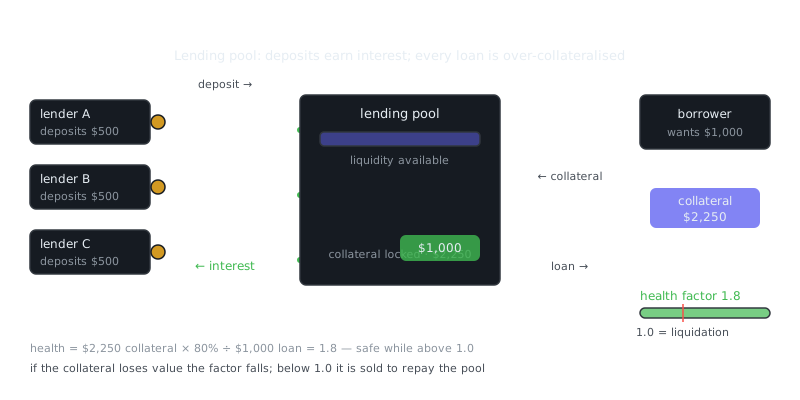
The main risks include smart contract bugs that can let hackers drain funds, sudden price crashes that can liquidate your collateral, and rug pulls where project developers abandon the project and take user funds. Unlike traditional banks, there's no insurance or safety net if something goes wrong, so losses are usually permanent.
How do I know if a DeFi project is safe to use?
Look for projects that have been audited by reputable security firms like Certik or Trail of Bits, and check how long the protocol has been running without incidents. Stick to well-known platforms with large total value locked (TVL) and active communities, and start with small amounts until you're comfortable with how it works.
What is impermanent loss and should I worry about it?
Impermanent loss happens when you provide liquidity to a trading pool and the price of your tokens changes compared to when you deposited them, leaving you with less value than if you had just held the tokens. It becomes a real loss only when you withdraw, so it's worth using calculators to estimate potential losses before committing funds to a liquidity pool.
Video Resources
Sources & Further Reading
- CFTC: Learn & Protect — Regulator's plain-language warnings about leverage and fraud.
- Investopedia — Reference definitions and explainers for markets and trading.
- DeFi Llama — Total value locked and protocol analytics across chains.
- Ethereum.org: DeFi — Official introduction to decentralised finance on Ethereum.
- Uniswap Docs — Protocol documentation for the leading automated market maker.
- Aave Docs — Lending protocol documentation, risk parameters and governance.
- Compound Docs — Documentation for the Compound money market protocol.