What Is Arbitrage Trading and How Does It Work?
Arbitrage trading exploits price differences for the same asset across different markets or platforms. Traders buy low in one market and simultaneously sell high in another, capturing the spread as profit with minimal risk.
On this page
Arbitrage trading exploits price differences for the same asset across different markets. Traders buy low in one place and simultaneously sell high in another, pocketing the spread as profit. Unlike strategies that depend on reading market sentiment or predicting direction, arbitrage focuses on pricing inefficiencies that exist right now, regardless of what the market is doing overall.
The core idea is straightforward: identical assets should cost the same everywhere. When they don't, arbitrageurs step in, profit from the gap, and in doing so, naturally close it. That's what makes this fundamentally different from directional trading. You're not guessing where prices are headed. You're just taking advantage of a difference that already exists.
Types of Arbitrage Trading
Spatial Arbitrage
Spatial arbitrage exploits price differences across geographic locations or trading venues. If a stock trades at $100.50 on the New York Stock Exchange and $100.80 in London, that $0.30 gap is a potential trade. Traders place simultaneous buy and sell orders to capture it before it closes.
Crypto markets make this especially visible. Bitcoin might trade at $43,200 on Coinbase and $43,450 on Kraken at the same moment. That $250 difference comes from uneven liquidity, regional demand, and the fragmented nature of crypto exchanges. High-frequency firms and retail traders both chase these gaps, though heavy competition has squeezed spreads considerably compared to crypto's early years.
Triangular Arbitrage
Triangular arbitrage happens within a single exchange using three different assets, most commonly in forex or crypto. Take three currency pairs: EUR/USD, GBP/USD, and EUR/GBP. If the implied cross-rate doesn't match the actual quoted rate, there's a window to exploit.
Example calculation:
Starting capital: $10,000

Step 1: USD → EUR at 0.92 = €9,200
Step 2: EUR → GBP at 0.87 = £8,004
Step 3: GBP → USD at 1.26 = $10,085.04

Profit: $85.04 (0.85%)
These windows are measured in milliseconds. Algorithmic systems spot and close the discrepancy almost instantly, so execution speed is everything here.
Statistical Arbitrage
Statistical arbitrage uses quantitative models to find temporary mispricings between correlated assets. It's not guaranteed profit like pure arbitrage — it's probability-based, built on the expectation that prices will revert to their historical relationship.
Pairs trading is the most common version. If two historically correlated stocks drift apart, you short the one that's outperformed and buy the underperformer, expecting them to converge again. This shares some DNA with range-based strategies like grid trading, though statistical arbitrage is about relative price levels rather than absolute ones.
Merger Arbitrage
When Company A announces it's acquiring Company B for $50 per share, Company B's stock might only trade at $48. That $2 discount reflects deal uncertainty, regulatory risk, and the time value of waiting for a close. Merger arbitrageurs buy at $48 and wait for $50.
If the deal closes, they earn $2 per share. If it falls apart, the stock typically drops back toward pre-announcement levels and they take a loss. The trade is a bet on completion, not direction.
How Arbitrage Trading Works in Practice
Execution Requirements
Arbitrage lives and dies on speed, low fees, and capital efficiency. Margins are thin — often under 1% — so execution quality matters as much as spotting the opportunity in the first place.
| Factor | Impact | Solution |
|---|---|---|
| Transaction fees | Erode thin margins | Volume discounts, maker-taker rebates |
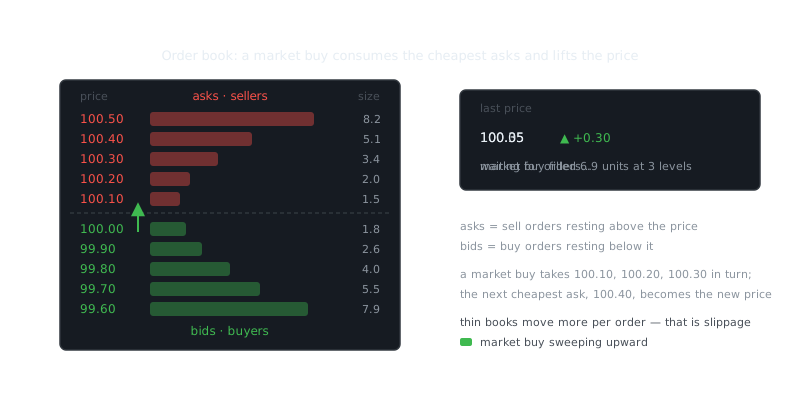
| Slippage | Price moves before execution | Algorithmic execution, direct market access |
| Capital lock-up | Reduces overall returns | Leverage (with risk), faster settlement |
| Latency | Miss fleeting opportunities | Colocation, fiber connections, optimized code |
High-frequency firms spend millions on infrastructure to shave off microseconds. Retail traders can still find openings in less efficient corners of the market, but you need to account for every cost — including the ones that aren't obvious upfront.
Real-World Crypto Example
Here's what that actually looks like in practice. Say you spot Bitcoin at different prices across two exchanges:
- Binance: $43,180
- Coinbase: $43,310
- Transfer time: 15 minutes
- Trading fee: 0.1% per trade
- Withdrawal fee: $25
Calculation for a $10,000 trade:
Buy on Binance: $10,000 / $43,180 = 0.2316 BTC
Trading fee: 0.2316 × 0.001 = 0.0002316 BTC
Net BTC: 0.2314 BTC

Sell on Coinbase: 0.2314 × $43,310 = $10,021.63
Trading fee: $10,021.63 × 0.001 = $10.02
Withdrawal fee: $25
Net profit: $10,021.63 - $10.02 - $25 - $10,000 = -$13.39
The trade loses money once you factor in all fees. That's the point. A price gap that looks attractive on the surface can easily flip negative when you run the real numbers.
Risks and Challenges
Execution Risk
The biggest risk in arbitrage isn't the strategy itself — it's what happens when one leg of the trade fails. You buy on one exchange but can't sell on the other because prices converged, a system went down, or liquidity dried up. Now you're not in a hedged arbitrage position. You're holding a naked directional trade.
During Bitcoin's crash in March 2020, some exchanges showed arbitrage gaps above 5%. But traders who bought on the cheaper exchange couldn't sell on the expensive one — systems were overloaded and withdrawals were frozen. The opportunity existed on paper. In reality, it wasn't accessible.
Regulatory and Counterparty Risk
Moving funds between international exchanges isn't just slow — it's complicated. You're dealing with compliance requirements, currency conversion costs, and different tax treatments depending on jurisdiction. And if an exchange freezes withdrawals or goes insolvent, your capital is stuck regardless of what the arbitrage math says.
Market Efficiency
Markets get more efficient over time. Algorithmic trading has compressed what used to be 2% opportunities lasting several minutes into 0.2% gaps that close in seconds. This isn't like volatility-based strategies such as Bollinger Bands trading, where recurring patterns keep showing up. Arbitrage opportunities are self-correcting by nature — the more traders chase them, the faster they vanish.
Tools and Technology
Trading Infrastructure
Professional arbitrageurs run sophisticated systems built for speed and reliability:
# Example: Monitoring price spreads across exchanges
# (Conceptual illustration)

curl -s https://api.exchange1.com/ticker/BTCUSD | jq '.price'
curl -s https://api.exchange2.com/ticker/BTCUSD | jq '.price'

# Output:
# Exchange 1: 43180.50
# Exchange 2: 43310.25
# Spread: 129.75 (0.30%)
Production systems run around the clock, processing thousands of API calls per second, calculating net profitability after costs, and firing trades through multiple simultaneous connections.
Data and Analytics
Real-time data is non-negotiable. Traders build dashboards that track current spreads across every monitored pair and venue, historical spread patterns to find sensible entry thresholds, fee structures and their drag on net returns, and liquidity depth to confirm trades are actually executable at the sizes you want.
Getting Started with Arbitrage
Retail Trader Approach
Institutional competition is lower in less efficient markets, and that's where retail traders have the best shot. Crypto markets — especially smaller altcoins on regional exchanges — still surface real opportunities. The key is honest cost accounting before you commit capital.
“Risk comes from not knowing what you're doing.”
— Warren Buffett
Start with markets you already know and platforms where you hold accounts. Keep working capital on multiple exchanges to cut down on fund transfers. Track every fee explicitly, including withdrawal costs, network fees, and the spread you pay on currency conversion. The math has to work after all of it.
Frequently Asked Questions
What is arbitrage trading?
Arbitrage trading is the practice of buying an asset in one market and simultaneously selling it in another market where the price is higher, profiting from the difference. For example, if Bitcoin is priced at $30,000 on one exchange and $30,200 on another, a trader can buy low and sell high at the same time. The goal is a risk-free profit, though in practice there are always some costs and risks involved.
Is arbitrage trading legal?
Yes, arbitrage trading is completely legal and is actually considered beneficial to markets because it helps prices stay consistent across exchanges. Regulators generally view it as a normal part of how markets self-correct. The only exception would be if the strategy involved market manipulation or insider information, which are illegal regardless of the trading method.
How much money do I need to start arbitrage trading?
The amount you need depends on the type of arbitrage, but price differences are usually very small — often less than 1% — so you typically need a significant amount of capital to turn a meaningful profit. Many beginners underestimate the impact of transaction fees, withdrawal fees, and slippage, which can easily wipe out small gains. Most serious arbitrage traders use automated bots and start with at least a few thousand dollars to make the strategy worthwhile.
Video Resources
Sources & Further Reading
- Investopedia — Reference definitions and explainers for markets and trading.
- Investopedia: Technical Analysis — Indicator-by-indicator guides with worked examples.
- TradingView — Charting platform with community education and indicator scripts.
- CoinGecko — Price history, volume and market capitalisation data.
- BabyPips School — Free structured course on chart reading and risk management.
- Glassnode Academy — On-chain metrics explained, from active addresses to realised cap.
- Wikipedia: Technical analysis — History, methods and the academic debate around technical analysis.