Essential Risk Management Principles for Trading Success
Risk management separates successful traders from those who blow up their accounts. Learn the core principles that protect capital while enabling consistent growth, from position sizing fundamentals to implementing effective risk controls across your trading strategy.
On this page
Risk management is what separates traders who last from those who blow up their accounts. It doesn't matter how good your strategy looks on paper — without proper risk controls, it won't survive contact with real markets.
“The market can remain irrational longer than you can remain solvent.”
— John Maynard Keynes
Position Sizing: The Foundation of Risk Control
How much capital you put into each trade matters more than almost anything else. More than your entry timing. More than your strategy selection. Get this wrong and even a great edge won't save you.
The Fixed Percentage Rule
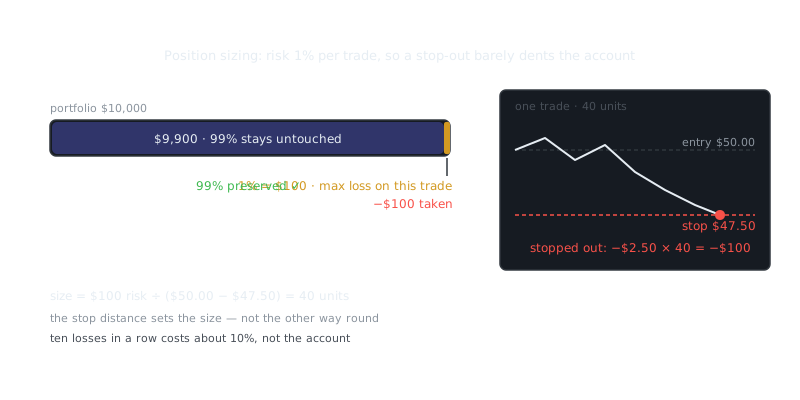
The most common approach is simple: never risk more than 1-2% of your total capital on a single trade. With a $50,000 account and a 1% rule, you're risking $500 per trade. If your stop loss is $2 per share, you can take 250 shares — no more.
Position Size = (Account Size × Risk Percentage) / Stop Loss Distance

Example:
Account: $50,000
Risk per trade: 1% ($500)
Stop loss: $2 per share
Position size: $500 / $2 = 250 shares
What makes this powerful is the math. Ten consecutive losses at 1% risk each only reduces your capital by 9.6% (slightly less than 10% because of compounding). You've still got plenty of room to recover and keep trading.
The Kelly Criterion
If you've got real backtesting data to work with, the Kelly Criterion takes things a step further. It calculates the theoretically optimal position size based on your win rate and average win/loss ratio.
Kelly % = W - [(1 - W) / R]

Where:
W = Win rate (probability of winning)
R = Win/Loss ratio (average win / average loss)

Example:
Win rate: 55% (0.55)
Win/Loss ratio: 1.5
Kelly % = 0.55 - [(1 - 0.55) / 1.5] = 0.55 - 0.30 = 0.25 or 25%
Full Kelly sizing is aggressive, though. Most professionals cut it to half-Kelly or quarter-Kelly, which reduces volatility while still outperforming fixed percentage methods over time.
Stop Loss Strategies: Defining Your Risk
A stop loss turns theoretical risk into real protection. Without one, a manageable loss has a way of becoming an account-ending loss. It happens faster than you'd expect.
Technical Stop Losses
Place your stop where your trade thesis breaks down — below support for longs, above resistance for shorts. This is more logical than picking an arbitrary percentage level, because you're letting the market structure tell you when you're wrong.
Say you enter a long at $50 and support sits at $48.50. Your stop goes at $48.40, just under that support. The trade has room to move, but if the technical setup fails, you're out.
Time-Based Stop Losses
Sometimes a trade just sits there. If a swing trade expected to work in 3-5 days is flat after seven, that capital isn't doing anything for you. Exit and redeploy it somewhere with actual momentum.
Trailing Stops
As a trade moves in your favor, trail your stop below each new swing low (for longs) or above each swing high (for shorts). You're letting winners run while locking in gains as they build. It's one of the few free lunches in trading.
Portfolio-Level Risk Management
Individual trade risk only tells part of the story. You can follow every position sizing rule perfectly and still blow up if all your trades move together.
Correlation and Concentration
Five positions at 1% risk each looks like 5% total portfolio risk. But if those five positions are all tech stocks and the sector drops 3%, they're likely hitting stops at the same time. That's a 5% loss in a single session — not the controlled 1% you planned for.
| Risk Approach | Positions | Sector Correlation | Actual Risk |
|---|---|---|---|
| Uncorrelated | 5 × 1% | Low (different sectors) | ~1-2% max drawdown |
| Correlated | 5 × 1% | High (same sector) | ~5% max drawdown |
| Hedged | 5 × 1% | Mixed with hedges | ~0.5-1% max drawdown |
If you're holding multiple tech longs, consider balancing them with positions that respond to different conditions — defensive stocks, commodities, or short positions. Diversify across sectors and strategies, not just across tickers.
Maximum Daily and Weekly Loss Limits
Pick a loss threshold and stop trading when you hit it. A widely used rule is 3% down in a day — once you're there, you're done for the session. This isn't weakness. It's how you avoid revenge trading, which is where bad days become catastrophic ones.
Leverage: The Double-Edged Sword
Leverage cuts both ways. A 2:1 leveraged position that moves 5% against you produces a 10% loss. And margin calls have a habit of forcing exits at exactly the worst moment.
Leverage Guidelines
Day traders with tight stops might reasonably use 2-4:1 leverage. Swing traders should be more conservative — 1:1 or at most 1.5:1. Options create leverage too, in ways that aren't always obvious. A $5,000 options position controlling $50,000 in stock is effectively 10:1 leverage, whether you think of it that way or not.
You can calculate your real leverage across all positions like this:
Effective Leverage = Total Position Value / Account Equity

Example:
Account equity: $50,000
Stock positions: $60,000 (includes $10,000 margin)
Options positions: $15,000 (controlling $75,000 stock value)
Total exposure: $135,000
Effective leverage: 2.7:1
When testing strategies, always run both leveraged and unleveraged versions. A lot of strategies look great unleveraged but fall apart once you account for leverage costs and forced exits during volatility spikes.
Risk-Reward Ratios and Expectancy
Every trade should offer reward potential that meaningfully exceeds its risk. A 2:1 minimum — $2 of potential profit for every $1 risked — is a reasonable baseline for most strategies.
Calculating Trade Expectancy
Expectancy tells you whether a strategy makes money over a large sample of trades. Win rate alone doesn't.
Expectancy = (Win Rate × Average Win) - (Loss Rate × Average Loss)

Example Strategy A:
Win rate: 40%
Average win: $300
Loss rate: 60%
Average loss: $100
Expectancy = (0.40 × $300) - (0.60 × $100) = $120 - $60 = $60 per trade

Example Strategy B:
Win rate: 60%
Average win: $150
Loss rate: 40%
Average loss: $150
Expectancy = (0.60 × $150) - (0.40 × $150) = $90 - $60 = $30 per trade
Strategy A wins less often but makes twice as much per trade. That's the risk-reward ratio doing its job. Track these numbers in your trading journal — you'll quickly see which setups actually make money versus which ones just feel good.
The Arbitrage Exception
True arbitrage is one of the few situations where the normal risk rules bend. If a stock is trading at $50.00 on NYSE and $50.15 on NASDAQ, you can buy on NYSE and sell on NASDAQ simultaneously for a $0.15 per share gain before fees. The profit is locked in at entry. You still deal with execution risk and transaction costs, but the directional risk that drives normal stop loss logic mostly disappears.
Risk Management in Different Market Conditions
Volatility changes everything. A stop loss 2% below your entry might be perfectly reasonable in a calm market and completely useless during a volatile one, where that 2% gets eaten in minutes.
Volatility-Adjusted Position Sizing
Average True Range (ATR) gives you a clean way to adjust position size based on how much the market is actually moving right now.
Volatility-Adjusted Size = Fixed Risk Amount / (ATR Multiplier × ATR)

Example:
Risk per trade: $500
ATR multiplier: 2 (exit if price moves 2 ATR against you)
Current ATR: $1.25
Position size: $500 / (2 × $1.25) = 200 shares
When volatility doubles, your position size halves automatically. Your dollar risk stays consistent even as market conditions shift.
Regime-Based Risk Adjustment
Cut position sizes when you're dealing with heightened market volatility (VIX above 25), a personal drawdown of more than 10% from your peak, low-volume holiday periods with choppy price action, or major news events and central bank announcements.
You can reasonably size up — modestly — during strong trends that align with your strategy, after a winning streak that confirms your current approach is working, or when a setup meets all your criteria with unusual clarity.
Summary and Key Takeaways
Risk management isn't about avoiding losses. Every trade carries risk; the goal is keeping losses small enough that they don't matter while giving your winners room to develop.
Essential principles:
- Position sizing comes first: Risk 1-2% per trade maximum. Calculate position size based on stop loss distance, not arbitrary share counts.
- Use stop losses every time: Define your exit before you enter. Technical stops — placed at levels where your thesis is proven wrong — beat percentage-based stops for most strategies.
- Manage portfolio correlation: Five uncorrelated 1% risks are very different from five correlated 1% risks. Diversify across sectors and strategies.
- Use leverage carefully: Calculate your effective leverage across all positions. Higher leverage demands tighter stops and smaller sizes.
- Track expectancy, not just win rate: A 40% win rate with 3:1 risk-reward beats a 60% win rate with 1:1 risk-reward. Know which side you're on.
- Adjust for conditions: Reduce risk during volatility spikes, drawdown periods, and uncertain markets. Let ATR-based sizing do the heavy lifting.
- Respect daily loss limits: Stop trading after hitting your predetermined daily threshold. Emotional trading during drawdowns is how losses multiply.
Your trading journal should track position size, actual risk taken, stop placement, exit reason, and whether you followed your rules — every single trade. Most traders eventually discover their losses come not from bad strategies but from risk management violations: oversized positions, moved stops, ignored correlation.
Markets reward discipline. A perfect entry means nothing if one oversized loss wipes out months of gains. Get the risk management right first, then work on sharpening your edge.
Frequently Asked Questions
What is risk management in trading and why does it matter?
Risk management is the process of identifying and limiting how much money you can lose on any single trade or overall. Without it, a few bad trades can wipe out your entire account, even if most of your trades are winners. It's what separates traders who last long-term from those who blow up their accounts quickly.
How much of my account should I risk on a single trade?
Most experienced traders risk no more than 1-2% of their total account on any single trade. This means if you have a $1,000 account, you'd risk $10-$20 per trade, not your whole balance. Keeping risk small per trade ensures a losing streak won't end your trading career.
What is a stop-loss and should I always use one?
A stop-loss is a preset price level where your trade automatically closes to prevent further losses. Yes, you should always use one — it removes emotion from the equation and enforces your risk limit even if you're not watching the market. Think of it as a safety net that protects your account from unexpected price moves.
Video Resources
Sources & Further Reading
- CFTC: Learn & Protect — Regulator's plain-language warnings about leverage and fraud.
- Investopedia — Reference definitions and explainers for markets and trading.
- Investopedia: Technical Analysis — Indicator-by-indicator guides with worked examples.
- TradingView — Charting platform with community education and indicator scripts.
- CoinGecko — Price history, volume and market capitalisation data.
- BabyPips School — Free structured course on chart reading and risk management.
- Glassnode Academy — On-chain metrics explained, from active addresses to realised cap.