How to Buy Crypto Anonymously: Methods, Tradeoffs & What to Know
Most crypto exchanges now require identity verification, but there are legitimate ways to acquire cryptocurrency with greater privacy. This guide covers P2P platforms, decentralized exchanges, Bitcoin ATMs, and other methods — along with the real tradeoffs each one involves.
On this page
Buying Crypto Anonymously: A Practical Guide
Cryptocurrency was originally built to be decentralized and pseudonymous. In practice, most mainstream exchanges now demand identity verification, tying your real name to every transaction you make. This guide walks through the legitimate ways to acquire crypto with more privacy, explains what you're trading off with each method, and helps you figure out which approach actually fits your situation.
Privacy in crypto isn't a switch you flip — it's a spectrum. The more you understand where you fall on that spectrum, the better your decisions about what personal information you expose and where.
Why Privacy Matters in Crypto Transactions
Financial privacy is a recognized right in most jurisdictions, and people pursue it for entirely legitimate reasons. Maybe you're protecting assets from targeted theft, operating in a politically sensitive environment, or just don't want your portfolio exposed to competitors. Some people simply want normal financial boundaries — the same ones cash has always provided.
When you buy Bitcoin on a KYC (Know Your Customer) exchange, your name, address, government ID, and every associated transaction get bundled together. If that exchange gets breached, subpoenaed, or goes bankrupt, that data can surface publicly or end up somewhere it shouldn't. The 2019 Binance KYC leak exposed over 10,000 user photos and identity documents. That's not hypothetical risk — it already happened.
Worth being clear about one thing: acquiring crypto privately doesn't mean you skip taxes. In most countries, you're expected to report gains regardless of how you got the coins.
Method 1: Peer to Peer Cryptocurrency Trading
Peer to peer platforms connect buyers and sellers directly without a centralized intermediary holding your funds. Some P2P platforms require minimal or no identity verification, depending on your payment method and where you're located.
How P2P Platforms Work
On platforms like Bisq or LocalMonero, a seller posts an offer listing their price and accepted payment methods. You pick an offer, funds get locked in escrow (handled by the protocol or a third-party arbitrator), you send payment through the agreed channel, and you receive crypto once the seller confirms. Simple enough in practice, though the interface takes some getting used to.
Bisq is fully decentralized and open-source. No account creation, runs as a desktop app over Tor, and uses a security deposit system to keep both sides honest.
# Running Bisq over Tor (it does this by default)
# Download from bisq.network and verify the GPG signature
gpg --keyserver keys.openpgp.org --recv-keys 0x...
gpg --verify Bisq-1.x.x.dmg.asc Bisq-1.x.x.dmg
Tradeoffs
| Platform | KYC Required | Decentralized | Supported Assets | Fraud Risk |
|---|---|---|---|---|
| Bisq | No | Yes | BTC + altcoins | Low (escrow) |
| LocalMonero | Minimal | No | XMR only | Medium |
| HodlHodl | Minimal | Partial | BTC | Low (multisig) |
| LocalBitcoins | Yes (now) | No | BTC | Low |
| Paxful | Yes | No | BTC | Low |
LocalBitcoins introduced mandatory KYC in 2019, which effectively removed it from this category. Bisq and HodlHodl are now the strongest options for non-custodial P2P trading.
Method 2: Bitcoin ATMs
Bitcoin ATMs let you convert cash to crypto at a physical kiosk. Many machines allow small purchases — typically under $900 — without identity verification, relying on transaction limits to satisfy anti-money-laundering thresholds in their jurisdiction.
Finding and Using a Bitcoin ATM
Head to coinatmradar.com to find machines near you. Filter by "no verification required" or check what the operator lists as their limits. Most no-KYC ATMs cap purchases between $200 and $900 per transaction per day.
The process itself is straightforward. Generate a wallet address on your phone or hardware wallet, insert cash, scan your wallet QR code, and confirm. The machine broadcasts the transaction to the network. The main catch is fees — expect anywhere from 5 to 15%, which is steep compared to exchanges.
Privacy Considerations
ATMs are physical locations with cameras, so you're not invisible just because you skipped the ID check. The transaction itself goes on-chain tied to your wallet address. To keep things cleaner, use a fresh wallet address for each purchase and consider running received funds through a CoinJoin transaction before you spend them.
Method 3: Mining as an Acquisition Method
Mining is one of the few ways to acquire crypto with no direct identity link at the protocol level. The coins you mine are issued by the network itself — there's no counterparty, no exchange, no KYC form. The block reward goes straight to a wallet address you control.
Your identity only enters the picture if you connect your hardware to a pool that requires registration, or if your electricity bill creates a traceable paper trail.
Solo vs. Pool Mining for Privacy
Solo mining preserves the most privacy but is only practical if you have serious hash rate behind you. For most people, pool mining is the realistic option — and pools typically log your IP address and wallet address.
# Example: Connecting to a mining pool with minimal info
# Use a pool that accepts connections without account registration
# like ckpool (solo gateway) or a Stratum pool over Tor

# cgminer example targeting a Tor-accessible pool
cgminer --url stratum+tcp://pooladdress.onion:3333 \
        --user YOUR_WALLET_ADDRESS \
        --pass x
Running your pool connection over Tor removes the IP linkage. The pool can still see your wallet address, but that address carries no KYC attachment.
If you're GPU mining, Monero (XMR) is the most accessible entry point. Its RandomX algorithm runs well on consumer CPUs and GPUs, and because Monero has privacy built in by default, freshly mined coins carry no transaction history.
Method 4: Privacy-Focused Cryptocurrencies
Not all cryptocurrencies treat privacy the same way. Bitcoin is pseudonymous — every amount and address is publicly visible on-chain. Monero and Zcash were built from the start with privacy as a core design goal, not an afterthought.
| Cryptocurrency | Privacy Model | Transparent by Default | KYC at Acquisition |
|---|---|---|---|
| Bitcoin (BTC) | Pseudonymous | Yes | Depends on method |
| Monero (XMR) | Mandatory privacy | No | Depends on method |
| Zcash (ZEC) | Optional shielded | Yes (t-address) | Depends on method |
| Dash (DASH) | Optional CoinJoin | Yes | Depends on method |
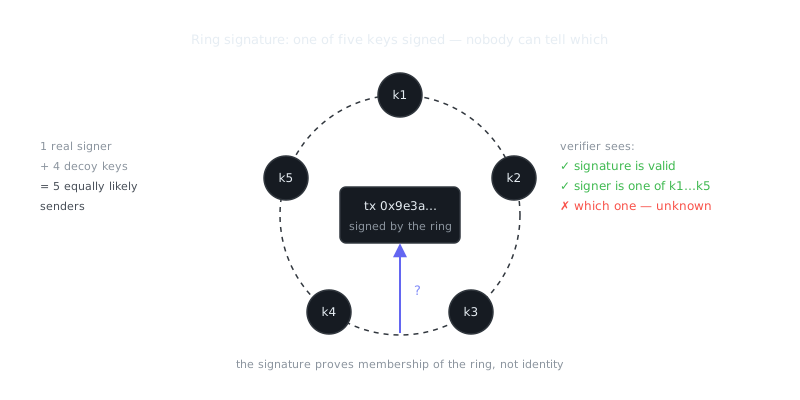
Monero uses ring signatures, stealth addresses, and RingCT to obscure sender, receiver, and amount. Even if someone knows your wallet address, they can't determine your balance or trace incoming transactions. That makes it the strongest default for anyone who prioritizes on-chain privacy.
Getting Monero privately is practical too. LocalMonero (P2P, minimal KYC), Bisq (P2P, no KYC), and dedicated Monero ATMs all give you real options.
Operational Security Practices
Acquiring crypto privately only matters if your habits around it hold up. The wallet you use, the network you connect from, and how you move funds afterward — all of it either protects or undermines your privacy.
Wallet Hygiene
Use a hardware wallet or air-gapped wallet for storage. Generate a new address for every transaction — most modern wallets handle this automatically through HD (hierarchical deterministic) derivation. Never reuse addresses. Address reuse is one of the most reliable ways transaction histories get linked together, and it's also one of the most avoidable mistakes.
Network Privacy
Connect to Bitcoin or Monero over Tor or a trusted VPN. The Tor Browser alone isn't enough here — you need a full node or wallet that routes P2P traffic through Tor.
# Running Bitcoin Core over Tor
# In bitcoin.conf:
proxy=127.0.0.1:9050
listen=0
onlynet=onion
Avoiding Common Mistakes
Depositing privately acquired coins to a KYC exchange immediately undoes everything — the exchange now links those coins to your identity. Mixing privately acquired coins with KYC exchange coins in the same wallet creates a transaction graph that's straightforward to follow. Blockchain analytics firms like Chainalysis and Elliptic specialize in tracing exactly these patterns, and they're good at it.
Think of privacy as a chain. It's only as strong as the weakest link in how you acquire, store, and spend.
Key Takeaways
“Blockchain is to trust what the internet was to communication.”
— Unknown
Buying crypto with more privacy is genuinely possible through P2P platforms, ATMs, mining, and privacy-native coins like Monero. Each method has real tradeoffs in convenience, cost, and residual exposure. No single method is perfect, but combining approaches — private acquisition, clean wallet hygiene, and Tor-routed connections — stacks the odds meaningfully in your favor. Start with the method that fits your situation, understand what it doesn't protect, and build from there.
Frequently Asked Questions
Can I buy crypto without verifying my identity?
Some peer-to-peer platforms and Bitcoin ATMs allow purchases with minimal or no ID verification, though limits are usually low. However, most regulated exchanges require KYC (Know Your Customer) verification by law, so fully anonymous purchases are increasingly difficult to find.
What payment methods are most private when buying crypto?
Cash is the most private payment method, often used at Bitcoin ATMs or in-person P2P trades. Prepaid debit cards can also add a layer of privacy, but they may still be traceable depending on where and how you purchased them.
Is buying crypto anonymously legal?
The legality depends on your country, but in most places buying crypto privately is not illegal in itself. That said, using anonymous crypto to evade taxes or fund illegal activity is against the law, and regulations around crypto privacy are tightening globally.
Video Resources
Sources & Further Reading
- Bitcoin Whitepaper — Satoshi Nakamoto's original nine-page design of Bitcoin.
- Bitcoin.org — Community-maintained introduction, wallet guidance and developer docs.
- Ethereum.org — Official Ethereum documentation and learning hub.
- CoinGecko — Market data, exchange listings and asset profiles.
- Messari Research — Research reports and asset fundamentals.
- Bitcoin Wiki — Long-running technical wiki covering protocol details.
- Mastering Bitcoin (open book) — Andreas Antonopoulos's free technical book on how Bitcoin works.