USDT, USDC, and DAI: Which Stablecoin Should You Use?
Stablecoins offer the speed and utility of crypto without the price volatility. This guide breaks down the three biggest stablecoins — Tether (USDT), USD Coin (USDC), and DAI — comparing their backing mechanisms, transparency, and real-world use cases.
On this page
Why Stablecoins Matter
Crypto markets are brutal. Bitcoin can drop 20% in a single day, and altcoins can lose half their value in a week. Stablecoins solve a specific problem: they keep the useful parts of blockchain — fast transfers, programmable money, permissionless access — without the price swings that make regular crypto impractical for everyday use.
The three you'll encounter most often are Tether (USDT), USD Coin (USDC), and DAI. All three are pegged to the US dollar, but they get there in completely different ways. If you're using DeFi, moving money between exchanges, or just want to hold digital dollars, those differences matter more than most people realize.
How Each One Actually Works
USDT — Tether
Tether launched in 2014 and has held the top spot ever since, with a market cap that regularly clears $100 billion. It's issued by a centralized company, Tether Limited, which claims to hold reserves of cash, cash equivalents, and other assets equal to every USDT in circulation.
What makes USDT genuinely useful is how widely it's supported. It runs on Ethereum, Tron, Solana, and a dozen other chains, which means you'll find it on almost every exchange and wallet without thinking twice. That ubiquity is the whole value proposition.
USDC — USD Coin
Circle and Coinbase launched USDC in 2018 through something called the Centre Consortium. Like Tether, it's fiat-backed and centrally issued. The thing that sets it apart is transparency: Circle publishes monthly attestation reports from accounting firm Grant Thornton confirming the reserves actually match what's in circulation.
USDC is deeply woven into Ethereum's smart contract ecosystem. It's become the go-to settlement currency for DeFi protocols, payroll systems, and cross-border payments. In practical terms, that means USDC can be programmatically transferred, locked in escrow, or distributed by code — no human intermediary required.
DAI — Decentralized Collateralized Stablecoin
DAI takes a completely different approach. It's not backed by bank deposits at all. Instead, users mint DAI by locking up collateral — primarily ETH and other approved crypto assets — into smart contracts called Vaults. The system requires over-collateralization, typically 150% or more, to account for the volatility of whatever's sitting in the Vault.
If your collateral drops below the required threshold, the Vault gets automatically liquidated. No one calls you. No one gives you a grace period. This design means DAI's supply expands and contracts based on market demand and collateral availability, with no central issuer pulling the strings.
Comparison Table
| Feature | USDT | USDC | DAI |
|---|---|---|---|
| Issuer | Tether Limited | Circle / Coinbase | MakerDAO (decentralized) |
| Backing | Fiat + reserves (opaque) | Fiat (audited monthly) | Crypto collateral (on-chain) |
| Transparency | Low | High | Full (on-chain verifiable) |
| Censorship resistance | Low | Low | High |
| Decentralization | None | None | High |
| Blockchain support | Multi-chain | Multi-chain | Ethereum-native |
| Market cap (approx.) | ~$110B | ~$33B | ~$5B |
| Yield / savings product | Yes (Tether savings) | Yes (Circle Yield) | Yes (DAI Savings Rate) |
| Smart contract risk | Low | Low | Higher |
Risks Worth Knowing About
Counterparty Risk in USDT and USDC
Both stablecoins live or die by the solvency of the companies behind them. In March 2023, USDC briefly fell to $0.87 after Circle disclosed it had $3.3 billion stuck at Silicon Valley Bank when the bank collapsed. The peg recovered within days once the FDIC backstop was confirmed, but that episode made the risk very concrete. A centralized stablecoin is only as stable as the institution holding its reserves.
USDT's history is messier. A 2021 settlement with the New York Attorney General found that Tether had misrepresented what was actually backing its reserves. Tether now publishes quarterly assurance reports, but a full independent audit still hasn't happened. Whether that bothers you depends on your risk tolerance.
There's another angle worth considering: both issuers can freeze or blacklist wallet addresses on demand, and they do so when law enforcement asks. From a tax perspective, frozen funds may still count as a taxable asset depending on your jurisdiction, even if you can't touch them.
Smart Contract Risk in DAI
DAI's decentralization doesn't make it risk-free — it just changes what you're exposed to. MakerDAO's smart contracts are complex, and complex on-chain code has a history of going wrong in expensive ways. During the March 2020 crash known as "Black Thursday," ETH prices dropped so fast that Maker's liquidation system couldn't process auctions properly, and some collateral ended up sold for $0.
MakerDAO has since added circuit breakers and diversified its collateral base, including real-world assets like US Treasury bonds. That shift actually brings DAI closer to a hybrid model, somewhere between fully decentralized and partially traditional.
“Blockchain is to trust what the internet was to communication.”
— Unknown
Practical Use Cases
Cross-Border Payments
A freelancer in Argentina receiving USDT over Tron pays near-zero fees and gets the money in seconds. Converting to local currency is a separate step, but the stablecoin handles the tricky cross-border part. USDT on Tron is genuinely popular in emerging markets for this reason — it's fast, cheap, and supported on local exchanges where people actually are.
DeFi Liquidity
USDC and DAI dominate DeFi on Ethereum. On Aave or Compound, you can supply USDC to earn interest or borrow against crypto collateral. DAI gets used as the borrow asset a lot because you can mint it directly rather than buying it, which gives you more flexible options when managing leveraged positions.
On-Chain Business Operations
A startup paying contractors around the world can do it with a single Ethereum transaction:
// Simplified ERC-20 transfer (USDC uses this standard)
IERC20 usdc = IERC20(0xA0b86991c6218b36c1d19D4a2e9Eb0cE3606eB48);
usdc.transfer(contractorAddress, 1000 * 10**6); // Transfer 1000 USDC
No bank, clears in minutes, permanent on-chain record. That record simplifies expense tracking but also creates a taxable event in most jurisdictions, so it's worth keeping clean records of how the funds were originally acquired.
Yield Generation
All three stablecoins offer native yield. DAI holders can deposit into the DAI Savings Rate (DSR) contract and earn interest funded by borrowing fees within the Maker system. USDC holders can use Circle's yield products or deposit into lending protocols. Rates fluctuate with DeFi market conditions, so don't treat them like a savings account with a fixed return.
Where Regulation Is Heading
Regulators are paying close attention to stablecoins now. Proposed US legislation would require issuers to hold 1:1 reserves in high-quality liquid assets and submit to regular audits — conditions USDC largely already meets. USDT doesn't, which is why Tether's future in regulated markets is less clear.
The EU's MiCA regulation, which took effect in 2024, imposes strict requirements on what it calls "e-money tokens." Tether initially signaled it wouldn't pursue MiCA compliance for USDT in the EU, though that position has softened under market pressure.
DAI sits in genuine regulatory grey territory. There's no legal entity to go after in the traditional sense, though MakerDAO's inclusion of real-world assets complicates that picture. It raises a fair question: how do you regulate a monetary system governed entirely by token holders through on-chain voting?
Summary
USDT, USDC, and DAI each represent a different bet on how to keep a dollar peg on a blockchain.
USDT gives you the broadest liquidity and multi-chain reach, but you're accepting real opacity around the reserves and full centralized control. USDC trades some of that reach for transparency and regulatory alignment, making it the natural fit for institutional use and on-chain business operations. DAI gives you genuine decentralization and censorship resistance, but you're carrying smart contract risk and exposure to crypto collateral volatility in exchange.
None of them is the obvious right answer. The best choice depends on what you're actually doing with it.
Frequently Asked Questions
What is the difference between USDT, USDC, and DAI?
USDT (Tether) and USDC (USD Coin) are both centralized stablecoins backed 1:1 by real US dollars held in reserves by companies (Tether Ltd. and Circle, respectively). DAI is different — it's a decentralized stablecoin created by the MakerDAO protocol and backed by crypto collateral rather than a company holding cash.
Which stablecoin is the safest to use as a beginner?
USDC is generally considered the most transparent option for beginners because Circle publishes regular third-party audits of its reserves. USDT is the most widely available across exchanges, while DAI is a good choice if you prefer not to rely on a centralized company at all.
Can stablecoins lose their value and go below $1?
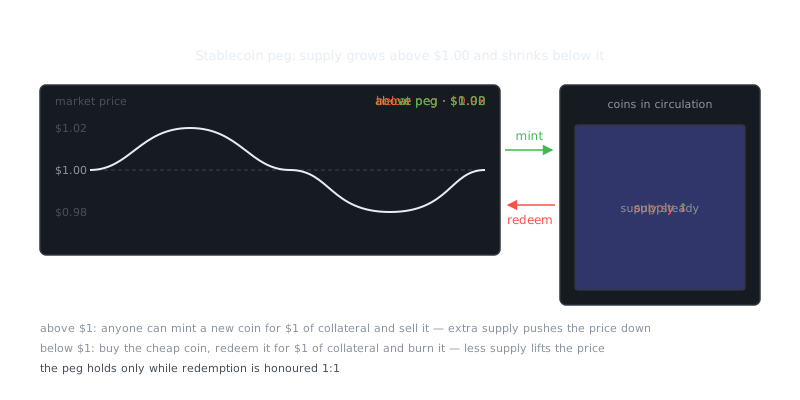
Yes, it can happen — this is called 'losing the peg.' USDT and USDC have briefly dipped below $1 during market stress events, though they recovered quickly. DAI is more vulnerable to depeg risks during extreme crypto market crashes because its collateral is crypto-based, not cash.
Video Resources
Sources & Further Reading
- Bitcoin Whitepaper — Satoshi Nakamoto's original nine-page design of Bitcoin.
- Bitcoin.org — Community-maintained introduction, wallet guidance and developer docs.
- Ethereum.org — Official Ethereum documentation and learning hub.
- CoinGecko — Market data, exchange listings and asset profiles.
- Messari Research — Research reports and asset fundamentals.
- Bitcoin Wiki — Long-running technical wiki covering protocol details.
- Mastering Bitcoin (open book) — Andreas Antonopoulos's free technical book on how Bitcoin works.