Cryptocurrency Mining: How It Works and Whether It's Profitable
Cryptocurrency mining validates transactions on proof-of-work blockchains like Bitcoin — but it's also a business decision. Before buying hardware, you need to understand the mechanics, the costs, and how to calculate real returns.
On this page
Cryptocurrency mining is how new transactions get verified and added to a blockchain, and how new coins enter circulation. For proof-of-work networks like Bitcoin, it's the backbone of network security. If you're thinking about mining as an income stream, you need to understand both the mechanics and the economics before you commit real money to hardware.
How Mining Works
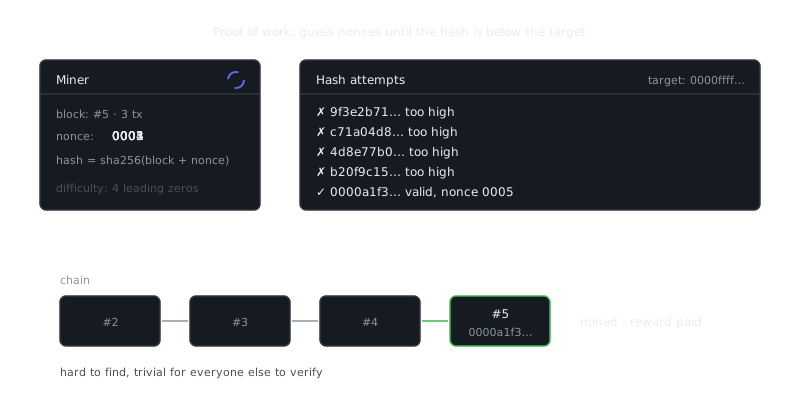
At its core, mining is a computational competition. Miners grab pending transactions from the mempool, bundle them into a candidate block, and repeatedly hash that block's header with a changing nonce until the output hash falls below a network-defined threshold called the difficulty target.
The node that finds a valid hash broadcasts the block, collects the block reward (freshly minted coins) plus every transaction fee in that block, and then the whole process resets for the next one.
Proof of Work vs. Proof of Stake
Not every cryptocurrency is mineable. Ethereum switched from proof-of-work to proof-of-stake in 2022, which killed GPU mining for that network entirely. Proof-of-stake replaces computational competition with economic collateral — validators lock up coins instead of burning electricity.
Mineable proof-of-work coins today include Bitcoin (SHA-256), Litecoin (Scrypt), Monero (RandomX), and Kaspa (kHeavyHash), among others. Each algorithm has different hardware requirements and very different accessibility profiles.
Mining Hardware
Your hardware choice determines your hash rate, power draw, and ultimately your profit margin. Three main categories exist.
ASICs (Application-Specific Integrated Circuits)
ASICs are purpose-built chips optimized for a single hashing algorithm. They deliver the highest performance-per-watt for their target algorithm by a wide margin, but they're completely useless for anything else.
| Hardware | Algorithm | Hashrate | Power Draw | Approx. Cost |
|---|---|---|---|---|
| Bitmain Antminer S21 Pro | SHA-256 (BTC) | 234 TH/s | 3,510 W | ~$4,000 |
| Bitmain Antminer L9 | Scrypt (LTC) | 16 GH/s | 3,260 W | ~$3,200 |
| iPollo V1 Mini | Ethash-compatible | 300 MH/s | 240 W | ~$800 |
| Goldshell KA Box | kHeavyHash (KAS) | 1.18 TH/s | 400 W | ~$500 |
GPUs (Graphics Processing Units)
GPUs are flexible. The same card can mine different algorithms or get repurposed for gaming, machine learning, or rendering — and that flexibility genuinely matters when a coin's profitability shifts. High-end options include the NVIDIA RTX 4090 and AMD RX 7900 XTX, though ROI timelines have stretched out significantly since Ethereum's merge removed the most profitable GPU workload from the table.
CPUs
Most CPU mining is limited to algorithms intentionally designed to resist ASICs, like Monero's RandomX. A modern Ryzen 9 7950X hits roughly 65,000 H/s on RandomX, making it one of the rare cases where consumer hardware stays competitive.
Solo Mining vs. Mining Pools
Solo mining means you're competing against the entire network for every block reward. Your odds of finding a block are proportional to your share of total network hash rate. For Bitcoin, a single modern ASIC represents about 0.000002% of the network — statistically, you'd wait decades between rewards.
Mining pools aggregate hash rate from thousands of participants, find blocks more frequently, and split rewards proportionally. The tradeoff is a pool fee, typically 1–3%, plus the need to trust whoever runs the pool.
To connect a miner to a pool, you configure the stratum endpoint and your wallet address:
# Example config for a Bitcoin ASIC pointing to a pool
# Replace <POOL_URL>, <PORT>, and <YOUR_WALLET_ADDRESS> with actual values

cgminer \
  --url stratum+tcp://<POOL_URL>:<PORT> \
  --user <YOUR_WALLET_ADDRESS>.worker1 \
  --pass x \
  --suggest-diff 512
For GPU miners using software like lolMiner or T-Rex, the config file approach is more common:
“Every informed person needs to know about Bitcoin because it might be one of the world's most important developments.”
— Leon Louw
{
  "algo": "kheavyhash",
  "pool": "stratum+tcp://<POOL_URL>:<PORT>",
  "wallet": "<YOUR_WALLET_ADDRESS>",
  "worker": "rig01",
  "power_limit": 80
}
One thing worth taking seriously: always store mined rewards in a wallet you control. Hardware wallets from Ledger and Trezor are the standard choice for securing accumulated mining proceeds because they keep private keys offline and away from exchange or pool custodial risk.
Calculating Profitability
Profitability comes down to four inputs: revenue (hash rate × block reward × your network share), electricity cost, amortized hardware cost, and pool fees.
The simplified formula:
Daily Profit = (Daily Revenue) - (Daily Electricity Cost) - (Daily Hardware Amortization)

Daily Electricity Cost = (Power Draw in kW) × 24 × (Cost per kWh)
Worked example — Antminer S21 Pro mining Bitcoin:
- Hardware: 234 TH/s, 3,510 W
- Electricity: $0.07/kWh (competitive rate)
- Daily electricity cost: 3.51 kW × 24 h × $0.07 = $5.90/day
- At a BTC price of $65,000 and current difficulty, estimated daily revenue ≈ $11.20/day
- Hardware cost of $4,000 amortized over 2 years = $5.48/day
- Net daily profit ≈ -$0.18/day — essentially breakeven
This is why electricity cost is the dominant variable. At $0.04/kWh (industrial rates), that same machine generates roughly $4.30/day net. At $0.12/kWh, which is the US residential average, it runs at a loss.
Tools like WhatToMine, Minerstat, and NiceHash's profitability calculator automate this math using live difficulty and price feeds.
The Difficulty Adjustment Factor
Bitcoin's difficulty adjusts every 2,016 blocks (roughly two weeks) to keep block times near 10 minutes. When more hash rate joins the network, difficulty rises and per-unit revenue falls. This is why the profitability numbers you calculate at purchase time almost never hold when you actually deploy the hardware.
Operational Considerations
Heat and Noise
A single Bitcoin ASIC throws off as much heat as a mid-size space heater and runs at 75–85 dB, which is louder than a vacuum cleaner. Residential mining at any real scale is a tough sell. Most serious operations use dedicated spaces with forced-air or immersion cooling.
Tax and Accounting
In most jurisdictions, mined cryptocurrency counts as ordinary income at fair market value on the day you receive it. Every sale after that is a capital gains event. That creates a real record-keeping burden: every mined unit needs a cost-basis timestamp. Mining accounting tools like Koinly and CoinTracking, or direct integrations with pool APIs, can handle most of this automatically.
Exiting Mined Coins
Once rewards accumulate, you need a plan for converting or holding them. Centralized exchanges offer the most liquidity, but they carry counterparty risk and KYC requirements. Alternatives include atomic swaps — trustless cross-chain trades that settle without an intermediary — and P2P platforms that connect buyers and sellers directly. These options matter most for privacy-focused miners or anyone operating in regions with limited exchange access.
Is Mining Still Profitable in 2024?
Honestly? It depends heavily on your electricity cost, what you paid for hardware, and your outlook on coin prices.
| Scenario | Electricity Cost | Hardware ROI Timeline |
|---|---|---|
| Industrial operation | $0.03–$0.05/kWh | 8–14 months (at current BTC prices) |
| Small operation with cheap power | $0.06–$0.08/kWh | 18–30 months |
| Residential (US average) | $0.12–$0.16/kWh | Likely unprofitable at current prices |
Frequently Asked Questions
What is cryptocurrency mining and how does it work?
Cryptocurrency mining is the process of using computer hardware to solve complex mathematical puzzles that validate transactions on a blockchain network. When your computer successfully solves a puzzle, you earn a reward in that cryptocurrency. It's essentially how new coins are created and how the network stays secure without a central authority.
Is cryptocurrency mining still profitable for beginners in 2024?
Profitability depends on three main factors: the cost of electricity in your area, the price of the cryptocurrency you're mining, and the upfront cost of your mining hardware. For most beginners using consumer-grade hardware, mining popular coins like Bitcoin is rarely profitable today due to intense competition from large mining farms. Smaller or newer cryptocurrencies can sometimes be more accessible, but they carry higher risk.
What equipment do I need to start mining cryptocurrency?
The most common setup uses either a GPU (graphics card) rig for mining altcoins or an ASIC (Application-Specific Integrated Circuit) miner for coins like Bitcoin. You'll also need a stable internet connection, mining software, and a cryptocurrency wallet to receive your earnings. ASICs are more efficient but expensive and locked to one coin, while GPU rigs are more flexible but generally less powerful per dollar.
Video Resources
Sources & Further Reading
- Bitcoin Whitepaper — Satoshi Nakamoto's original nine-page design of Bitcoin.
- Bitcoin Wiki — Long-running technical wiki covering protocol details.
- Mastering Bitcoin (open book) — Andreas Antonopoulos's free technical book on how Bitcoin works.
- Bitcoin.org — Community-maintained introduction, wallet guidance and developer docs.
- Ethereum.org — Official Ethereum documentation and learning hub.
- CoinGecko — Market data, exchange listings and asset profiles.
- Messari Research — Research reports and asset fundamentals.