Dollar Cost Averaging in Crypto: How to Build a Consistent Investment Strategy
Dollar cost averaging (DCA) is a strategy where you invest fixed amounts at regular intervals instead of going all in at once. In crypto's volatile markets, DCA removes the pressure of timing your entry and lowers your average purchase price over time. Whether you're investing $50 a week or $500 a month, consistency is what makes it work.
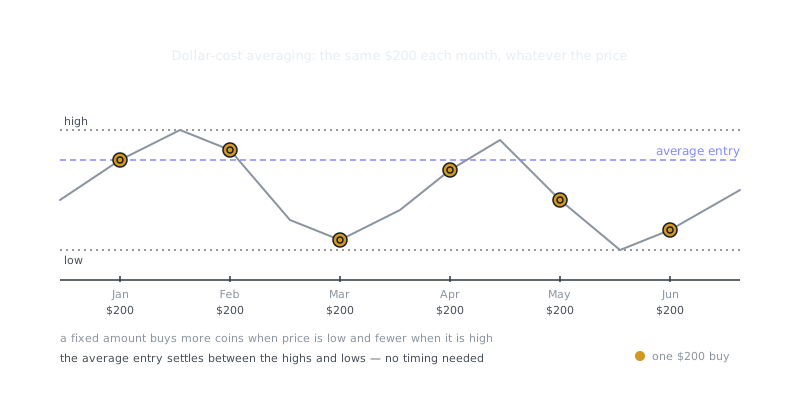
Try it: how the average entry price behaves
Drag the sliders. Buying the same amount every month means you buy more units when the price is low and fewer when it is high, so the average entry settles below the average price.
On this page
Dollar Cost Averaging in Cryptocurrency: A Complete Strategy Guide
Dollar cost averaging (DCA) is an investment strategy where you split your capital into periodic purchases instead of going all-in at once. In crypto markets — where 30% swings in a week aren't unusual — this approach takes the pressure off timing the market and smooths out what you pay per coin over time. Whether you're putting in $50 a week or $500 a month, the mechanic is the same: consistency beats precision.
How Dollar Cost Averaging Works
Nobody reliably buys Bitcoin at the bottom. DCA doesn't try to. Instead, you commit to a fixed schedule and a fixed dollar amount, letting the number of coins you receive vary with the price.
The Core Mechanic
Say you invest $100 in Ethereum every week for four weeks:
| Week | ETH Price | ETH Purchased |
|---|---|---|
| 1 | $2,000 | 0.0500 ETH |
| 2 | $1,600 | 0.0625 ETH |
| 3 | $2,500 | 0.0400 ETH |
| 4 | $1,800 | 0.0556 ETH |
| Total | Avg: $1,975 | 0.2081 ETH |
Total spent: $400. Average purchase price: roughly $1,922 per ETH. If you'd tried to time it and bought the full $400 in week one at $2,000, you'd hold 0.2000 ETH — less than the DCA approach got you. That gap looks small in four weeks. Over years, it compounds into something real.
Why Volatility Works in Your Favor
Most people treat volatility as pure downside. With DCA, it's actually a mechanical advantage. When prices drop, your fixed dollar amount buys more units. When prices rise, it buys fewer — but you already hold coins from the cheaper periods. Over a long enough timeline, this asymmetry tends to pull your cost basis below the time-weighted average price. So the wild swings that scare people away are actually doing you a favor.
Setting Up a DCA Strategy for Crypto
Three decisions drive a DCA strategy: what to buy, how often, and how much. Everything else is just execution.
Choosing Your Asset
DCA works best on assets you're genuinely willing to hold through multi-year drawdowns. Bitcoin and Ethereum are the most common targets because they've shown real long-term demand and have recovered from brutal corrections before. Applying DCA to low-cap altcoins is a different game entirely. Some of those assets never come back from a major correction, which means a lower average cost per coin is irrelevant if the value approaches zero.
Selecting Your Interval
Daily, weekly, and monthly are the most practical intervals. Weekly tends to strike the best balance between spreading out your purchase timing and keeping transaction fees manageable. If you're on a network or exchange with high per-transaction costs, buying too frequently eats into your returns fast. Monthly intervals reduce that fee drag but mean each individual purchase carries more timing risk.
Automating Execution
Most major platforms support recurring buys. Use that feature. Automation removes the temptation to pause during downturns, which is exactly when DCA is doing its best work. If you prefer scripting it yourself with an exchange API, here's a basic example:
import schedule
import time
from exchange_client import ExchangeClient

client = ExchangeClient(api_key="YOUR_KEY", api_secret="YOUR_SECRET")

def weekly_buy():
    client.market_buy(symbol="BTC/USD", amount_usd=100)
    print("DCA purchase executed")

schedule.every().monday.at("09:00").do(weekly_buy)

while True:
    schedule.run_pending()
    time.sleep(60)
This is a stripped-down illustration. Anything running in production needs error handling, rate limit awareness, and proper key management. For most people, the built-in recurring purchase feature on their exchange is simpler and more reliable.
DCA vs. Lump Sum Investing
Here's the honest answer: lump sum historically outperforms DCA in consistently rising markets. DCA outperforms in volatile or declining markets. Neither is universally better.
| Factor | DCA | Lump Sum |
|---|---|---|
| Market timing risk | Low | High |
| Psychological difficulty | Low | High |
| Performance in bull markets | Slightly lower | Higher |
| Performance in bear markets | Higher | Lower |
| Suitable for | Regular income investors | Large one-time capital |
| Fee exposure | Higher (more transactions) | Lower (one transaction) |
For most retail crypto investors who get paid on a schedule — paychecks, freelance income, whatever — DCA is the practical default. There's no lump sum to deploy. If you do have a windfall, a hybrid approach often makes sense: put a portion in immediately and DCA the rest over 6 to 12 months.
Exchange Selection and Fee Impact
Where you execute your purchases directly affects your returns. It's worth treating cryptocurrency exchange comparisons as a practical exercise, not an academic one.
Spot trading fees typically run from 0% to 0.5% per transaction. On a $100 weekly purchase, a 0.5% fee costs $0.50, or about $26 a year. At 0.1%, that drops to $5.20 annually. Those numbers seem small until you run the math over a decade and see how much of your compounding they've consumed.
When evaluating exchanges for DCA, pay attention to these things:
- Recurring buy feature: automated scheduling so you're not manually executing each purchase
- Fee structure: flat fee vs. percentage, and whether taker/maker rates apply to your order type
- Withdrawal costs: on-chain fees when moving assets to cold storage
- Supported assets: whether your target coins are actually available
- Jurisdiction and compliance: regulatory standing in your country
Centralized exchanges dominate DCA use cases because they handle custody, automation, and fiat on-ramps in one place. If you prefer more control, it's worth reading up on non-KYC buying options — though those typically involve manual execution and higher friction, which can quietly undermine your DCA discipline over time.
Integrating DCA into a Broader Portfolio
DCA is a purchasing strategy, not a portfolio strategy. Once you've accumulated assets, you still need a framework for managing them.
Allocation Across Assets
Running DCA across multiple assets at once is common. A simple allocation might be 60% into Bitcoin, 30% into Ethereum, and 10% into a small basket of larger-cap altcoins. Each slice runs on its own recurring schedule with proportional dollar amounts.
Rebalancing Considerations
After big price moves, your actual allocation drifts from your target. If Bitcoin goes on a strong run, it might represent 80% of your portfolio when you intended 60%. Rebalancing — trimming the overweight asset and adding to the underweight one — keeps your risk profile where you want it. Some investors do this quarterly, others annually or when any position drifts more than 10 percentage points from its target.
Exit Strategy
DCA tells you when and how much to buy. It doesn't tell you when to sell. You need to figure that part out separately, and the time to do it is before you need it. Common approaches include selling a fixed percentage at predetermined price targets, dollar cost averaging out by selling fixed amounts on a schedule, or holding until your portfolio hits a specific value. Having a plan in place before a bull run peaks is what separates a strategy from a guess.
Common Mistakes and How to Avoid Them
Pausing during downturns. The instinct to stop buying when prices fall is exactly backwards. Down periods are when your fixed dollar amount buys the most units. Stopping during a bear market means you absorbed the psychological pain without capturing the recovery gains.
Spreading too thin across too many assets. Splitting $200 monthly across 15 altcoins creates excess fees, complicates your taxes, and dilutes the advantage of DCA on assets with real long-term potential. Focus on fewer positions and let DCA actually do its job.
Ignoring fees on small purchase amounts. A $20 weekly DCA on a platform that charges a flat $2 fee means you're losing 10% to fees before your investment does anything. Adjust your amount, frequency, or platform until your fee ratio is under 1% per transaction.
Setting it and forgetting it completely. Automation doesn't mean abandonment. Check in quarterly — make sure the assets still fit your thesis, that fees haven't changed, and that your financial situation doesn't warrant adjusting the amounts up or down.
Summary and Key Takeaways
“Bitcoin is a technological tour de force.”
— Bill Gates
Dollar cost averaging is one of the most accessible and psychologically durable strategies for investing in cryptocurrency. It won't always beat lump sum investing, but it removes the hardest part of the equation: trying to time a market that doesn't reward timing. Set a schedule, automate it, keep fees low, and don't stop when things get uncomfortable. That's when it's working hardest for you.
Frequently Asked Questions
What is dollar cost averaging in crypto and how does it work?
Dollar cost averaging (DCA) means investing a fixed amount of money into a cryptocurrency at regular intervals, like $50 every week, regardless of the price. When prices are low, your fixed amount buys more coins; when prices are high, it buys less. Over time, this averages out your cost per coin and reduces the risk of buying everything at the wrong moment.
Is dollar cost averaging a good strategy for beginners in crypto?
Yes, DCA is widely considered one of the safest starting strategies for beginners because it removes the pressure of trying to time the market. It builds a habit of consistent investing and protects you from putting all your money in right before a price drop. It works especially well with volatile assets like crypto, where prices can swing dramatically in short periods.
How often should I buy crypto when using a dollar cost averaging strategy?
Common intervals are weekly or monthly, depending on your budget and the fees your exchange charges. Monthly is simpler to manage and keeps transaction fees low, while weekly spreads your purchases more evenly across price fluctuations. The most important thing is picking a schedule you can stick to consistently rather than optimizing the exact timing.
Video Resources
Sources & Further Reading
- Bitcoin Whitepaper — Satoshi Nakamoto's original nine-page design of Bitcoin.
- Bitcoin.org — Community-maintained introduction, wallet guidance and developer docs.
- Ethereum.org — Official Ethereum documentation and learning hub.
- CoinGecko — Market data, exchange listings and asset profiles.
- Messari Research — Research reports and asset fundamentals.
- Bitcoin Wiki — Long-running technical wiki covering protocol details.
- Mastering Bitcoin (open book) — Andreas Antonopoulos's free technical book on how Bitcoin works.