Impermanent Loss Explained: How It Works and Why It Matters
Impermanent loss is one of the most misunderstood risks in DeFi, silently eating into returns for liquidity providers on automated market makers. It occurs when the price of your deposited assets shifts relative to when you first provided liquidity. Understanding how it works is essential before committing funds to any AMM pool.
On this page
Decentralized finance offers real ways to earn yield on crypto, but the risks are nothing like what you'd find in traditional finance. Impermanent loss is one of the least understood — a quirk of automated market makers that can quietly eat into your returns even when prices are going up. If you're providing liquidity anywhere in DeFi, you need to understand this.
“Smart contracts will replace lawyers.”
— Andreas Antonopoulos
What Is Impermanent Loss?
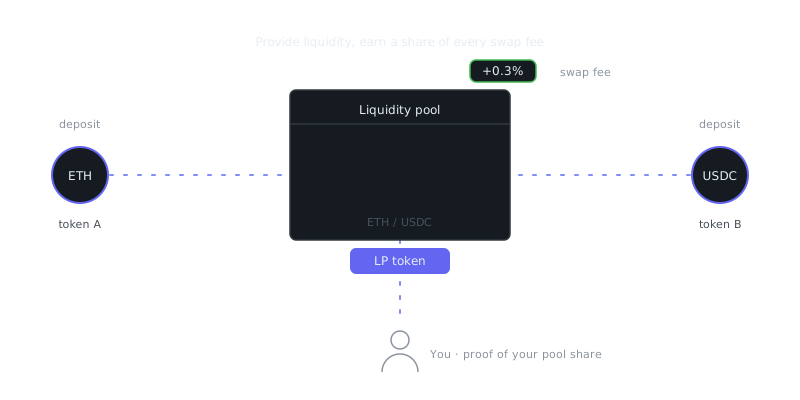
Impermanent loss happens when you deposit two assets into a liquidity pool and the price ratio between them shifts after you're in. It's called "impermanent" for a specific reason: if prices drift back to where they were when you deposited, the loss vanishes. It only locks in when you withdraw at the wrong moment.
This isn't a bug in the system. It's a direct consequence of how AMMs like Uniswap, Curve, and PancakeSwap keep prices in line without an order book. They use a mathematical formula to balance pool reserves automatically, and that rebalancing is exactly what creates impermanent loss.
Here's the distinction that trips most people up: impermanent loss isn't measured against your entry price. It's measured against what you would have made just holding those same assets in your wallet. You can still come out ahead providing liquidity — the real question is whether trading fees and incentives are enough to cover the drag.
How AMMs Create Impermanent Loss
The Constant Product Formula
Most AMMs run on a simple formula:
x * y = kx and y are the quantities of two tokens in the pool. k stays constant. When a trader buys token X, they push token Y into the pool and pull token X out, which drives X's price up. The pool rebalances automatically to keep k intact.
What does that mean for you? The pool is constantly selling the asset that's going up and buying the one that's going down. It's the opposite of what a passive holder would do. As a liquidity provider, your share of the pool reflects every one of those rebalancing trades.
A Concrete Example
Say you deposit 1 ETH and 2,000 USDC when ETH is worth $2,000. You own 50% of a pool worth $4,000.
ETH then jumps to $3,000 on external markets. Arbitrageurs immediately start buying ETH from the pool until the pool price catches up. Once the dust settles, the math looks like this:
New ETH in pool:  sqrt(k / new_price) = sqrt(4,000,000 / 3,000) ≈ 1.1547 ETH (pool total)
Your 50% share:   0.5774 ETH + 1,732 USDC ≈ $3,464 value

HODL equivalent:  1 ETH + 2,000 USDC = $5,000
Your LP position is worth roughly $3,464. If you'd just held, you'd have $5,000. That gap — about $1,536, or 30% — is impermanent loss. Trading fees collected along the way offset some of it, but the structural drag is real.
Quantifying Impermanent Loss
The relationship between price divergence and IL follows a predictable curve. Given a price ratio change r:
IL = 2 * sqrt(r) / (1 + r) - 1Here's how that plays out across different price movements:
| Price Change (one asset) | Impermanent Loss |
|---|---|
| No change (1x) | 0% |
| 1.25x | ~0.6% |
| 1.5x | ~2.0% |
| 2x | ~5.7% |
| 3x | ~13.4% |
| 5x | ~25.5% |
| 10x | ~42.5% |
One thing worth noting: the loss is symmetric. A 2x price increase causes the same IL as a 50% drop. That has real implications — providing liquidity on volatile pairs during a bull run can be surprisingly costly, even when prices are moving in a direction you'd normally celebrate.
Real-World Applications and Pool Types
Stablecoin Pools
Pools pairing two stablecoins — like USDC/DAI on Curve — carry almost no IL because the price ratio barely moves. Curve uses a different formula called the StableSwap invariant, built specifically for pegged assets. Slippage stays low, IL stays low. If you're new to liquidity provision, this is a sensible place to start.
Correlated Asset Pools
Pairs like stETH/ETH or WBTC/renBTC tend to move together, so the price ratio stays relatively stable. Curve and Balancer have both built specialized pools to take advantage of that correlation, keeping IL manageable on assets that would otherwise be risky to pair.
Concentrated Liquidity (Uniswap v3)
Uniswap v3 lets you pick a specific price range for your liquidity. Your capital only works within that range, which means more fees per dollar deployed — but also more IL if the price moves. If the price leaves your range entirely, your position flips to 100% of the depreciating asset and stops earning fees until the price comes back. Higher upside, higher stakes.
Balancer and Asymmetric Pools
Balancer supports pools with more than two assets and unequal weights. An 80% ETH / 20% USDC pool, for example, experiences far less IL than a standard 50/50 pool because there's less rebalancing to do when prices shift. Protocols like Aura Finance and BeethovenX use this structure specifically as an IL mitigation strategy.
Managing Impermanent Loss Risk
Knowing what IL is gets you halfway there. Actually managing it is where the work is.
Choose pools that match your market view. If you're bullish on ETH, putting it into an ETH/USDC pool means you'll likely underperform a straight ETH hold if you're right. A stablecoin pair, or a pool of assets you expect to track each other, fits better with that conviction.
Compare fee APR against expected IL honestly. High-volume pairs generate more fees. A pair earning 50% annualized in fees can absorb a lot of IL. Low-volume pairs with high volatility are the worst of both worlds. Always look at historical fee data alongside IL projections before committing.
Understand IL protection before trusting it. Some protocols have offered IL insurance — Bancor v3 is the most cited example, with single-sided staking backed by protocol reserves. But that experiment also showed what happens when redemptions spike and the mechanism gets stressed. Any protection mechanism is only as good as its funding model, so dig into the sustainability before you rely on it.
Track your positions actively. Tools like Revert Finance, APY.vision, and DeBank calculate your real IL, accrued fees, and net performance in real time. Without something like this, it's easy to look at your pool balance and think you're up when fees haven't actually covered your IL. Don't skip the tracking.
Define your exit before you enter. Before depositing, decide at what price level IL would meaningfully hurt your position. If ETH reaching $4,000 would wipe out your fee income, set a price alert and have a plan ready. Making that call after the fact is much harder.
Impermanent Loss in the Broader Context of DeFi Risks
IL doesn't exist in isolation. It sits alongside smart contract exploits, oracle manipulation, rug pulls, and liquidity crunches — all things any serious DeFi participant needs to account for. Treating IL as the only risk to manage is a mistake.
A mental model that helps: think of LP positions as writing a covered option on the price divergence between your two assets. You collect a premium (fees) in exchange for taking on the rebalancing exposure. That framing makes it easier to reason about when providing liquidity actually makes sense — when implied volatility is low, when fees are high, or when you have a genuinely neutral view on the pair.
For anyone working through DeFi fundamentals, impermanent loss is often the concept that separates theoretical understanding from being ready to deploy real capital. It demands price intuition, protocol mechanics knowledge, and yield math — all at the same time.
Summary and Key Takeaways
Impermanent loss is the opportunity cost liquidity providers pay when asset prices diverge from their ratio at deposit time. It's structural to how AMMs work, not a flaw, and it scales non-linearly with price divergence.
- IL is measured relative to holding, not relative to your entry price.
- Stablecoin and correlated asset pools carry significantly less IL than volatile pairs.
- Concentrated liquidity amplifies both fee earnings and IL exposure.
- Fees, incentives, and pool structure all affect whether providing liquidity is actually worth it for your specific situation.
- Active tracking and defined exit criteria aren't optional — they're how you stay in control.
Frequently Asked Questions
What is impermanent loss in DeFi?
Impermanent loss happens when you deposit two tokens into a liquidity pool and the price ratio between them changes after you deposit. The automated market maker rebalances your holdings, so you end up with less value than if you had simply held the tokens in your wallet. It's called 'impermanent' because the loss only becomes real when you withdraw your funds.
Can I lose all my money to impermanent loss?
No, impermanent loss doesn't wipe out your funds entirely — it just means you may end up with less value compared to holding the tokens outside the pool. The more the price of one token moves relative to the other, the larger the loss, but you still retain the underlying assets. Trading fees earned from the pool can offset or even outweigh the impermanent loss depending on trading volume.
When is impermanent loss the biggest risk?
Impermanent loss is most severe when you pair two volatile tokens that move independently, like ETH and a small altcoin, because large price swings between them force the pool to rebalance aggressively. Stablecoin pairs (like USDC/USDT) have very low impermanent loss risk since their prices stay close together. Providing liquidity during a strong one-sided price surge — where one token moons while the other stays flat — is typically the worst-case scenario.
Video Resources
Sources & Further Reading
- Uniswap Docs — Protocol documentation for the leading automated market maker.
- Finematics — Educational explainers on DeFi mechanisms with diagrams.
- DeFi Llama — Total value locked and protocol analytics across chains.
- Ethereum.org: DeFi — Official introduction to decentralised finance on Ethereum.
- Aave Docs — Lending protocol documentation, risk parameters and governance.
- Compound Docs — Documentation for the Compound money market protocol.
- Lido Docs — Liquid staking protocol documentation.