Liquid Staking Protocols: Unlocking Liquidity in Proof-of-Stake Networks
Liquid staking protocols solve one of DeFi's core capital efficiency problems: locked staking collateral. By issuing derivative tokens that represent your staked position, they let you earn validator rewards while still deploying your assets across DeFi. Here's how the leading protocols work and what risks to consider.
On this page
Liquid Staking Protocols: Unlocking Liquidity in Proof-of-Stake Networks
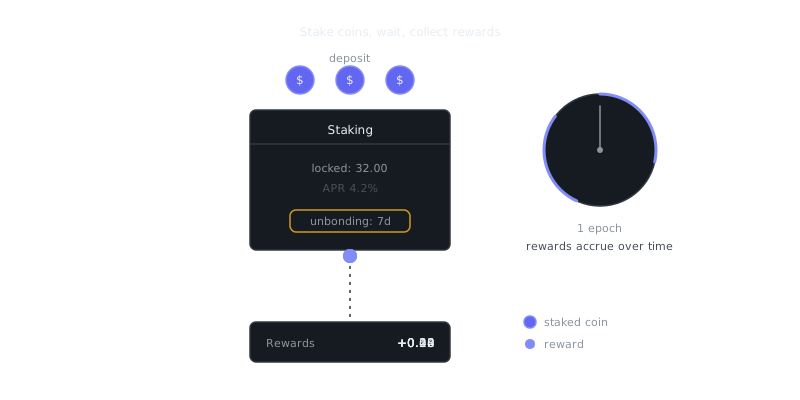
Proof-of-stake networks require validators to lock up capital as collateral. That secures the network, but it creates a real liquidity problem for token holders. Stake ETH on Ethereum, and that ETH is frozen — you can't trade it, use it as collateral, or put it to work anywhere else. Liquid staking protocols fix this by issuing a derivative token that represents your staked position, so you keep earning staking yield while your capital stays productive. Here's how these protocols actually work, what the risks are, and how they fit into the broader DeFi ecosystem.
“Smart contracts will replace lawyers.”
— Andreas Antonopoulos
How Liquid Staking Works
When you deposit tokens into a liquid staking protocol, it stakes those tokens on your behalf through a set of validators it manages. In return, you get a liquid staking token (LST) — essentially a receipt representing your staked position plus the rewards accumulating on top of it.
The Token Mechanics
LSTs come in two flavors.
Rebasing tokens (like Lido's stETH) automatically adjust your balance to reflect staking rewards. Hold 1 stETH today and you might hold 1.003 stETH tomorrow without doing anything — the protocol mints new tokens proportional to validator earnings.
Reward-bearing tokens (like Rocket Pool's rETH or Frax's sfrxETH) keep your balance fixed but increase in value relative to the underlying asset. 1 rETH is always redeemable for more ETH than when you minted it, because the exchange rate drifts upward over time.
That distinction matters when you start integrating with other DeFi protocols. Rebasing tokens can break accounting in smart contracts that assume static balances. Reward-bearing tokens are generally easier to compose with lending protocols, Uniswap liquidity pools, and other on-chain applications — which is why many developers prefer them when building on top of LSTs.
Major Protocols Compared
The liquid staking landscape has expanded well beyond Ethereum. Here's a snapshot of the leading protocols as of 2024:
| Protocol | Network | LST | Validator Model | Annual Yield (approx.) | Withdrawal |
|---|---|---|---|---|---|
| Lido | Ethereum, Polygon, Solana | stETH, stMATIC, stSOL | Curated node operators | ~3.5% | Unstaking queue |
| Rocket Pool | Ethereum | rETH | Permissionless node operators | ~3.2% | Secondary market / queue |
| Frax Ether | Ethereum | frxETH / sfrxETH | Frax-operated validators | ~4.1% | Redemption contract |
| Jito | Solana | JitoSOL | MEV-optimized validators | ~7–8% | Standard unstake |
| Stride | Cosmos ecosystem | stATOM, stOSMO, etc. | IBC-based delegation | ~15–19% | Unbonding period |
| Marinade | Solana | mSOL | Delegation strategy program | ~6–7% | Delayed or immediate |
Rocket Pool's permissionless model deserves a closer look. Any operator can run a Rocket Pool validator by depositing 8 ETH (reduced from 16 ETH after the Atlas upgrade) and borrowing the rest from the protocol's staking pool. That spreads trust much more broadly than Lido's whitelisted operator set — though it introduces different risk dynamics around operator collateral, which we'll get to.
Using LSTs in DeFi
Here's the real value proposition: your staking yield becomes a floor return, and you can stack additional yield on top by putting your LST to work elsewhere.
Lending and Borrowing
LSTs are widely accepted as collateral on lending protocols like Aave and Compound. You deposit stETH, borrow USDC against it, and deploy that USDC elsewhere — all while your stETH keeps earning staking rewards. The net cost of borrowing is effectively the borrow rate minus the staking APY. Done right, you're getting paid to borrow.
This is structurally similar to the mechanics behind flash loans: DeFi lets you use capital in multiple places at once, which amplifies both returns and risks.
Liquidity Provision
Providing liquidity for LST/ETH pairs is one of the most common yield strategies out there. On Curve Finance, the stETH/ETH pool has historically been one of the deepest pools on the protocol. On Uniswap, you can set concentrated liquidity positions within a tight range around the peg to capture fees with minimal impermanent loss — the same logic that applies to any correlated asset pair.
Here's what a basic interaction with an LST pool looks like using the Curve protocol:
# Approve stETH spending
cast send 0xae7ab96520DE3A18E5e111B5EaAb095312D7fE84 \
  "approve(address,uint256)" \
  0xDC24316b9AE028F1497c275EB9192a3Ea0f67022 \
  1000000000000000000 \
  --rpc-url $ETH_RPC_URL \
  --private-key $PRIVATE_KEY

# Add liquidity to Curve stETH/ETH pool
cast send 0xDC24316b9AE028F1497c275EB9192a3Ea0f67022 \
  "add_liquidity(uint256[2],uint256)" \
  "[0,1000000000000000000]" \
  990000000000000000 \
  --rpc-url $ETH_RPC_URL \
  --private-key $PRIVATE_KEY
Restaking
EigenLayer introduced restaking on Ethereum, where stETH or natively staked ETH gets committed to secure additional services called Actively Validated Services (AVSs). That creates a third layer of yield on top of base staking rewards and any DeFi deployment — but it also multiplies your slashing exposure significantly. More yield, more attack surface. That tradeoff is worth sitting with before you commit.
Risk Profile
Liquid staking carries risks that plain staking doesn't. You need to understand them before putting capital in.
Smart Contract Risk
The liquid staking protocol is itself a smart contract system. Lido's contracts hold billions of dollars of ETH. A critical vulnerability in the withdrawal credentials logic, the reward distribution mechanism, or the oracle system could mean total or partial loss. Audits reduce that risk — they don't eliminate it.
Validator Slashing
If a validator misbehaves — double-signing a block, going offline at the wrong moment — the network slashes a portion of their staked ETH. That loss gets socialized across all stakers in the pool. Rocket Pool partially addresses this by requiring node operators to post an RPL bond as insurance against their own slashing events.
Peg Risk and Liquidity Risk
LSTs are supposed to trade at parity with the underlying asset, but secondary market dynamics can push them off. During the June 2022 deleveraging event, stETH traded at roughly a 5% discount to ETH on Curve for several weeks. That's fine if you can wait out the withdrawal queue. It's a real problem if you need to exit fast.
Centralization and Governance Risk
Lido controls roughly 30% of all staked ETH. That's a systemic risk for Ethereum's consensus layer — a compromised or colluding Lido validator set could theoretically threaten finality. The community has debated self-limiting mechanisms for years, and Lido governance decisions can materially affect both the protocol's behavior and its fee structure.
Oracle Risk
Many protocols rely on oracles to report validator balances and calculate reward accrual. If an oracle gets manipulated or reports stale data, the exchange rate between the LST and the underlying asset can get corrupted — opening up arbitrage at the protocol's expense.
Evaluating a Liquid Staking Protocol
Before you allocate capital, run through this checklist:
Due Diligence Checklist
─────────────────────────────────────────────────
[ ] Smart contract audit history (who, when, findings)
[ ] Oracle design (centralized feed vs. decentralized)
[ ] Validator operator set (permissioned vs. permissionless)
[ ] Slashing insurance mechanism
[ ] LST liquidity depth on secondary markets
[ ] Withdrawal mechanism (queue length, redemption contract)
[ ] Governance token distribution and upgrade controls
[ ] Protocol fee structure (usually 10% of st
Frequently Asked Questions
What is liquid staking and how is it different from regular staking?
Regular staking locks up your crypto in a network to earn rewards, but you can't use those funds while they're locked. Liquid staking gives you a token that represents your staked assets, so you can still use that token in other DeFi apps while continuing to earn staking rewards.
Is liquid staking safe to use?
Liquid staking carries risks beyond regular staking, including smart contract bugs and the possibility that the liquid token loses its peg to the underlying asset. Established protocols like Lido or Rocket Pool have been audited and hold billions in assets, but no DeFi protocol is entirely risk-free.
What can I do with the liquid staking token I receive?
You can use your liquid staking token (like stETH or rETH) across DeFi — for example, lending it to earn extra yield, using it as collateral to borrow other assets, or providing liquidity in a pool. This lets you stack multiple sources of yield on top of your base staking rewards.
Video Resources
Sources & Further Reading
- Ethereum.org — Official Ethereum documentation and learning hub.
- Lido Docs — Liquid staking protocol documentation.
- DeFi Llama — Total value locked and protocol analytics across chains.
- Ethereum.org: DeFi — Official introduction to decentralised finance on Ethereum.
- Uniswap Docs — Protocol documentation for the leading automated market maker.
- Aave Docs — Lending protocol documentation, risk parameters and governance.
- Compound Docs — Documentation for the Compound money market protocol.