Leverage Trading: Understanding the Risks and Rewards
Leverage trading allows you to control positions larger than your account balance, amplifying both gains and losses. A 10x leveraged position turns a 5% move into a 50% result—in either direction. Understanding the mechanics and psychology of leverage is critical to survival.
On this page
Leverage trading amplifies both profits and losses by letting you control positions far larger than your account balance. A 10x leveraged position turns a 5% price movement into a 50% gain — but that same 5% move in the wrong direction wipes out half your account or triggers a full liquidation. What separates traders who last from those who blow up isn't just strategy. It's understanding the math, the psychology, and exactly how the mechanics work against you.
“Risk comes from not knowing what you're doing.”
— Warren Buffett
How Leverage Works
Leverage is expressed as a ratio. At 10:1, you're controlling $10,000 worth of an asset with just $1,000 of your own money. The rest is borrowed from your broker or exchange, which charges interest (called the funding rate in perpetual futures) and reserves the right to liquidate your position if losses start eating into that collateral.
Here's a concrete example. A trader with $5,000 using 5x leverage opens a $25,000 position. If the asset rises 4%, the position gains $1,000 — that's a 20% return on the original capital. But a 4% drop creates the same $1,000 loss, wiping out 20% of the account. At most exchanges, a 20% loss triggers liquidation to protect the borrowed funds.
What catches people off guard is how quickly liquidation prices tighten as leverage increases. At 2x leverage on a long, you need roughly a 50% price drop to get liquidated. At 10x, a 10% move against you does it. At 50x, a 2% swing ends the trade. That's not theoretical risk — in crypto markets, 2% moves happen within minutes.
Margin and Maintenance Requirements
Exchanges split margin into two types. Initial margin is what you put up to open the position. Maintenance margin is the minimum equity required to keep it open. Drop below that threshold and liquidation starts automatically.
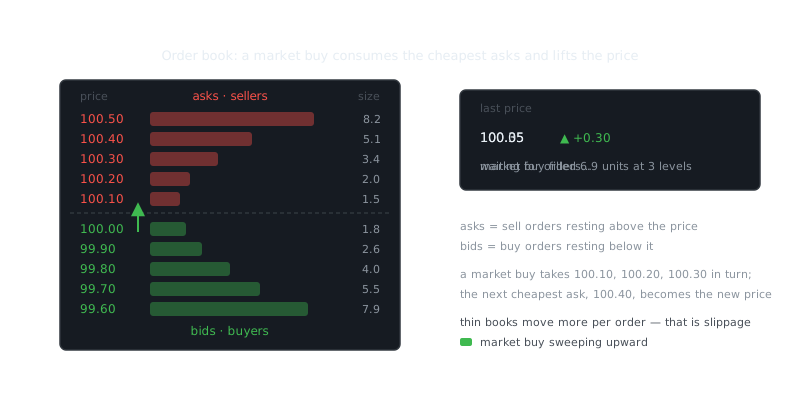
It's not always a clean process either. During volatile periods, slippage can push your actual losses beyond your collateral, meaning you could technically owe the exchange money after liquidation.
You'll also choose between cross margin and isolated margin. Cross margin pools your entire account as collateral across all positions. Isolated margin caps the risk to whatever you allocate to a single trade. Isolated margin keeps one bad trade from taking down your whole portfolio, though it does reduce capital efficiency. Most experienced traders use isolated margin for speculative positions and cross margin only when managing correlated hedges where the risk profile is well understood.
The Rewards: Capital Efficiency and Opportunity
Capital efficiency is the real reason professional traders use leverage. Instead of tying up $50,000 in a single position, 5x leverage lets you control that same position size with $10,000, leaving the other $40,000 free to deploy elsewhere.
This matters most for strategies that depend on diversification or fast position adjustments. Market makers and arbitrageurs depend on leverage to make small price discrepancies worth pursuing. A 0.3% arbitrage opportunity is barely worth the effort without leverage, but at 20x it becomes a 6% return on capital. Grid trading strategies — which place layered buy and sell orders across a price range to capture volatility — use moderate leverage to extract returns from small oscillations without locking up too much capital.
Leverage also creates tactical flexibility that pure spot trading doesn't offer. A long-term Bitcoin holder who expects a short-term correction can open a small leveraged short instead of selling spot and creating a taxable event. That preserves the long-term position while hedging near-term downside.
When Leverage Actually Helps
Leverage only amplifies edge if the edge is real and the math supports it. A strategy with a 55% win rate and 1:1 risk-reward generates modest returns over time. Apply 3x leverage and you triple both the gains and the drawdowns. The equity curve builds faster, but so does the potential for ruin if variance goes against you for a stretch.
Backtesting shows this clearly. A strategy with a 15% maximum drawdown without leverage experiences a 45% drawdown at 3x. If your account — or your psychology — can't handle that, the leverage is too high regardless of how strong the long-term expectancy looks. Good backtests include Monte Carlo simulations that randomize trade order to model worst-case drawdown sequences, not just average ones.
The Risks: Liquidation, Volatility, and Compounding Losses
Leverage turns temporary paper losses into permanent ones. A spot trader who buys at $100 and watches the price fall to $70 hasn't lost anything until they sell. A trader with 5x leverage gets liquidated around $80, locking in that loss and eliminating any chance to recover when price bounces back.
Volatility risk is the less obvious killer. Assets that routinely move 10% in a day — normal in crypto — liquidate 10x leveraged positions during what's essentially routine price action. Your directional thesis can be completely correct, but intraday swings stop you out before the move plays out. More leveraged positions die this way than from simply being wrong about direction.
Funding Rates and Hidden Costs
Perpetual futures contracts charge funding rates every 8 hours, transferred between long and short traders depending on market sentiment. During strong uptrends, these rates can run above 0.1% per period — over 10% annualized. Hold a leveraged long for several weeks during a bull run and you're quietly bleeding profits the whole time. These costs rarely show up in backtests, but they have a real impact on live performance.
Liquidation itself adds another layer of cost, often 0.5% or more of position size. On top of that, cascading liquidations during volatile periods create slippage that pushes your exit price further against you. A position you sized to risk $1,000 can easily end up losing $1,200 or more once fees and execution slippage are factored in.
Psychological Traps and Decision-Making Under Leverage
Leverage doesn't just affect your account balance — it warps your judgment. The prospect of amplified gains pulls traders toward larger position sizes than their risk rules would normally allow. It's easy to rationalize using 10x "just this once" instead of the usual 3x. Then normal volatility triggers liquidation and the rationalization disappears.
Watching a position approach its liquidation price creates a specific kind of panic that's hard to describe until you've felt it. Traders exit perfectly good setups simply because the leverage made the drawdown psychologically unbearable, turning potential wins into confirmed losses.
After getting liquidated, revenge trading is almost reflexive. Losing 50% of an account in minutes creates an emotional urge to win it back immediately, usually with even higher leverage. That's how one bad trade becomes a blown account. Professional traders set hard daily loss limits and step away after hitting them — not because they lack discipline, but because they understand how decision-making deteriorates after big losses.
Leverage Comparison Across Asset Classes
Different markets offer very different leverage levels, and the risk profile varies significantly across them.
| Market | Typical Max Leverage | Volatility (Annual) | Liquidation Risk | Best Use Case |
|---|---|---|---|---|
| Forex | 50:1 to 500:1 | 8-12% | Moderate | Short-term technical trading |
| Stock CFDs | 5:1 to 20:1 | 15-25% | Moderate | Swing trading, earnings plays |
| Crypto Spot Margin | 3:1 to 10:1 | 60-100% | High | Trend following with wide stops |
| Crypto Perpetuals | 10:1 to 125:1 | 60-100% | Extreme | Scalping, market making |
| Commodity Futures | 10:1 to 20:1 | 20-40% | Moderate | Hedging, seasonal strategies |
Forex offers extreme leverage but relatively low volatility outside of major news events, so 20:1 is far more survivable there than in crypto. Crypto's volatility — routinely 60-100% annually — makes even 5x leverage genuinely dangerous for retail traders without disciplined risk management. The number on the leverage slider means very little without understanding the volatility of the underlying asset.
Risk Management for Leveraged Trading
Position sizing deter
Frequently Asked Questions
What is leverage trading and how does it work?
Leverage trading lets you control a larger position than your actual account balance by borrowing funds from your broker. For example, with 10x leverage, a $100 deposit lets you trade a $1,000 position. This amplifies both your potential gains and your potential losses by the same multiplier.
Can I lose more money than I deposit with leverage trading?
Yes, this is one of the biggest risks beginners overlook. If the market moves against your position, losses are calculated on the full leveraged amount, not just your deposit, and your account can be wiped out faster than you expect. Some brokers offer negative balance protection, but not all do, so always check before trading.
What are the rewards of leverage trading if it's so risky?
Leverage lets traders with smaller accounts take meaningful positions and potentially earn significant returns on a modest amount of capital. A 1% move in your favor on a 10x leveraged trade translates to a 10% gain on your deposit. The key is using strict risk management, like stop-loss orders, to keep the downside controlled while still benefiting from the upside.
Video Resources
Sources & Further Reading
- CFTC: Learn & Protect — Regulator's plain-language warnings about leverage and fraud.
- Investopedia — Reference definitions and explainers for markets and trading.
- Investopedia: Technical Analysis — Indicator-by-indicator guides with worked examples.
- TradingView — Charting platform with community education and indicator scripts.
- CoinGecko — Price history, volume and market capitalisation data.
- BabyPips School — Free structured course on chart reading and risk management.
- Glassnode Academy — On-chain metrics explained, from active addresses to realised cap.