Crypto Staking Explained: How to Put Your Digital Assets to Work
Staking lets you earn yield on cryptocurrency by participating in network security or liquidity provisioning instead of letting assets sit idle. From proof-of-stake validators to DeFi liquidity pools, there are multiple ways to stake. This guide covers how each model works and what to consider before getting started.
On this page
Staking is one of the most accessible ways to earn yield on crypto you already hold. Rather than letting tokens sit idle in a wallet, you can put them to work — earning rewards by participating in network security or supplying liquidity to DeFi protocols. Here's what you need to know about how it actually works, what forms it takes, and what to think through before committing funds.
How Proof-of-Stake Staking Works
In a proof-of-stake (PoS) blockchain, validators are chosen to produce and confirm blocks based on how much cryptocurrency they lock up as collateral. That locked amount is their stake. It replaces the energy-hungry computation of proof-of-work with an economic commitment — you put skin in the game instead of burning electricity.
When you stake on a PoS network, you're either running a validator node yourself or delegating your tokens to someone who does. Either way, you get a share of the block rewards the network mints as new tokens, plus a cut of transaction fees.
Native Staking vs. Delegated Staking
Native staking means running your own validator. On Ethereum, that requires locking exactly 32 ETH and keeping a node online with consistent uptime. If your validator goes offline or behaves maliciously, you face slashing — a penalty that permanently destroys part of your staked funds.
Delegated staking is far more accessible. On networks like Cosmos or Solana, you can delegate any amount to a validator of your choice. They handle the node operations; you earn proportional rewards minus their commission fee.
# Example: delegating ATOM on Cosmos using the CLI
gaiad tx staking delegate <validator-address> 1000000uatom \
  --from <your-wallet> \
  --chain-id cosmoshub-4 \
  --gas auto \
  --fees 5000uatom
Liquid Staking: Unlocking Capital Efficiency
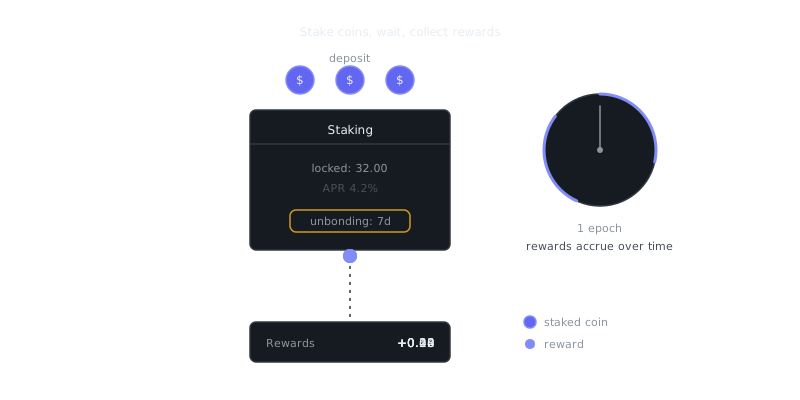
Traditional staking has a real problem: your tokens get locked. Unbonding periods range from a few days to several weeks depending on the network, which means you can't touch your capital during that time. Liquid staking protocols solve this by issuing a derivative token that represents your staked position.
Stake ETH through Lido, for example, and you receive stETH at a 1:1 ratio. That stETH accrues staking rewards over time and you can still use it across DeFi — as collateral for loans, in liquidity pools, or traded on secondary markets. This composability is what's made liquid staking such a central piece of how DeFi capital flows today.
Popular Liquid Staking Protocols
| Protocol | Supported Asset | Derivative Token | Unstaking Period |
|---|---|---|---|
| Lido | ETH, SOL, MATIC | stETH, stSOL, stMATIC | Variable (ETH: days–weeks) |
| Rocket Pool | ETH | rETH | Market-dependent |
| Marinade Finance | SOL | mSOL | ~2 days |
| Stride | ATOM, OSMO, others | stATOM, stOSMO | Chain-dependent |
The tradeoff is smart contract risk. Your funds pass through protocol code, and a vulnerability in that code could mean loss. That's not theoretical — it's happened repeatedly.
DeFi Staking and Liquidity Mining
DeFi protocols use the word "staking" more loosely than PoS networks. Here it usually means depositing tokens into a protocol contract to earn rewards, typically the protocol's own governance token.
Single-Asset Staking
Some protocols let you stake a single token to earn yield. Compound, for instance, lets you supply assets to earn COMP tokens on top of the base lending interest. Supplying USDC earns you both the base supply APY and COMP rewards at the same time — two yield streams from one position.
LP Token Staking
A common DeFi pattern works in three steps. You provide liquidity to an AMM like Uniswap or Curve, receive LP tokens representing your share of that pool, then stake those LP tokens in a separate rewards contract. The result is stacked yield: trading fees from the pool plus token emissions from the rewards contract.
// Conceptual flow — not production code
// 1. Add liquidity to pool
router.addLiquidity(tokenA, tokenB, amountA, amountB, ...);

// 2. Receive LP tokens, then stake them
lpToken.approve(stakingContract, lpBalance);
stakingContract.stake(lpBalance);

// 3. Claim rewards over time
stakingContract.getReward();
This is where impermanent loss becomes relevant. Your LP tokens represent a position in two assets. If those assets diverge significantly in price, the pool rebalances and you end up with more of whichever token fell and less of whichever rose. Put simply, you'd have been better off just holding. Your staking rewards need to outpace that loss for the position to make sense.
Evaluating Staking Yield: What the Numbers Actually Mean
APY figures get thrown around a lot in staking, and they rarely come with enough context. A few things actually determine your real return.
Token inflation. If a network mints new tokens to pay stakers, those rewards dilute the supply. A 10% APY in a token inflating at 15% annually is a real loss in purchasing power. Always check the network's emission schedule before assuming a yield number means anything.
Denominated return vs. dollar return. A 20% APY staking a volatile asset can still result in a dollar loss if the token drops 50% during your staking period. Stablecoin staking yields are easier to evaluate precisely because you're not carrying price risk on the principal itself.
Compounding frequency. Rewards that auto-compound daily generate meaningfully more yield than weekly manual claims over a full year. Protocols like Beefy Finance automate this, which matters more than most people account for.
Lock-up and exit risk. If you need to exit quickly and the unbonding period is 21 days, you carry price exposure through that entire window. Liquid staking helps here, but it introduces another variable: the derivative token's own liquidity. stETH has traded at a discount to ETH during periods of market stress.
Risks to Understand Before Staking
Staking isn't risk-free, and different mechanisms carry very different risk profiles.
Slashing risk is specific to native PoS staking. Validators that go offline or act maliciously lose a portion of staked funds. When you delegate, you inherit your chosen validator's operational risk — their mistake becomes your loss.
Smart contract risk applies to every DeFi staking mechanism. Audited code reduces this risk but doesn't eliminate it. The 2022 Ronin bridge exploit and countless yield farming hacks show that even protocols with billions in TVL can fail.
Regulatory risk is growing fast. Multiple jurisdictions have questioned whether staking-as-a-service constitutes an unregistered securities offering. The SEC's action against Kraken's staking program in 2023 ended in a $30 million settlement and the shutdown of its US staking service entirely.
Counterparty risk is the issue with centralized staking services. If the exchange or platform holding your staked assets collapses — as Celsius and BlockFi did — recovery is often limited, slow, or both.
Getting Started: A Practical Path
If you're figuring out where to begin, here's a rough progression by complexity and risk.
The simplest entry point is staking ETH through a liquid staking protocol like Lido or Rocket Pool. You get a liquid derivative back, there's no lock-up, and there's no minimum beyond gas costs. One contract interaction and you're earning.
A step up from that is delegating tokens on a Cosmos-chain validator. It requires picking a reliable validator and understanding the unbonding period, but it's not technically demanding.
More involved is providing liquidity to a stable pair like USDC/USDT on Curve, receiving LP tokens, then staking those in Curve's gauge system. Impermanent loss risk is low because the assets stay close in price, but you're touching multiple contracts which means more surface area for things to go wrong.
The most advanced route is running a native ETH validator. That means 32 ETH, technical node operation, and ongoing maintenance. It's not for most people, at least not without significant preparation.
Key Takeaways
Staking covers several distinct mechanisms — PoS consensus participation, liquid staking derivatives, and DeFi liquidity incentives — and each carries its own risk and reward profile.
Native PoS staking secures the network and earns block rewards, but carries slashing risk and lock-up periods. Liquid staking solves the liquidity problem but adds smart contract exposure. DeFi staking can generate high yields, but impermanent loss, token inflation, and contract risk can quietly erode those returns.
“Decentralized finance is the future of money.”
— Unknown
The number one mistake new stakers make is chasing the highest APY without understanding what's generating it. A 200% yield on a brand-new governance token isn't the same as 4% on ETH. Know what you're actually holding, what can go wrong, and how you'd exit before putting real money in.
Frequently Asked Questions
What is staking in DeFi?
Staking is the process of locking up your cryptocurrency in a protocol to help support its operations, like validating transactions or providing liquidity. In return, you earn rewards — usually paid out in the same token you staked. Think of it like earning interest on a savings account, but in the crypto world.
Is staking risky?
Yes, staking comes with risks you should understand before jumping in. The value of your staked tokens can drop while they're locked up, and some protocols have a 'slashing' penalty that can reduce your holdings if something goes wrong on the network. There's also smart contract risk, where bugs in the protocol's code could lead to loss of funds.
Can I unstake my tokens whenever I want?
It depends on the protocol — some let you unstake at any time, while others have a lock-up period that can range from a few days to several weeks. During that waiting period, your tokens are usually not earning rewards and you can't move or sell them. Always check the unbonding period before staking so you're not caught off guard.
Video Resources
Sources & Further Reading
- Ethereum.org — Official Ethereum documentation and learning hub.
- Lido Docs — Liquid staking protocol documentation.
- DeFi Llama — Total value locked and protocol analytics across chains.
- Ethereum.org: DeFi — Official introduction to decentralised finance on Ethereum.
- Uniswap Docs — Protocol documentation for the leading automated market maker.
- Aave Docs — Lending protocol documentation, risk parameters and governance.
- Compound Docs — Documentation for the Compound money market protocol.