Yield Farming Strategies: How to Maximize Your DeFi Returns
Yield farming lets you put your crypto assets to work across DeFi protocols — earning returns through liquidity provision, lending, and governance participation. But higher yields come with real risks like impermanent loss and smart contract vulnerabilities. This guide breaks down the strategies that balance reward with risk.
On this page
Yield farming is one of the most powerful and complex ways to generate returns in DeFi. At its core, you're deploying crypto assets into protocols that pay you for providing liquidity, lending capital, or participating in governance. Done well, it can significantly outperform traditional savings. Done poorly, it exposes you to smart contract exploits, impermanent loss, and liquidation. Here's what you need to know before putting capital to work.
“Decentralized finance is the future of money.”
— Unknown
How Yield Farming Works
When you deposit assets into a DeFi protocol, you're essentially becoming a counterparty to other users — lenders, traders, or borrowers. The protocol compensates you with fees, interest, or token incentives.
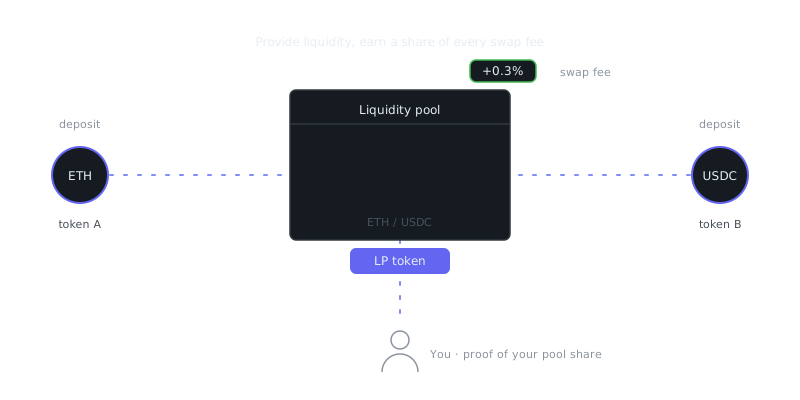
Returns come from three main sources. Trading fees flow to liquidity providers on AMMs like Uniswap or Curve, who earn a cut of every swap routed through their pool. Lending protocols like Aave or Compound pay depositors from the interest borrowers pay. And many protocols distribute their native governance tokens to attract early liquidity — a practice commonly called liquidity mining.
APY figures in DeFi can look dramatic. Four or five digits, sometimes more. Those numbers are almost always unsustainable and reflect token reward inflation, not real economic activity. A 1,000% APY paid in a protocol's governance token can collapse to near zero if that token drops 95% in price, which happens regularly. Don't build a strategy around inflated APY numbers.
Core Yield Farming Strategies
Single-Asset Lending
This is the simplest entry point. You deposit a stablecoin or blue-chip asset like ETH or WBTC into a lending protocol and earn interest from borrowers.
Take depositing USDC into Aave v3 on Arbitrum as an example. The protocol lends your USDC to overcollateralized borrowers and pays you a variable interest rate. There's no impermanent loss and no token price exposure beyond whatever asset you deposited.
It also pairs well with gas efficiency since you're depositing once and either compounding manually or letting an auto-compounder handle it.
Liquidity Provision on AMMs
Here you supply two assets to an AMM pool in a set ratio — 50/50 on Uniswap v2-style pools, or custom weights on Balancer — and earn a share of trading fees.
Uniswap v3 introduced concentrated liquidity, where instead of spreading capital across all possible prices, you define a tight price band. This amplifies fee earnings when price trades within your range, but the flip side is higher impermanent loss if price moves outside it.
# Simplified example: Uniswap v3 position parameters
Token pair:    ETH / USDC
Lower tick:    1800 USDC per ETH
Upper tick:    2200 USDC per ETH
Capital:       1 ETH + 2000 USDC

# If ETH trades at 2000, you earn fees on every swap
# If ETH drops to 1500, your position converts to 100% ETH
# and earns nothing until price returns to range
Managing concentrated liquidity positions is a strategy in itself. Protocols like Gamma Strategies and Arrakis Finance automate the rebalancing for you if you'd rather not babysit the range.
Yield Aggregators
Rather than manually compounding rewards, yield aggregators like Yearn Finance or Beefy Finance handle it automatically. They deploy capital into underlying strategies, harvest reward tokens, sell them, and reinvest — squeezing out better effective yields through compounding frequency.
The tradeoff is an extra smart contract layer, which means extra smart contract risk. Before depositing into an aggregator, check whether the strategy vaults have been audited by firms like Trail of Bits or OpenZeppelin. Audits aren't guarantees, but unaudited vaults are a hard pass.
Advanced Strategies
Leveraged Yield Farming
Some protocols let you borrow against your deposited collateral and farm with the borrowed assets, multiplying both returns and risk.
Here's a concrete example using Aave. You deposit 10,000 USDC as collateral, borrow 6,000 USDC at 60% LTV to give yourself a safety buffer, then deploy the borrowed USDC into a yield farm. For this to make sense, your farming APR needs to exceed your borrowing cost plus a buffer for liquidation risk.
If the farming APR is 12% and borrowing costs 5%, you're netting 7% on the borrowed amount. But if you're using a volatile asset as collateral and its value drops sharply, you risk getting liquidated. Tools like DeFi Saver can automate position management and help prevent that from happening.
Flash Loan Arbitrage
Flash loans let you borrow large sums within a single transaction with zero upfront collateral. You borrow, use, and repay within the same block. If repayment fails, the entire transaction reverts like it never happened. They're often associated with exploits, but they have legitimate uses in yield farming too.
Yield farmers use them to rebalance leveraged positions without liquidation risk, capture yield differentials between protocols, and execute collateral swaps atomically in one transaction.
// Conceptual flash loan callback structure (Aave v3)
function executeOperation(
    address asset,
    uint256 amount,
    uint256 premium,
    address initiator,
    bytes calldata params
) external returns (bool) {
    // 1. Execute your strategy here
    // 2. Approve repayment of amount + premium
    IERC20(asset).approve(address(POOL), amount + premium);
    return true;
}
Stablecoin Curve Wars Strategies
Curve Finance controls a massive share of stablecoin liquidity on-chain. Convex Finance built on top of that, letting you stake Curve LP tokens to earn boosted CRV rewards without locking CRV yourself. This dynamic created a layered strategy that became popular for good reason.
You provide liquidity to a Curve pool and receive LP tokens, stake those LP tokens on Convex to earn CRV and CVX rewards, then lock CVX for vlCVX to earn protocol fees and bribe income on top. Each layer adds complexity and smart contract exposure, but the stablecoin base keeps impermanent loss minimal.
Comparing Common Yield Farming Strategies
| Strategy | Risk Level | Impermanent Loss | Complexity | Typical APY Range |
|---|---|---|---|---|
| Single-asset lending | Low | None | Low | 2–12% |
| Stablecoin LP (Curve) | Low–Medium | Minimal | Medium | 4–20% |
| Volatile AMM LP | Medium–High | Significant | Medium | 10–80%+ |
| Yield aggregators | Medium | Varies | Low | 5–40% |
| Leveraged farming | High | Amplified | High | 15–100%+ |
| Flash loan strategies | High | None | Very High | Variable |
The APY ranges above reflect sustainable fee-based returns. Token incentive programs can inflate these numbers temporarily, but don't let that factor into your base case assumptions.
Risk Management Fundamentals
Yield farming risk is multi-layered, and you need to understand each layer on its own terms.
Smart Contract Risk: Every protocol you interact with is a potential attack vector. Look for recent audits from reputable firms, but understand that audits aren't guarantees. The Euler Finance exploit in March 2023 drained $197M from a fully audited protocol. Spreading capital across multiple protocols limits what you can lose to any single failure.
Impermanent Loss: When you provide liquidity to a two-asset pool, price divergence between the assets reduces your position value compared to simply holding both. It's called "impermanent" because prices could theoretically revert, but in practice that often doesn't happen.
# Impermanent loss at various price changes
Price change  |  IL
10%           |  ~0.1%
25%           |  ~0.6%
50%           |  ~2.0%
100% (2x)     |  ~5.7%
400% (5x)     |  ~25.5%
Gas Costs: On Ethereum mainnet, transaction costs will quietly destroy returns on smaller positions. A $100 position compounded weekly will lose a significant chunk to gas alone. The practical workarounds are batching operations, farming on L2 networks like Arbitrum, Optimism, or Base, and compounding less frequently.
Frequently Asked Questions
What is yield farming and how do I get started?
Yield farming is a way to earn passive income by depositing your crypto into DeFi protocols that lend or provide liquidity to other users. To get started, you connect a wallet like MetaMask to a platform like Aave or Uniswap, deposit supported tokens, and start earning rewards. Begin with small amounts on well-established protocols while you learn how the mechanics work.
What are the risks of yield farming I should know about?
The main risks include smart contract bugs (which can lead to loss of funds), impermanent loss when providing liquidity to trading pairs, and token price volatility that can wipe out your earned yield. Rug pulls are also a real danger on newer or unaudited protocols where developers abandon the project and drain funds. Always research a protocol's audit history and stick to platforms with a strong track record when you're just starting out.
What does APY mean in yield farming and can I trust those numbers?
APY (Annual Percentage Yield) represents the estimated return you'd earn over a year, including compounding effects. The numbers can look extremely high, but they're calculated based on current conditions and change constantly as more liquidity enters the pool or token prices shift. Treat high APYs as a snapshot, not a guarantee, and factor in gas fees and token volatility before committing funds.
Video Resources
Sources & Further Reading
- DeFi Llama — Total value locked and protocol analytics across chains.
- Ethereum.org: DeFi — Official introduction to decentralised finance on Ethereum.
- Uniswap Docs — Protocol documentation for the leading automated market maker.
- Aave Docs — Lending protocol documentation, risk parameters and governance.
- Compound Docs — Documentation for the Compound money market protocol.
- Finematics — Educational explainers on DeFi mechanisms with diagrams.
- Lido Docs — Liquid staking protocol documentation.