Anonymous Payments: A Practical Guide to Financial Privacy
Financial privacy is a practical skill with real-world applications — from protecting journalistic sources to shielding personal data from aggregators. This guide breaks down how anonymous payment methods work, the tools available, and how to evaluate their trade-offs. Whether you're new to financial privacy or refining your approach, you'll find actionable guidance here.
On this page
Anonymous Payments: A Practical Guide to Financial Privacy
Financial privacy is a fundamental aspect of personal security. Whether you're a journalist protecting a source, a business shielding competitive information, or an individual concerned about data aggregation, understanding how to transact with reduced traceability is a practical skill. This guide covers how payment tracing actually works, the tools available, their trade-offs, and how they fit into a broader privacy posture.
How Payment Traceability Works
Every traditional payment leaves a trail. Credit and debit cards link transactions to your identity through your bank, merchant records, and payment processors. Even cash has limits: ATM withdrawals are logged, and deposit patterns can be analyzed.
Digital payments make this exposure worse. When you pay online, your IP address, browser fingerprint, billing address, and transaction metadata all get captured. Websites collect data points like your screen resolution, installed fonts, browser plugins, and hardware configuration to build a unique identifier — even without cookies. Two transactions from the same device can be linked even if you used completely different accounts.
Traceability comes from three distinct layers. First is the identity layer: your name, address, or account tied to the payment method. Second is the network layer: your IP address and device fingerprint at the time of the transaction. Third is the ledger layer: a permanent record of the transaction, whether that's a bank statement or a public blockchain.
Meaningful anonymity requires addressing all three. Fix one and ignore the others, and you've only done part of the job.
Cash and Physical Privacy
Cash is still the most private payment method for in-person transactions. It requires no account, leaves no digital record between parties, and works for everyday purchases without any setup.
For higher-stakes privacy needs, how you use cash matters as much as using it at all. Withdraw from ATMs in locations not tied to your routine. Pay cash for purchases where linking your identity to a product or service creates real risk. Be aware that in the US, transactions over $10,000 trigger a Currency Transaction Report — structuring withdrawals to avoid that threshold is itself a federal crime, so just be aware of the reporting landscape rather than trying to game it.
Cash falls apart entirely for online transactions. That's where you need different tools.
Cryptocurrency and Its Privacy Trade-offs
Cryptocurrency is often assumed to mean anonymous payments. It doesn't, at least not automatically.
Bitcoin is pseudonymous, not anonymous. Every transaction is permanently recorded on a public ledger. If your wallet address ever gets linked to your identity — through a KYC exchange, a merchant record, or an IP address logged during a transaction — your entire transaction history becomes visible to anyone who looks.
Privacy-Focused Cryptocurrencies
Some cryptocurrencies build privacy into the protocol itself:
| Currency | Privacy Mechanism | Default Privacy | Auditability |
|---|---|---|---|
| Bitcoin (BTC) | None (transparent ledger) | None | Full public |
| Monero (XMR) | Ring signatures, stealth addresses, RingCT | Always on | Optional view key |
| Zcash (ZEC) | zk-SNARKs (shielded transactions) | Optional | Selective disclosure |
| Dash (DASH) | CoinJoin mixing (PrivateSend) | Optional | Partial |
| Litecoin (LTC) | MimbleWimble extension (MWEB) | Optional | Limited |
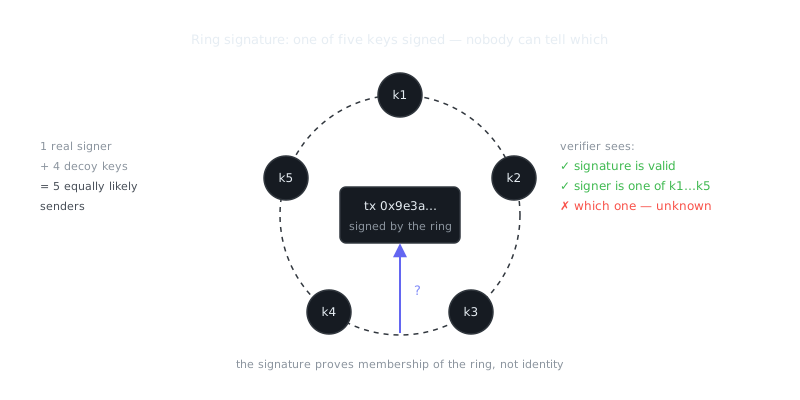
Monero is the strongest default-privacy option. Ring signatures obscure the sender by grouping a real transaction with decoy inputs. Stealth addresses ensure the recipient's address never appears on-chain. RingCT hides transaction amounts. You don't have to opt into any of this — it's on by default.
CoinJoin and Transaction Mixing
If you want better Bitcoin privacy without switching currencies, CoinJoin is the main option. It works by combining multiple users' transactions into a single transaction, making it harder to trace which input corresponds to which output.
Three main implementations exist. Wasabi Wallet has built-in CoinJoin coordination using the WabiSabi protocol. JoinMarket is a decentralized CoinJoin market where users can participate as makers or takers. Whirlpool, part of Samourai Wallet, uses pool-based mixing with uniform UTXO outputs.
The key limitation: mixing obscures but doesn't eliminate chain analysis. Sophisticated heuristics can sometimes de-anonymize mixed coins, especially if you're careless about how you spend the outputs afterward.
Network-Level Anonymity
Paying with a privacy-focused cryptocurrency means nothing if your IP address gets logged when you broadcast the transaction. Network anonymity isn't optional — it's a prerequisite.
Using Tor
Tor routes your traffic through three encrypted relays, hiding your IP from the destination server. For cryptocurrency transactions, routing your wallet through Tor prevents your IP from being associated with your wallet address.
# Install Tor on Debian/Ubuntu
sudo apt install tor

# Start the Tor service
sudo systemctl start tor

# Verify Tor is running on SOCKS5 port 9050
ss -tlnp | grep 9050

# Configure a CLI wallet to use Tor (example: monero-wallet-cli)
monero-wallet-cli --proxy 127.0.0.1:9050
For Bitcoin, running your own full node over Tor prevents any third-party node from logging your transaction alongside your IP.
# bitcoin.conf: route Bitcoin Core through Tor
proxy=127.0.0.1:9050
bind=127.0.0.1
onlynet=onion
listen=1
Don't substitute a VPN for Tor. A VPN provider can log your traffic and is subject to legal requests. Tor's layered architecture means no single relay knows both who you are and what you're doing. That's a fundamentally different security model.
Practical Anonymous Payment Workflows
Theory only gets you so far. Here's how this actually looks in practice.
Workflow 1: Anonymous Online Purchase
- Acquire Monero without KYC — use a peer-to-peer exchange like LocalMonero or a no-KYC instant exchange. Pay with cash if possible.
- Transfer XMR to a wallet you control, running over Tor.
- Find a merchant that accepts Monero directly, or use a gift card service that accepts XMR.
- Use a Tor Browser session with JavaScript disabled to make the purchase. This prevents browser fingerprinting from linking the session to your regular identity.
- Ship to a pickup point — a PO box or package locker — rather than your home address.
Workflow 2: Anonymous Recurring Payments
For subscriptions or services requiring repeated payments:
- Use a privacy-focused email like Proton Mail or Tutanota, created over Tor with no personal details.
- Pay with Monero each billing cycle from a freshly generated subaddress. Monero subaddresses are unlinkable to each other from any external observer.
- For account communications, use encrypted messaging. Signal provides strong metadata resistance. Session goes further by removing the phone number requirement entirely, which makes it better suited to anonymous account registration.
Operational Security Mistakes That Undermine Anonymity
Technical tools fail when your habits don't match them. These are the mistakes that actually get people.
Reusing addresses. Every reused Bitcoin or Ethereum address is a link analysts can follow. Generate a new address for every transaction.
KYC leakage. If you deposit privacy coins to a KYC exchange and then withdraw to a "clean" wallet, that exchange has just linked your identity to the withdrawal address. The on-chain history follows the coins regardless of any mixing that happened beforehand.
Timing correlation. Receive a payment and immediately spend it, and timing analysis can link those two transactions — even on Monero. Introduce delays between receiving and spending.
Device hygiene. Using your anonymous wallet on a device that's also logged into your Google account, tied to your real phone number, or connected to your home Wi-Fi collapses the identity layer completely. Use a dedicated device or a live OS like Tails for sensitive transactions.
Metadata in communication. Even if a payment is anonymous, discussing it over a non-private channel lets someone reconstruct the context. Use encrypted messaging and avoid talking about sensitive transactions over email or SMS.
Key Takeaways
Anonymous payments aren't a single tool — they're a stack of practices that address identity, network, and ledger exposure at the same time. A privacy coin without Tor still exposes your IP. Tor without a privacy coin still leaves a public transaction record. Neither matters if you use a KYC exchange as your entry or exit point.
“The Internet is a surveillance state.”
— Bruce Schneier
Cash is the strongest option for in-person transactions and has no digital equivalent for simplicity. Online, that same level of privacy requires layering Monero, Tor, and careful operational habits together. Skip any one layer and the others don't fully protect you.
Frequently Asked Questions
What is the easiest way to make anonymous payments online?
The most accessible options for beginners are privacy-focused cryptocurrencies like Monero, or prepaid debit cards purchased with cash. These methods reduce the personal information tied to your transactions compared to credit cards or bank transfers.
Can I use a regular credit card anonymously?
No, standard credit and debit cards are directly linked to your identity through your bank and billing address. Every transaction is logged and can be traced back to you, making them unsuitable for anonymous payments.
Is using cash the most private payment method?
Cash is one of the most private options for in-person transactions since it leaves no digital trail tied to your identity. However, for online purchases you'll need digital alternatives like prepaid cards or privacy-focused crypto, since cash isn't accepted online.
Video Resources
Sources & Further Reading
- Tor Project — Official site of the Tor network and Tor Browser.
- Tor Browser Manual — Setup, security levels, bridges and troubleshooting.
- EFF Surveillance Self-Defense — Threat-model based guides from the Electronic Frontier Foundation.
- Privacy Guides — Independent recommendations for privacy-respecting tools.
- Security in a Box — Digital security guides for activists and journalists.
- Tails Documentation — Official documentation for the amnesic live operating system.
- Whonix Documentation — Wiki for the Tor-based Whonix operating system.