Privacy Coins: A Technical Comparison of Anonymity Features
Not all privacy coins are equal. This guide breaks down the cryptographic techniques behind leading privacy coins — from ring signatures to zero-knowledge proofs — so you can evaluate them against your actual threat model. Learn which coin fits your privacy needs and why the implementation details matter.
On this page
Privacy Coins: A Technical Comparison Guide
Privacy coins are cryptocurrencies built to hide what Bitcoin and Ethereum expose by default: who sent money, who received it, and how much changed hands. On a transparent blockchain, every transaction is permanently recorded and publicly inspectable. Privacy coins use cryptographic techniques to break those links. Understanding them requires the same mindset as privacy threat modeling — you figure out who your adversaries are, what data you're protecting, and which tools actually match your risk level.
This guide compares the leading privacy coins by their underlying technology, practical tradeoffs, and real-world use cases.
The Problem with Transparent Blockchains
Bitcoin's ledger is pseudonymous, not anonymous. Chain analysis firms like Chainalysis and Elliptic have built entire businesses around de-anonymizing Bitcoin users by clustering addresses, tracing flows through exchanges, and correlating on-chain data with off-chain identifiers. It's a mature industry, and it works.
Think of it like browser fingerprinting. Just as a browser leaks device attributes that can uniquely identify you without cookies, Bitcoin leaks transaction patterns that uniquely identify spending behavior. Privacy coins were built to close those gaps.
The Major Privacy Coins
Monero (XMR)
Monero is the most widely adopted privacy-by-default coin, and it gets there by combining three cryptographic mechanisms.
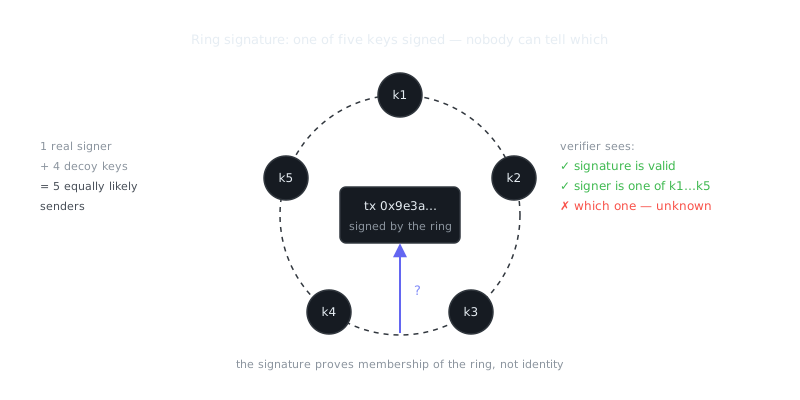
Ring signatures mix a user's transaction input with a ring of decoy inputs, making it statistically hard to identify the real sender. Stealth addresses generate a one-time address for every transaction, so the receiver's public address never appears on-chain. RingCT (Ring Confidential Transactions) hides transaction amounts using Pedersen commitments.
Since Monero 0.13, RingCT is mandatory. Every transaction uses all three mechanisms — there's no opt-out. That's a deliberate design choice worth understanding. Optional privacy tends to fail because the small anonymity set of privacy-using transactions makes those users more conspicuous, not less.
What does this look like in practice? An exchange operator receiving Monero can't determine whether a deposit came from a single wallet or was aggregated from 20. The amount is hidden, and the sender's address is unlinkable.
Zcash (ZEC)
Zcash uses zk-SNARKs — zero-knowledge succinct non-interactive arguments of knowledge — a proof system that lets one party prove knowledge of something without revealing the thing itself. Cryptographically, it's impressive. Practically, its deployment has been messier.
Zcash has two address types. Transparent addresses behave like Bitcoin — fully visible on-chain. Shielded addresses encrypt transactions so only the sender and receiver can see details. The problem is that most Zcash transactions historically used transparent addresses, which dramatically shrinks the anonymity set for anyone using shielded ones.
The Sapling and Orchard upgrades improved shielded usage, but the split still leaves Zcash's privacy weaker than Monero's in practice.
Where Zcash has a real advantage is viewing keys. These let you grant selective access to your transaction history — useful for a regulated business that needs to stay auditable without exposing everything publicly. A company can share its viewing key with auditors while keeping transactions private from everyone else.
Dash (DASH)
Dash's privacy feature, PrivateSend, is a CoinJoin-based mixing service. CoinJoin combines multiple users' transactions into one, obscuring the input-output mapping. It works at a surface level, but it's a coordination mechanism, not a cryptographic primitive.
“Privacy is not something that I'm merely entitled to, it's an absolute prerequisite.”
— Marlon Brando
A well-resourced adversary who controls mixing nodes or runs statistical analysis on transaction graphs can partially de-anonymize it. Dash is more accurately described as a coin with optional privacy features than a true privacy coin. It's not in the same category as Monero or Zcash for serious threat models.
Grin and Beam (MimbleWimble)
Both Grin and Beam implement MimbleWimble, a protocol that eliminates transaction scripts entirely and uses Confidential Transactions combined with "cut-through" to compress blockchain history. Inputs and outputs are blinded using Pedersen commitments, and spent outputs get removed from the UTXO set, keeping the chain compact.
MimbleWimble handles amount confidentiality well and produces a lean chain, but researchers have demonstrated that transaction graphs can be reconstructed by monitoring the mempool at broadcast time. The protocol obscures history, but leaks information during propagation. That's an important distinction depending on your threat model.
Technical Comparison
| Feature | Monero | Zcash | Dash | Grin/Beam |
|---|---|---|---|---|
| Privacy model | Ring sigs + stealth + RingCT | zk-SNARKs | CoinJoin (PrivateSend) | MimbleWimble |
| Privacy by default | Yes | No (optional) | No (optional) | Yes |
| Amount hiding | Yes (RingCT) | Yes (shielded) | No | Yes |
| Sender hiding | Yes (ring signatures) | Yes (shielded) | Partial | Partial |
| Receiver hiding | Yes (stealth addresses) | Yes (shielded) | No | Yes |
| Auditability | View keys (limited) | Viewing keys | On-chain | No |
| Scalability impact | High (larger tx size) | High (proving time) | Low | Low (cut-through) |
| Regulatory risk | High | Medium | Low | Medium |
| Active development | Very active | Active | Moderate | Moderate |
How zk-SNARKs Actually Work
A zk-SNARK lets a prover convince a verifier that something is true — say, "this transaction is valid and the sender has sufficient funds" — without revealing the transaction details. The proof is succinct (small, fast to verify), non-interactive (no back-and-forth required), and zero-knowledge (the verifier learns nothing beyond the truth of the statement).
One historical concern with Zcash was its trusted setup, called "the ceremony," used to generate public parameters. A compromise during setup could allow undetectable money creation. The Sapling and Orchard upgrades use Groth16 and PLONK-based constructions with improved ceremony designs, which significantly reduced but didn't fully eliminate that risk. It's worth knowing about if you're evaluating Zcash for high-stakes use.
Real-World Threat Models
Which privacy coin is right for you depends entirely on who you're protecting yourself from. This is the same reasoning that applies when choosing between a VPN and Tor — different tools, different adversaries.
Someone in a country with capital controls who needs to move savings without government surveillance should use Monero. Its mandatory, strong privacy is appropriate against a state-level adversary. Zcash could work if you're disciplined about using shielded addresses exclusively, but that discipline is easy to break. Dash's CoinJoin isn't close to sufficient in this scenario.
A business accepting crypto is a different story. If you need transaction privacy for competitive reasons but must stay auditable for tax purposes, Zcash's viewing keys are genuinely useful here. Monero's view key support covers income but doesn't expose the full transaction graph, which makes accounting integration significantly harder.
A developer building a privacy-preserving micropayment system has different priorities again. Low fees and fast confirmation matter more than bulletproof sender anonymity. Grin's lightweight chain and MimbleWimble's cut-through compression make it more scalable for that use case, and if you can accept the weaker propagation-time privacy, the tradeoff is reasonable.
Then there's the exchange question. Most regulated exchanges have delisted or restricted privacy coins to comply with FATF travel rule requirements. Monero is off Binance, and Kraken has removed it in several jurisdictions. Zcash retains more exchange support because transparent addresses give compliance teams something to work with. That affects liquidity in ways that matter just as much as the cryptography when you're trying to actually use these assets.
The Regulatory Reality
Regulatory pressure on privacy coins has intensified since 2020. FATF guidance requires virtual asset service providers to collect sender and receiver information — a requirement that's structurally incompatible with Monero's design. Japan and South Korea have effectively banned privacy coin trading on domestic exchanges. The EU's MiCA regulation creates compliance burdens for any asset where transaction tracing is impossible.
Holding privacy coins remains legal in most jurisdictions, but the on/off ramps are shrinking. If you're relying on a privacy coin for legitimate financial privacy, liquidity risk needs to sit alongside technical capability in your evaluation. A coin with perfect cryptography that you can't convert when you need to isn't a complete solution.
Frequently Asked Questions
What is a privacy coin and how is it different from Bitcoin?
A privacy coin is a cryptocurrency designed to hide transaction details like sender, receiver, and amount from public view. Unlike Bitcoin, where all transactions are visible on a public blockchain, privacy coins use techniques like encryption and obfuscation to keep that data confidential.
What are the most popular privacy coins and what makes each one unique?
The most well-known privacy coins are Monero (XMR), Zcash (ZEC), and Dash (DASH). Monero hides all transaction data by default, Zcash offers optional privacy using a technology called zk-SNARKs, and Dash provides a privacy feature called CoinJoin that mixes transactions to obscure their origin.
Are privacy coins legal to use?
In most countries privacy coins are legal to own and use, but regulations vary and some exchanges have delisted them due to compliance concerns. Countries like Japan and South Korea have banned them on regulated exchanges, so it's worth checking the rules in your specific region before buying.
Video Resources
Sources & Further Reading
- Monero Documentation — Official Monero user guides and privacy explanations.
- Tor Project — Official site of the Tor network and Tor Browser.
- Tor Browser Manual — Setup, security levels, bridges and troubleshooting.
- EFF Surveillance Self-Defense — Threat-model based guides from the Electronic Frontier Foundation.
- Privacy Guides — Independent recommendations for privacy-respecting tools.
- Security in a Box — Digital security guides for activists and journalists.
- Tails Documentation — Official documentation for the amnesic live operating system.