Position Sizing Strategies: Managing Risk and Capital Allocation
Position sizing determines how much capital you risk on each trade—and it's the difference between consistent profits and blown accounts. Even traders with winning strategies fail without disciplined allocation. Learn the core methods that protect your capital while maximizing returns.
On this page
Position sizing determines how much capital you allocate to each trade. This one concept separates profitable traders from those who blow up accounts despite having solid strategies. A trader with a 60% win rate can still lose everything with poor position sizing, while someone winning only 40% of the time can stay profitable through disciplined capital allocation.
Position sizing directly impacts your risk per trade, portfolio volatility, and ability to survive losing streaks. It answers the question: how many shares, contracts, or lots should you trade — not just whether to enter a position.
Fixed Dollar Amount Method
The simplest approach puts the same dollar amount into every trade, no matter the stop loss distance or how volatile the asset is. You might decide to risk $500 on every position, full stop.
It's easy to calculate and keeps your dollar risk consistent across all trades. No formulas needed. The problem is it ignores everything else. It doesn't account for where your stop is placed or how wildly different two assets can behave. Risking $500 on a stable blue-chip stock versus a volatile small-cap creates dramatically different real-world exposure, even if the dollar amount looks identical on paper.
This method works fine for beginners trading similar assets, but it breaks down quickly once you start mixing instruments with different volatility profiles.
Fixed Percentage Risk Model
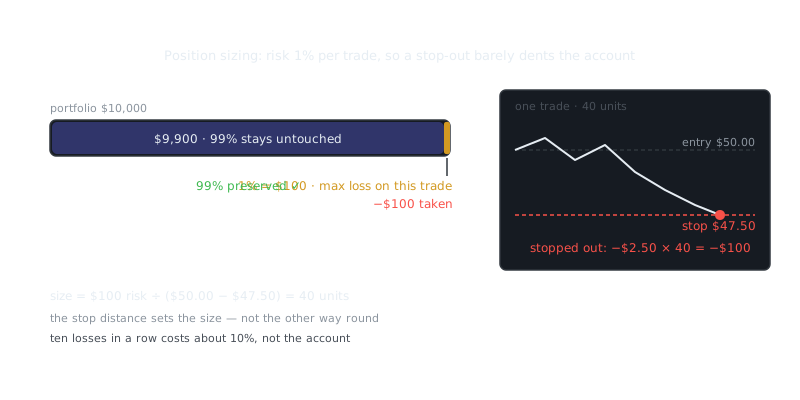
This is the method most serious traders use. You risk a fixed percentage of your account equity on each trade, typically 1-2%. With a $50,000 account and a 1% rule, you're risking $500 per trade regardless of how many shares that translates to.
The math is straightforward:
Risk Amount = Account Size × Risk Percentage
Position Size = Risk Amount ÷ (Entry Price - Stop Loss Price)
Walk through a quick example. You have a $50,000 account, you're risking 1% ($500), your entry is $100, and your stop is at $95. That's $5 of risk per share. Divide $500 by $5 and you get 100 shares.
What makes this method powerful is that it scales automatically. Your position sizes shrink during drawdowns and grow as your account builds. It also forces you to think about stop placement before sizing your trade, which is the right order to think about things. You're not arbitrarily picking a number — your stop loss distance and account size do the math for you.
Volatility-Based Position Sizing
Once you're trading multiple assets, fixed percentage alone doesn't tell the whole story. A 1% risk on a sleepy utility stock and a 1% risk on a meme stock feel very different in practice. Volatility-based sizing solves that.
This method uses Average True Range (ATR) to measure how much an asset actually moves, then adjusts your position size accordingly. More volatile assets get smaller positions; stable assets allow larger ones.
The formula looks like this:
Position Size = (Account Size × Risk %) ÷ (ATR × Multiplier)The multiplier, usually 2 to 3, determines how many ATRs away you set your stop.
Here's a concrete example. You have a $100,000 account, you're risking 1.5% ($1,500), the stock trades at $50, and its 14-day ATR is $2.50. With a 2x multiplier, your stop sits $5 away. That gives you 300 shares.
Now take the same setup but with a stock that has a $5 ATR. Your stop is now $10 away, and you'd only take 150 shares. Same dollar risk, but the volatile stock automatically gets a smaller position. That's the whole point.
Kelly Criterion
The Kelly Criterion takes a different approach entirely — it calculates the mathematically optimal position size based on your win rate and risk-reward ratio.
Kelly % = ((Win Rate × Average Win) - (Loss Rate × Average Loss)) ÷ Average WinSay you win 55% of your trades, your average winner is $400, and your average loser is $200. Kelly suggests risking about 32.5% of your account per trade.
That number tends to shock people, and for good reason. Full Kelly creates stomach-churning drawdowns even when your edge is real. Most traders who use Kelly at all cut it in half or use a quarter of it. Half-Kelly dramatically reduces volatility while still capturing most of the mathematical benefit.
“Cut your losses short and let your profits run.”
— Jesse Livermore
The deeper issue is that Kelly is highly sensitive to your input estimates. If your win rate or average win/loss figures are off — and they usually are to some degree over small sample sizes — your Kelly percentage can be wildly inaccurate. Treat it as a ceiling, not a target.
Position Sizing by Market Condition
Good traders don't use the same position size in every market environment. They adjust based on what's happening around them.
Scaling During Drawdowns
When you're in a losing streak, your instinct might be to trade bigger to recover faster. That instinct will wreck you. Do the opposite. After 3 consecutive losses, drop to 75% of your normal size. After 5 losses, cut to 50%. Return to normal sizing only after you string together 2 consecutive wins. This isn't about psychology — it's about protecting your capital base while you're underperforming.
Market Volatility Adjustments
When the VIX spikes above 30, markets are gapping, or major news is hitting, reduce your position sizes by 30-50%. Stop losses that would hold in normal conditions get blown through in chaotic markets. Smaller size means a bad gap hurts less.
Correlation Considerations
Five tech stock positions aren't five independent risks. They're largely one big tech bet. When you're holding correlated positions, the individual sizing has to reflect that reality:
Adjusted Position Size = Base Size × (1 / √Number of Correlated Positions)Running five correlated positions? Each one gets about 45% of what you'd normally take. Your total sector exposure stays sane even as you hold multiple names.
Position Sizing Comparison
| Method | Complexity | Best For | Key Advantage | Main Limitation |
|---|---|---|---|---|
| Fixed Dollar | Low | Beginners, single asset | Simplicity | Ignores varying risk |
| Fixed Percentage | Medium | Most traders | Scales with account | Requires stop loss calculation |
| Volatility-Based | High | Multi-asset portfolios | Adjusts for volatility | Needs ATR data |
| Kelly Criterion | High | Statistical traders | Mathematically optimal | Can be aggressive |
| Market-Adaptive | High | Experienced traders | Responds to conditions | Requires judgment |
Integration with Order Types
Calculating your position size is only half the job. You still need to execute it cleanly.
Market orders fill your calculated size immediately, but large positions in illiquid stocks can suffer serious slippage. If you're taking 1,000 shares of a thinly traded name, consider breaking it into several limit orders rather than hitting the market all at once.
Limit orders let you define your entry precisely, though you risk missing the trade entirely if price doesn't reach your level. Use them when your position sizing gives you some flexibility on entry — if you've determined you can enter anywhere between $49.50 and $50.50, a limit at $50 makes sense.
One rule worth treating as non-negotiable: once you've calculated 500 shares based on a $2 stop, you can't then decide to "give it more room" with a $3 stop. That changes your actual risk to $1,500 when you planned for $1,000. Your stop placement drives the position size calculation — they're not independent decisions.
Practical Implementation
Here's the process in order:
- Set your account risk percentage (1-2% to start)
- Calculate your dollar risk amount
- Identify your entry price and stop loss location based on the chart
- Calculate risk per share or contract
- Divide dollar risk by risk per share
- Apply volatility adjustments if you're using that method
- Round down to the nearest tradeable unit
- Confirm the total position value fits within your portfolio constraints
A few mistakes that consistently hurt traders: sizing up after losses to recover faster, risking more on "high conviction" trades, calculating your size but forgetting to actually place the stop, and ignoring commissions when trading small accounts where they eat meaningfully into returns. The worst one is sizing based on how much you want to make rather than how much you're willing to lose.
Key Takeaways
Position sizing determines whether you survive long enough to let your edge play out. The method you pick matters less than applying it consistently. A mediocre sizing approach followed religiously beats perfect math applied whenever it's convenient.
The core principles don't change regardless of which method you use. Never risk more than 1-2% of capital on a single trade. Your stop loss distance and account size should drive position size, not gut feel. Volatile assets need smaller positions to carry equivalent risk. Scale down during losing streaks and high-volatility markets. And account for correlation when you're holding multiple positions at once.
If you're new to this, start with the fixed percentage model. It's not flashy, but it works and it's easy to apply. As you build experience, layer in volatility adjustments and market-adaptive scaling. Keep tracking your drawdowns — if you're consistently losing more than 20% despite following a strategy with real edge, your sizing is the first thing to examine.
You can't control whether any single trade wins or loses. What you can control is how much you put at risk each time. That's where durable trading accounts are built.
Frequently Asked Questions
How much of my account should I risk on a single trade?
Most experienced traders recommend risking no more than 1-2% of your total account balance on any single trade. This means if you have a $10,000 account, you'd risk $100-$200 per trade, which protects you from wiping out your account during a losing streak.
What is a position size and how do I calculate it?
A position size is the number of shares, contracts, or units you buy or sell in a single trade. You calculate it by dividing the dollar amount you're willing to risk by the distance between your entry price and your stop-loss price — for example, risking $100 with a $5 stop-loss means buying 20 shares.
Should I use the same position size for every trade?
Not necessarily — many traders adjust their position size based on how confident they are in a setup or how volatile the asset is. A common approach is to trade smaller when volatility is high or when a setup is less certain, and larger when conditions are more favorable.
Video Resources
Sources & Further Reading
- CFTC: Learn & Protect — Regulator's plain-language warnings about leverage and fraud.
- Investopedia — Reference definitions and explainers for markets and trading.
- Investopedia: Technical Analysis — Indicator-by-indicator guides with worked examples.
- TradingView — Charting platform with community education and indicator scripts.
- CoinGecko — Price history, volume and market capitalisation data.
- BabyPips School — Free structured course on chart reading and risk management.
- Glassnode Academy — On-chain metrics explained, from active addresses to realised cap.