Proof of Work vs Proof of Stake: Which Consensus Mechanism Wins?
Blockchain networks rely on consensus mechanisms to validate transactions without a central authority. Proof of Work and Proof of Stake take fundamentally different approaches to that problem. Here's what sets them apart and why it matters for investors and developers alike.
Try it: change one character and watch the chain break
Each block stores the hash of the previous one. Edit any block's data: its hash changes, so every later block no longer matches and turns red.
0000…0000…0000…0000…0000…0000…0000…0000…On this page
Blockchain networks have no central authority to validate transactions. Instead, they rely on consensus mechanisms — rules that determine how participants agree on the state of the ledger. The two dominant approaches are Proof of Work (PoW) and Proof of Stake (PoS). Whether you're building on a blockchain, managing a crypto portfolio, or just trying to understand why Ethereum and Bitcoin behave so differently, knowing the distinction matters.
What Is Proof of Work?
Proof of Work launched with Bitcoin in 2009 and still underpins the world's largest cryptocurrency network. The core idea is simple: to add a new block to the chain, a participant (called a miner) must solve a computationally expensive puzzle. Solving it proves that real-world resources — electricity and processing power — were actually spent.
How the Puzzle Works
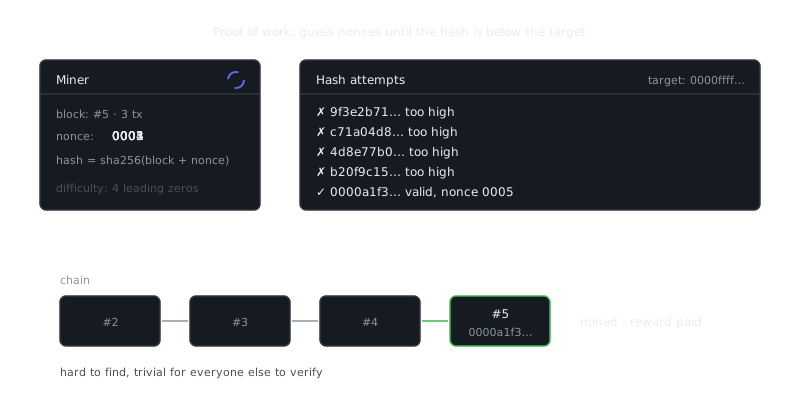
The puzzle involves finding a number called a nonce that, when combined with the block's data and run through a hash function, produces a result below a specific target value. Bitcoin uses SHA-256.
Block data + Nonce → SHA-256 → Hash

Target: 0000000000000000000abc123...
Because SHA-256 is one-way, there's no shortcut. Miners try billions of nonce values per second until one produces a valid hash. The difficulty adjusts automatically so a new block appears roughly every 10 minutes, regardless of how much total hash rate the network has.
Real-World PoW Example
Bitcoin mining today requires specialized hardware called ASICs (Application-Specific Integrated Circuits). A single ASIC miner can perform around 100 terahashes per second, and large mining operations consume as much electricity as some small countries. That's both PoW's greatest strength and its most criticized weakness. The energy expenditure is exactly what makes attacks expensive — rewriting the chain means outspending everyone else combined.
What Is Proof of Stake?
Proof of Stake replaces computational work with financial commitment. Instead of burning electricity, validators lock up (stake) cryptocurrency as collateral. The network selects validators to propose and confirm new blocks, weighted by how much they've staked. Behave dishonestly, and your stake gets slashed — partially destroyed as a penalty.
Ethereum completed its transition from PoW to PoS in September 2022, an event called "The Merge." Its PoS implementation, called Gasper, requires validators to stake a minimum of 32 ETH.
How Validator Selection Works
Different PoS implementations handle selection differently, but the general pattern looks like this:
Validator set → Random selection (weighted by stake)
             → Propose block
             → Committee of validators attests
             → Block finalized after supermajority attestation
Randomness is critical here. Ethereum uses RANDAO, a commit-reveal scheme where validators contribute randomness each epoch to prevent anyone from predicting or manipulating who gets selected next.
Delegated and Liquid Staking
Not everyone can afford to run a validator. Delegated Proof of Stake (DPoS), used by networks like EOS and Tron, lets token holders vote for a smaller set of delegates who handle the actual validation. Liquid staking protocols like Lido take a different approach — stake any amount of ETH and you'll receive a liquid token (stETH) in return, which you can use elsewhere in DeFi. For anyone thinking about crypto portfolio management, this is worth knowing: staking yields have become a meaningful source of returns for long-term holders.
Head-to-Head Comparison
| Feature | Proof of Work | Proof of Stake |
|---|---|---|
| Security model | Computational cost | Economic stake at risk |
| Energy use | Very high | Very low (~99% less than PoW) |
| Hardware required | Specialized ASICs / GPUs | Standard server hardware |
| Attack cost | Must control 51% of hash rate | Must control 33–51% of staked supply |
| Decentralization risk | Mining pool centralization | Stake concentration |
| Finality | Probabilistic (more blocks = safer) | Economic finality in minutes |
| Block rewards | Newly minted coins + fees | Fees + newly minted coins |
| Notable networks | Bitcoin, Litecoin, Monero | Ethereum, Cardano, Solana, Avalanche |
Security Tradeoffs
Neither mechanism is objectively more secure. They just face different attack vectors.
51% Attacks on PoW
A PoW network becomes vulnerable when a single entity controls more than half the hash rate. Smaller PoW networks are especially exposed — Ethereum Classic has suffered multiple 51% attacks because its hash rate is low enough that renting the necessary hash power is actually affordable. Bitcoin's scale makes this economically impractical, though not theoretically impossible.
Long-Range and Nothing-at-Stake Attacks on PoS
PoS has its own attack surface. In a "nothing-at-stake" scenario, validators could theoretically vote on multiple competing forks at no cost. Modern PoS implementations solve this with slashing: sign two conflicting blocks and you lose a chunk of your stake. Long-range attacks — where an attacker tries to rewrite history from far in the past — get addressed through checkpointing and weak subjectivity.
“Blockchain is to trust what the internet was to communication.”
— Unknown
The Role of Anonymity and Network Participation
How participants interact with these networks also matters for security. A validator's identity is pseudonymous, but their staking address is public and fully traceable on-chain. This is one reason users sometimes explore options covered in resources like a buying crypto anonymously guide — the transparency of on-chain activity means acquiring stake without revealing your identity requires deliberate effort.
Environmental Impact
The energy conversation around crypto is driven almost entirely by PoW. Bitcoin's annualized energy consumption sits at an estimated 120–150 TWh, comparable to Argentina's entire electricity usage. That's triggered regulatory scrutiny across multiple jurisdictions and pushed institutional investors to question ESG compliance.
Ethereum's move to PoS cut its energy consumption by roughly 99.95%, dropping from about 83 TWh per year to under 0.01 TWh. That shift changed the calculus for a lot of applications built on Ethereum, including NFTs. The environmental criticism that once followed NFT marketplaces around largely disappeared after The Merge. If you're exploring NFTs explained for beginners, understanding that most NFT activity now runs on PoS chains is a foundational point worth internalizing early.
Choosing the Right Mechanism for a Network
From a design perspective, the choice between PoW and PoS comes down to clear tradeoffs.
PoW makes sense when censorship resistance is the primary concern, when you want security that doesn't depend on existing wealth distribution, or when the network is bootstrapping without a pre-existing group of wealthy stakeholders.
PoS makes more sense when energy efficiency is a priority, when you need faster transactions with economic finality, or when the network already has a token distribution that can form a working validator set.
Newer consensus variants like Proof of Space-Time (Chia), Proof of Authority (private chains), and Proof of History (Solana's clock mechanism layered under PoS) represent continued experimentation. None have displaced PoW or PoS as the dominant models for public blockchains.
Summary and Key Takeaways
Proof of Work and Proof of Stake solve the same problem — trustless consensus without a central authority — using fundamentally different resources. PoW spends energy to make attacks expensive. PoS locks capital to make attacks economically self-defeating.
A few things worth keeping in mind:
Bitcoin uses PoW and has no plans to change. Its security model depends entirely on the cumulative cost of mining. Ethereum has used PoS since The Merge in 2022, achieving near-identical security at a fraction of the energy. PoS introduces new attack vectors — nothing-at-stake, long-range attacks — that get mitigated through slashing and checkpointing. Liquid staking and delegated staking have made PoS participation accessible without running dedicated validator hardware. And for investors and developers alike, understanding consensus mechanisms explains why networks differ in speed, cost, security assumptions, and long-term sustainability.
The consensus mechanism isn't a minor implementation detail. It defines a network's incentive structure, its attack surface, and ultimately its credibility as a store of value or settlement layer.
Frequently Asked Questions
What is the difference between Proof of Work and Proof of Stake?
Proof of Work requires miners to solve complex mathematical puzzles using computing power to validate transactions and earn rewards. Proof of Stake instead selects validators based on how much cryptocurrency they 'stake' or lock up as collateral, making it far less energy-intensive.
Which one uses less energy, Proof of Work or Proof of Stake?
Proof of Stake uses significantly less energy because it doesn't rely on massive computational effort to secure the network. Ethereum's switch from Proof of Work to Proof of Stake in 2022 reduced its energy consumption by roughly 99.95%.
Is Proof of Stake more secure than Proof of Work?
Both systems have strong but different security models. Proof of Work is considered battle-tested since Bitcoin has used it for over 15 years, while Proof of Stake secures the network by making attacks financially costly — an attacker would need to own a large portion of the staked cryptocurrency to gain control.
Video Resources
Sources & Further Reading
- Bitcoin Whitepaper — Satoshi Nakamoto's original nine-page design of Bitcoin.
- Bitcoin Wiki — Long-running technical wiki covering protocol details.
- Mastering Bitcoin (open book) — Andreas Antonopoulos's free technical book on how Bitcoin works.
- Ethereum.org — Official Ethereum documentation and learning hub.
- Lido Docs — Liquid staking protocol documentation.
- Bitcoin.org — Community-maintained introduction, wallet guidance and developer docs.
- CoinGecko — Market data, exchange listings and asset profiles.