DeFi for Beginners: A Plain-English Guide to Decentralized Finance
Decentralized Finance (DeFi) is reshaping financial services by replacing banks and brokers with blockchain-powered smart contracts. Anyone with an internet connection can access lending, borrowing, and trading — no approval required. This guide breaks down how DeFi works and what it means for everyday users.
On this page
Decentralized Finance, or DeFi, is a fundamental shift in how financial services work. Instead of banks, brokers, and exchanges sitting in the middle of every transaction, DeFi uses smart contracts on blockchain networks to automate the whole thing. Anyone with an internet connection can access lending, borrowing, trading, and investment services without asking permission from anyone.
The total value locked in DeFi protocols grew from practically nothing in 2019 to tens of billions of dollars. That kind of growth doesn't happen by accident. It reflects real demand for financial services that are transparent, accessible, and hard to censor. Understanding how DeFi actually works helps you decide whether it fits your needs — and your risk tolerance.
What Makes DeFi Different from Traditional Finance
Traditional finance runs on institutions. When you deposit money in a bank, the bank holds your funds and tracks your balance in their own database. When you trade stocks, a broker executes the order and a clearinghouse settles it days later. Every intermediary in that chain takes a cut and keeps control over your assets.
DeFi cuts out those intermediaries by encoding financial logic directly into smart contracts. These are self-executing programs that live on blockchain networks like Ethereum. When the right conditions are met, the contract executes automatically — no human required. You keep your assets in a wallet you control, and transactions settle in minutes instead of days.
That architecture leads to some real, practical differences worth knowing.
Custody and control: You hold your assets in a non-custodial wallet. No institution can freeze your account or block you from your own funds. The tradeoff is that you're entirely responsible for securing your private keys. Lose them, and your funds are gone for good.
Transparency: Every transaction and every line of smart contract code is visible on the blockchain. You can verify exactly how a protocol works and check its financial state in real time. Traditional finance doesn't give you that — it runs on internal systems you can't see.
Accessibility: DeFi protocols are permissionless. No minimum balance, no credit check, no identity verification. The same interface works in New York and Lagos. The main constraint is internet access and the know-how to use it without making expensive mistakes.
Composability: DeFi protocols connect like building blocks. You can borrow funds from one protocol, trade them on another, and earn yield on a third — all inside a single transaction. Pulling that off in traditional finance would require multiple institutions, days of settlement, and a lot of paperwork.
Core DeFi Services and How They Work
DeFi recreates most traditional financial services using smart contracts. The three foundational categories are trading, lending, and yield generation.
Decentralized Exchanges
A decentralized exchange (DEX) lets you trade cryptocurrencies without an intermediary holding your funds. Two main models exist: order book DEXs and automated market makers (AMMs).
Order book DEXs work similarly to traditional exchanges, matching buyers with sellers. Liquidity tends to be fragmented across chains though, which is why AMMs have become far more popular.
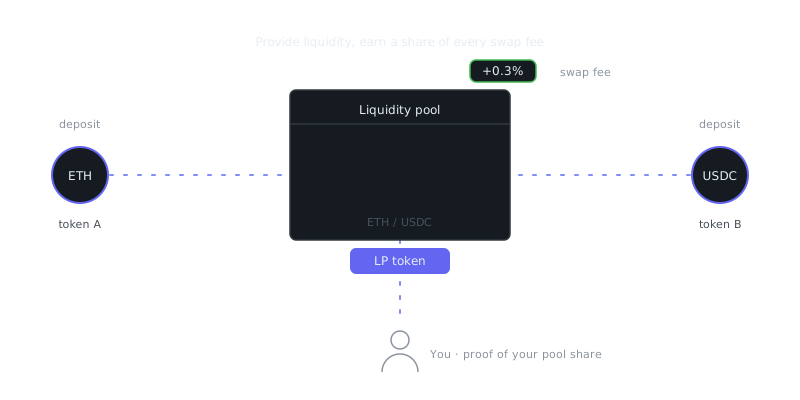
AMMs like Uniswap and Curve use liquidity pools instead of order books. Users deposit pairs of tokens into a pool, and a mathematical formula sets the exchange rate based on the ratio of tokens in that pool. When you trade, you're swapping with the pool itself, not another person.
Here's a concrete example. A Uniswap ETH/USDC pool might hold 100 ETH and 200,000 USDC. The constant product formula (x × y = k) keeps it in balance. If you buy 1 ETH, you're adding USDC to the pool and removing ETH, which nudges the price of remaining ETH upward. That automatic price adjustment is what creates "slippage" on large trades.
“Smart contracts will replace lawyers.”
— Andreas Antonopoulos
The upside is instant liquidity — no waiting for a matching order. The downside is that large trades cost you more in effective price compared to a deep order book market.
Lending and Borrowing in DeFi
DeFi lending protocols like Aave and Compound create money markets where you can lend assets to earn interest or borrow assets by putting up collateral. Smart contracts handle everything automatically.
When you deposit USDC into Aave, the protocol mints aUSDC tokens representing your deposit plus the interest you're earning. Other users can borrow your USDC by depositing collateral worth more than they want to borrow. Put up $15,000 in ETH and you might be able to borrow up to $10,000 in USDC, depending on the collateralization ratio.
Interest rates adjust algorithmically based on demand. When more people borrow USDC, rates climb to pull in more deposits. When borrowing drops off, rates fall. No credit committee, no quarterly rate decision — it just happens.
If your collateral value drops below the required ratio, your position gets liquidated. Liquidators are third parties who repay part of your loan in exchange for your collateral at a discount. It's an automated system that protects lenders from defaults without anyone having to manually intervene.
The overcollateralization requirement is what makes DeFi lending fundamentally different from a traditional loan. You can't borrow more than you already have, which limits leverage but eliminates credit risk for lenders entirely. That's why there's no credit check — the collateral guarantees repayment.
Yield Farming Strategies
Yield farming means moving assets between DeFi protocols to maximize returns. The core mechanic is liquidity mining, where protocols reward users who provide liquidity with governance tokens.
A straightforward yield farming strategy might look like this:
- Deposit USDC and ETH into a Uniswap liquidity pool
- Receive LP (liquidity provider) tokens representing your share
- Stake those LP tokens in a yield farm to earn additional token rewards
- Claim and either sell or reinvest those rewards
Your annual percentage yield (APY) comes from several sources at once: trading fees from the liquidity pool, token rewards from the protocol, and potential price appreciation of whatever tokens you're earning.
Returns can be significant, but the risks are real. Impermanent loss is one most beginners don't see coming. If you deposit ETH and USDC and ETH doubles in price while your funds are in the pool, you'll end up with more USDC and less ETH than if you'd just held both tokens in your wallet. It's called "impermanent" because it reverses if prices return to the original ratio — but the moment you withdraw, it becomes permanent.
Smart contract risk is the other big one. Bugs in protocol code can wipe out funds fast. Even audited protocols get exploited sometimes. Spreading funds across established protocols reduces that risk, but nothing eliminates it completely.
Comparing DeFi and Traditional Finance
| Aspect | Traditional Finance | DeFi |
|---|---|---|
| Access | Requires approval, documentation | Permissionless, internet only |
| Custody | Institution holds funds | User maintains control |
| Transparency | Opaque internal systems | Public blockchain, auditable |
| Operating hours | Business hours, weekdays | 24/7/365 |
| Settlement time | 1-3 days typical | Minutes |
| Geographic restrictions | Limited by regulations | Global by default |
| Interest rates | Set by institution | Algorithmically determined |
| Recourse | Legal system, insurance | Smart contract code, no chargebacks |
Getting Started with DeFi Safely
The technical barriers have come down a lot, but DeFi still demands more knowledge than opening a bank account. Here's a practical path to start exploring without getting burned.
Set up a self-custodial wallet: MetaMask is the most common wallet for Ethereum-based DeFi. Install the browser extension and write your seed phrase down on paper — keep it offline. That 12 or 24-word phrase is the only way to recover your wallet.
# Never store your seed phrase digitally
# Write it on paper and store
Frequently Asked Questions
What is DeFi and how is it different from regular banking?
DeFi, or Decentralized Finance, is a system of financial services built on blockchain networks that operates without banks or other middlemen. Instead of a bank holding your money and approving transactions, smart contracts — self-executing code on the blockchain — handle everything automatically. This means anyone with an internet connection can access services like lending, borrowing, or trading without needing a bank account.
Is DeFi safe to use as a beginner?
DeFi carries real risks, including smart contract bugs, scams, and the high volatility of crypto assets, so it's not risk-free. Because there's no central authority, there's also no customer support or insurance if something goes wrong — you're fully responsible for your funds. Beginners should start small, research any platform thoroughly, and only use well-audited protocols with a proven track record.
How do I actually make money with DeFi?
The most common ways are lending your crypto to earn interest, providing liquidity to decentralized exchanges in exchange for a share of trading fees, or yield farming — moving funds between protocols to chase the best returns. The potential earnings are often higher than traditional savings accounts, but so are the risks, including losing value due to price swings or a concept called impermanent loss. Always understand the mechanism before committing funds.
Video Resources
Sources & Further Reading
- DeFi Llama — Total value locked and protocol analytics across chains.
- Ethereum.org: DeFi — Official introduction to decentralised finance on Ethereum.
- Uniswap Docs — Protocol documentation for the leading automated market maker.
- Aave Docs — Lending protocol documentation, risk parameters and governance.
- Compound Docs — Documentation for the Compound money market protocol.
- Finematics — Educational explainers on DeFi mechanisms with diagrams.
- Lido Docs — Liquid staking protocol documentation.