Data Minimization: The Privacy Principle That Starts Before Collection
Data minimization is a foundational privacy principle requiring organizations to collect only what they need, retain it only as long as necessary, and limit access accordingly. It underpins major regulations including GDPR, CCPA, and HIPAA. The simplest way to protect data is to never collect it in the first place.
On this page
Data minimization is one of the foundational principles of modern privacy practice. At its core, it means collecting only the data you actually need, keeping it only as long as necessary, and limiting access to people who genuinely require it. The principle shows up across major regulatory frameworks — GDPR Article 5(1)(c), CCPA, HIPAA, and ISO 27001 — because it addresses a simple truth: data you never collect cannot be breached, misused, or subpoenaed.
“The Internet is a surveillance state.”
— Bruce Schneier
This article covers what data minimization looks like in practice, how to apply it across system design, policy, and operations, and why it matters for both individual privacy and organizational risk.
Why Data Minimization Matters
Every data point you hold is a liability. The 2017 Equifax breach exposed 147 million records, including Social Security numbers that Equifax had no compelling reason to store in plaintext. The 2021 Facebook leak of 533 million phone numbers showed the long-tail risk of keeping data that was collected years earlier for features that no longer exist.
Minimization reduces your attack surface. It also reduces regulatory exposure: GDPR fines can reach €20 million or 4% of global annual turnover, and regulators routinely treat excessive data retention as an aggravating factor when calculating penalties.
Beyond compliance, minimization fits naturally into privacy threat modeling — the practice of identifying what data exists, who might want it, and how it could be misused. When you map threats against your actual data inventory, the fastest way to eliminate an entire threat class is often to eliminate the data itself. Hard to argue with that logic.
Core Principles and Their Regulatory Basis
Data minimization isn't a single rule but a cluster of related obligations:
| Principle | Definition | Regulatory Basis |
|---|---|---|
| Purpose limitation | Data collected for one purpose can't be repurposed without fresh consent | GDPR Art. 5(1)(b) |
| Data minimization | Only collect data adequate and relevant to the stated purpose | GDPR Art. 5(1)(c) |
| Storage limitation | Retain data only as long as necessary | GDPR Art. 5(1)(e) |
| Accuracy | Keep data up to date; delete stale records | GDPR Art. 5(1)(d) |
| Access minimization | Limit internal access to least privilege | ISO 27001 A.9 / Zero Trust |
These principles reinforce each other. Collecting minimal data makes purpose limitation easier to enforce. Short retention windows reduce the cost of maintaining accuracy. And least-privilege access is meaningless if you're sitting on 10 years of user behavior logs that nobody should be reading in the first place.
Applying Minimization at the System Design Level
The best time to minimize data is before you write the first line of code. During requirements and design, challenge every proposed data field — is it strictly necessary, or just nice to have?
Data Inventory and Classification
Start by classifying data you already hold or plan to collect:
- Directly identifying: name, email, government ID, IP address
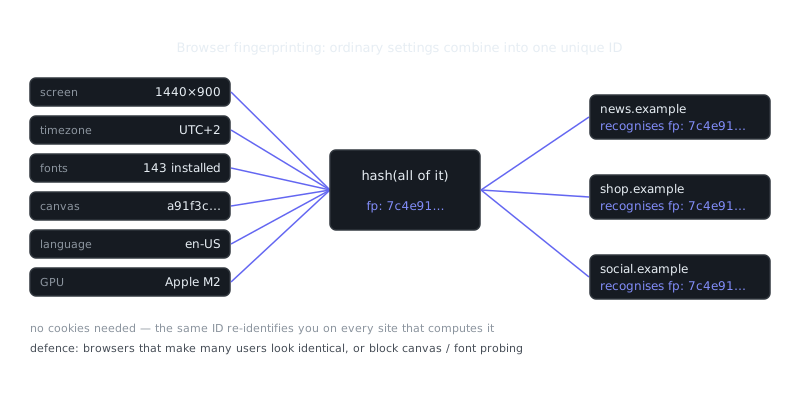
- Quasi-identifying: ZIP code, birth year, device fingerprint (individually innocuous, dangerous in combination)
- Sensitive categories: health, financial, biometric, location history
- Operational metadata: logs, audit trails, session tokens
Each category needs a documented retention schedule and an owner. Without that, data accumulates indefinitely by default — and it always does.
Schema Design
At the database level, minimization means not adding columns "just in case." A common anti-pattern is designing a user profile table with dozens of optional fields on the assumption that some future feature might use them. Each unused column is dead weight that still gets backed up, replicated, and potentially exposed.
A minimal user table might look like this:
CREATE TABLE users (
    id          UUID PRIMARY KEY DEFAULT gen_random_uuid(),
    email_hash  BYTEA NOT NULL,        -- hashed, not plaintext
    created_at  TIMESTAMPTZ NOT NULL DEFAULT NOW(),
    verified    BOOLEAN NOT NULL DEFAULT FALSE
);
-- Store display name only when the user explicitly sets one
CREATE TABLE user_profiles (
    user_id     UUID PRIMARY KEY REFERENCES users(id) ON DELETE CASCADE,
    display_name TEXT,
    updated_at  TIMESTAMPTZ
);
Separating the core identity record from optional profile data makes it straightforward to delete enrichment data on a shorter schedule than the base account.
Anonymization and Pseudonymization
Where real data isn't required, substitute it. For analytics, aggregate rather than track individuals. For testing environments, generate synthetic data or pseudonymize production exports:
# Using PostgreSQL's pgcrypto to pseudonymize an export
psql -c "COPY (
  SELECT
    md5(email || 'salt_value'),
    date_trunc('month', created_at),
    country_code
  FROM users
) TO STDOUT CSV;" > analytics_export.csv
This pattern is common in privacy-focused operating systems and secure development environments, where production data never reaches dev or staging without explicit anonymization steps gated into the pipeline.
Retention Policies and Automated Deletion
A minimization policy without automated enforcement is just a document. Retention schedules need to be built into the system, not handed off to manual review that may never happen.
Defining Retention Windows
Work backward from purpose. If you send a transactional email, you need the recipient's address until the transaction is complete, plus a reasonable window for disputes. You don't need it indefinitely.
Typical retention tiers worth considering:
- Session data: hours to days
- Transactional records: 1–7 years (often driven by tax and accounting law)
- Security logs: 90 days to 1 year
- Marketing preferences: until consent is withdrawn
- Inactive accounts: 12–24 months, then prompt or delete
Automating Deletion
# Example: scheduled deletion of expired user data
from datetime import datetime, timedelta
import psycopg2

INACTIVE_THRESHOLD_DAYS = 730  # 2 years

def delete_inactive_users(conn):
    cutoff = datetime.utcnow() - timedelta(days=INACTIVE_THRESHOLD_DAYS)
    with conn.cursor() as cur:
        cur.execute("""
            DELETE FROM users
            WHERE last_active_at < %s
              AND verified = FALSE
            RETURNING id
        """, (cutoff,))
        deleted = cur.rowcount
        conn.commit()
    return deleted
Run this as a scheduled job. Log the count, not the deleted IDs — you don't want your deletion audit trail becoming another source of sensitive data.
Minimization in Third-Party Integrations
Integrations are where minimization breaks down in practice. Connect a CRM, analytics platform, or ad network, and data flows somewhere outside your control. Each integration deserves the same scrutiny as internal data collection.
Ask these questions before any integration:
- What data does this vendor receive by default?
- Can you configure it to send less (field-level filtering, server-side rather than client-side tracking)?
- What's the vendor's own retention policy?
- Does their use of your users' data conflict with the purpose limitation under which you collected it?
This matters especially in the context of privacy infrastructure. Tools like the I2P network (Invisible Internet Project) route traffic through a distributed overlay to prevent traffic analysis — a pattern that illustrates how infrastructure-level design choices can enforce minimization properties without relying on policy promises. The same thinking applies to your integrations: architectural decisions about what data crosses the wire are far more reliable than a vendor's word.
Server-side tag management is a practical middle ground. Rather than loading third-party JavaScript directly on user devices (which gives vendors direct access to browser state), proxy requests through your own server and forward only the fields you've decided to share.
Organizational Practices
Technical controls only get you so far. Minimization requires organizational habits that stick:
- Privacy by default: new features ship with the minimal data configuration, not the maximal one. Expanding collection requires justification; restriction shouldn't.
- Regular data audits: quarterly or annual reviews of what you're collecting versus what you're actually using. Unused data streams should be shut off.
- Employee access reviews: periodic checks that internal access rights still match current job functions. Former project members hold onto access longer than most organizations realize.
- Vendor due diligence: data processing agreements that bind vendors to minimization obligations, with audit rights you can actually exercise.
Summary and Key Takeaways
Data minim
Frequently Asked Questions
What is data minimization and why does it matter?
Data minimization means only collecting the personal information you actually need for a specific purpose, nothing more. It matters because collecting less data reduces the risk of harm if there's a breach, and it builds trust with users by showing you respect their privacy.
How do I know if I'm collecting too much data?
Ask yourself whether each piece of information you collect is directly necessary to deliver your product or service. If you can't clearly explain why you need it, you probably shouldn't be collecting it.
Does data minimization mean I have to delete data I've already collected?
Yes, it includes not holding onto data longer than necessary, which is called storage limitation. Once data has served its original purpose, best practice — and in many regions, legal requirement — is to delete or anonymize it.
Video Resources
Sources & Further Reading
- Tor Project — Official site of the Tor network and Tor Browser.
- Tor Browser Manual — Setup, security levels, bridges and troubleshooting.
- EFF Surveillance Self-Defense — Threat-model based guides from the Electronic Frontier Foundation.
- Privacy Guides — Independent recommendations for privacy-respecting tools.
- Security in a Box — Digital security guides for activists and journalists.
- Tails Documentation — Official documentation for the amnesic live operating system.
- Whonix Documentation — Wiki for the Tor-based Whonix operating system.