Trading Psychology and Discipline: Mastering the Mental Game
Most traders chase perfect strategies while ignoring the real key to success: psychology and discipline. Research proves that emotional control and mental discipline outweigh technical systems in determining long-term profitability.
On this page
Most traders spend their time hunting for the perfect strategy, the right indicators, or a better entry signal. Yet research consistently shows that psychology and discipline drive more long-term trading success than any technical system ever will. A trader with an average strategy and strong mental discipline will outperform someone with a brilliant strategy and poor emotional control — every single time, across a large enough sample.
This article covers the core psychological challenges traders face, the discipline frameworks that actually address them, and how to build habits that hold up when things get hard.
The Psychological Landscape of Trading
Trading is one of the few professions where being wrong costs you money in real time. That creates a feedback loop of fear, greed, regret, and overconfidence that distorts decision-making in ways most people seriously underestimate until they've lived through it.
Fear and Greed: The Two Dominant Forces
Fear shows up in two flavors: fear of losing money, which triggers premature exits, and fear of missing out (FOMO), which causes late entries. If you exit a winning position too early because you're scared of a reversal, you'll systematically undercut your reward-to-risk ratio over time. If you chase a breakout because you can't stand watching a move happen without you, you'll keep entering at bad prices with unfavorable risk profiles.
Greed pushes you to hold positions longer than your plan says, add size at dangerous moments, or bet everything on a single big win. The 2021 meme stock frenzy is a clean example: retail traders who held GameStop well past any reasonable profit target, driven by greed and narrative, gave back massive gains or turned profits into losses entirely.
Cognitive Biases That Cost Money
| Bias | Description | Trading Impact |
|---|---|---|
| Confirmation bias | Seeking information that supports an existing position | Ignores contradicting signals, holds losing trades |
| Loss aversion | Feeling losses more acutely than equivalent gains | Cuts winners early, lets losers run |
| Recency bias | Overweighting recent events in decision-making | Overconfidence after a win streak; paralysis after losses |
| Anchoring | Fixating on a specific price (e.g., entry price) | Refuses to exit a losing trade because the price "should" return |
| Overconfidence | Overestimating skill relative to luck | Oversizing positions, under-researching trades |
These biases get worse during market extremes. When the broader market is in a euphoric phase, confirmation bias and overconfidence spike across nearly every participant. Recognizing which part of the cycle you're trading in helps you calibrate how much weight to give crowd sentiment versus your own analysis.
Building a Trading Plan That Enforces Discipline
Discipline isn't willpower. Willpower is finite and degrades under stress. Real trading discipline is structural — it comes from rules you write down before emotion enters the picture.
The Core Components of a Trading Plan
A functional trading plan covers six areas:
- Universe of instruments — which markets, sectors, or assets you trade
- Entry criteria — the specific conditions that must be met before entering a position
- Exit criteria — both profit targets and stop-loss levels
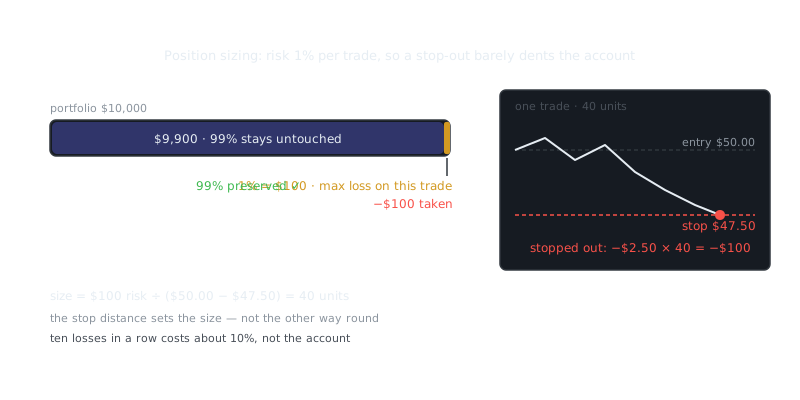
- Position sizing rules — how much capital is at risk per trade
- Maximum drawdown limits — the point at which you stop trading and reassess
- Review cadence — how and when you evaluate performance
Understanding order types — market, limit, stop — is essential for execution discipline. A trader who only uses market orders during volatile conditions will take on unnecessary slippage. A limit order enforces price discipline by refusing to execute unless the market meets your terms. A stop order automates your exit and removes the emotional question of when to finally cut a loss.
Pre-Trade Checklists
A pre-trade checklist turns your plan into a repeatable process. Before entering any position, you should be able to answer four questions honestly: Does this setup match my defined entry criteria? Where's my stop, and is the risk acceptable given my sizing rules? What's my target, and does the reward justify the risk? Am I entering because of a signal, or because of emotion?
That last one is the hardest — and the most important.
Risk Management as a Psychological Tool
Risk management gets framed as a math exercise, but its primary function is psychological. When you know your maximum loss before you enter a trade, you eliminate the anxiety of the unknown. That clarity lets you execute without hesitation and exit without second-guessing yourself.
The 1-2% Rule
A standard framework limits risk to 1-2% of total account equity per trade. On a $50,000 account, that means no single trade should cost more than $500-$1,000. This does two things: it prevents catastrophic drawdowns, and it reduces the emotional weight of any individual trade. A loss that represents 0.5% of your account is easy to absorb and move past. A loss that represents 20% of your account creates psychological damage that distorts every decision that follows.
Drawdown Limits and Circuit Breakers
Professional traders use daily and weekly drawdown limits as circuit breakers. Lose 3% in a single day? Stop trading that day. Lose 8% in a week? Step back for a defined period and review. These aren't signs of weakness — they're the same mechanisms used by quantitative hedge funds and proprietary trading desks. The goal is simple: don't let a bad day turn into a bad month.
The Role of Journaling and Self-Review
A trading journal is probably the most underused tool in retail trading. It creates accountability and surfaces patterns that are completely invisible in the moment.
What to Record
Every trade should log the date, instrument, direction, and size, along with the reason for the entry and which criteria were met. You should also note your emotional state at entry and exit, the outcome, and whether you actually followed your process — regardless of whether the trade made money.
That last part really matters. A losing trade executed according to plan is a good trade. A winning trade taken impulsively is a bad trade. Journaling trains you to evaluate process rather than outcome, which is the only thing you actually control.
Monthly Review Protocol
At the end of each month, dig into your journal data and look for a few things: your win rate and average reward-to-risk ratio, which setups worked and which didn't, how many trades deviated from your plan and what happened when they did, and whether losses clustered on specific days or after specific events.
This is where real improvement happens. Without this kind of review, you'll repeat the same mistakes with bigger and bigger capital at risk.
Discipline Under Pressure: Real-World Scenarios
Handling a Losing Streak
A losing streak is the hardest psychological stretch in trading. The instinctive responses — taking larger positions to recover, switching strategies mid-stream, throwing out your rules — are all exactly wrong. A losing streak is precisely when discipline matters most.
The right move is to reduce position size, not increase it. Smaller size cuts P&L volatility and the emotional charge of each trade, which helps you think clearly again. If the streak keeps going, revisit your plan and check whether market conditions have shifted in ways that make your strategy temporarily ineffective.
Managing a Large Winning Position
Greed and anchoring combine to make winning positions genuinely difficult to manage. You anchor to the peak unrealized profit and can't accept a smaller exit. A cleaner approach is to take partial profits at predefined levels and trail a stop on the rest. This locks in gains while leaving room for further upside and removes the painful binary pressure of all-or-nothing.
Arbitrage and Low-Emotion Trading
At its core, arbitrage is the practice of exploiting price discrepancies across markets or instruments with limited directional risk. Pure arbitrage is one of the few strategies that largely removes emotion from the equation — the edge is mathematical, not predictive. True risk-free arbitrage is rare for retail traders, but studying its structure reinforces a useful principle: the less a strategy depends on prediction and the more it depends on process, the easier it is to execute with discipline.
Key Takeaways
Trading psychology and discipline aren't soft skills. They're the operational layer that determines whether any strategy survives contact with real markets.
“The market can remain irrational longer than you can remain solvent.”
— John Maynard Keynes
A few things worth keeping with you: fear and greed are structural forces in markets, and recognizing them in yourself is the first layer of defense. Cognitive biases like loss aversion, recency bias, and overconfidence translate directly into poor execution and poor trade management. Discipline comes from systems written before emotion shows up, not from willpower exercised in the heat of the moment. Knowing your order types gives you execution discipline and removes emotional decision-making from entries and exits. And risk management — specifically capping your exposure per trade — is as much about protecting your psychology as it is about protecting your capital.
Frequently Asked Questions
Why do I keep making impulsive trades even when I know I shouldn't?
Impulsive trading is usually driven by emotions like fear of missing out (FOMO) or the urge to recover losses quickly, which can override logical thinking. Building a written trading plan with clear entry and exit rules helps you make decisions before emotions kick in. Over time, following the plan consistently builds the discipline muscle that keeps impulsive behavior in check.
How do I stop letting losses affect my next trade?
Letting a loss bleed into your next trade is called 'revenge trading,' and it's one of the fastest ways to blow an account. After a losing trade, take a short break to reset mentally before entering another position. Accepting that losses are a normal part of trading — not a personal failure — is the mindset shift that separates consistent traders from struggling ones.
How do I know if I have a trading discipline problem or just a bad strategy?
If you have a strategy but frequently deviate from it — moving stop losses, sizing up out of frustration, or exiting too early — that's a discipline problem. If you follow your rules consistently but still lose money, the issue is more likely the strategy itself. Keeping a trading journal makes it much easier to tell the difference by tracking both your decisions and their outcomes.
Video Resources
Sources & Further Reading
- Investopedia — Reference definitions and explainers for markets and trading.
- Investopedia: Technical Analysis — Indicator-by-indicator guides with worked examples.
- TradingView — Charting platform with community education and indicator scripts.
- CoinGecko — Price history, volume and market capitalisation data.
- BabyPips School — Free structured course on chart reading and risk management.
- Glassnode Academy — On-chain metrics explained, from active addresses to realised cap.
- Wikipedia: Technical analysis — History, methods and the academic debate around technical analysis.