Spot Trading vs Futures Trading: Which Is Right for You?
Spot trading offers immediate asset exchange at current prices, while futures trading uses contracts for predetermined future transactions. This guide breaks down the mechanics, advantages, and risks of each approach to help you choose the right strategy for your goals and risk tolerance.
On this page
Choosing between spot and futures trading shapes everything from your risk exposure to how much capital you actually need. Spot trading means you buy or sell an asset right now at today's price. Futures trading means you're dealing with contracts that lock in a price for a transaction happening later. Knowing how each one works — and when to use which — is what separates traders who stumble into bad positions from those who don't.
“Risk comes from not knowing what you're doing.”
— Warren Buffett
What Is Spot Trading?
Spot trading is straightforward: you buy an asset and you own it. Whether that's Bitcoin, a stock, or a commodity, the purchase settles immediately (or within a day or two for traditional markets, and essentially instantly on crypto exchanges).
Ownership is the whole point. Buy 100 shares at $50 each, spend $5,000, and those shares are yours. Your worst-case loss is what you put in. Your upside is theoretically unlimited as the asset appreciates.
Spot markets are also transparent. The price on the screen is the price you pay. There are no expiration dates to track, no funding rates eating into your position, no contract mechanics to decode. That simplicity is why most people start here.
How Spot Orders Work
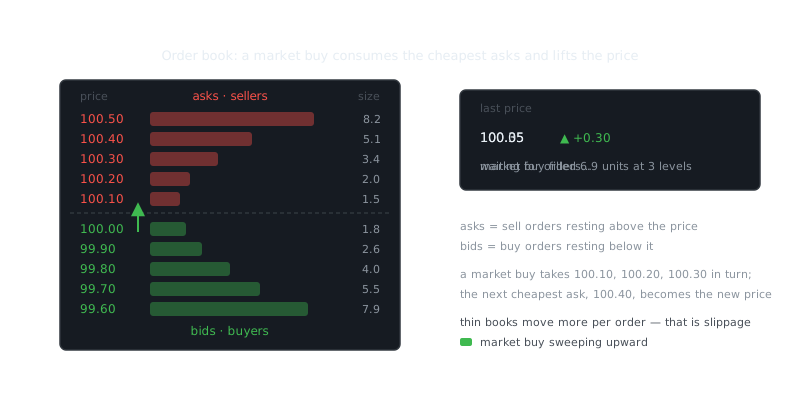
Exchanges match buyers and sellers through an order book. Market orders fill immediately at whatever price is available. Limit orders sit and wait until the market hits your target price. Stop-loss orders trigger automatic sales when the price drops to a level you set — basic protection that doesn't require you to watch charts all day.
One real constraint with spot crypto trading: you need the full amount upfront. If Bitcoin is trading at $45,000 and you want one, you need $45,000 sitting in your account. That limits your position size, but it also means you'll never get liquidated.
What Is Futures Trading?
Futures contracts commit you to buy or sell an asset at a set price on a specific date. You don't own the underlying asset — you hold a derivative that tracks its price. A crude oil futures contract, for example, might lock you into buying 1,000 barrels at $80 per barrel three months out. If oil climbs to $90 before then, your contract becomes more valuable because you locked in the lower price.
Most traders never actually want the physical asset. They close the position before expiration by taking an offsetting trade — selling what they bought, or buying what they sold. The profit or loss is just the difference between where you entered and where you exited.
Leverage and Margin Requirements
Leverage is what makes futures fundamentally different from spot. Instead of paying full price, you post margin — a fraction of the contract's total value. With 10x leverage, $5,000 in margin controls a $50,000 position.
That cuts both ways. A 5% move in your favor returns 50% on your margin. The same 5% move against you wipes out half your capital. Exchanges set a maintenance margin threshold — fall below it, and you either deposit more or your position gets forcibly closed. That's liquidation, and it tends to happen at the worst possible moment.
Perpetual futures, which dominate crypto markets, have no expiration date. They use funding rates — periodic payments between long and short traders — to keep the contract price tied to spot. When funding is positive, longs pay shorts. When it flips negative, shorts pay longs.
Key Differences Between Spot and Futures
| Aspect | Spot Trading | Futures Trading |
|---|---|---|
| Ownership | Direct ownership of asset | Contract ownership, not asset |
| Capital Required | Full asset value | Margin (fraction of value) |
| Leverage | None (1x) or limited | High (5x-125x typical) |
| Profit Direction | Long only | Long or short equally |
| Expiration | None | Dated contracts expire; perpetuals don't |
| Liquidation Risk | None | Yes, when margin depleted |
| Complexity | Low | Moderate to high |
| Ideal For | Long-term holders, beginners | Active traders, hedgers |
The leverage gap changes your risk profile completely. Spot traders deal with paper losses that only become real when they sell. Futures traders face liquidation when losses burn through their margin — no choice, no waiting for a recovery.
Direction flexibility is the other major difference. Spot trading only makes money when prices go up, which creates an obvious bias toward bull markets. Futures traders profit equally from rises and falls. During a prolonged bear market, that symmetry isn't just useful — it's often the only way to stay active.
Practical Applications and Use Cases
When to Use Spot Trading
Spot makes the most sense when you're accumulating with a long time horizon. If you believe Bitcoin reaches $100,000 over the next two years, buying spot means you can sit through a 40% drawdown without getting forced out. No margin call, no liquidation — just waiting.
Dollar-cost averaging fits naturally here too. Buying fixed amounts on a regular schedule smooths out your entry price and removes the pressure of trying to time the market perfectly. You build your position gradually without worrying about margin requirements or funding costs chewing into your returns.
When to Use Futures Trading
Futures shine for short-term directional trades and hedging. A trader spotting a bullish MACD crossover on Ethereum's 4-hour chart might open a 5x leveraged long to capture that momentum move without deploying five times the capital.
Hedging is where futures really earn their keep. Say a mining company is holding 100 Bitcoin and wants to protect against a price drop. They sell Bitcoin futures contracts to lock in current prices while keeping the actual coins. If Bitcoin falls 20%, the futures profits offset the spot losses. If Bitcoin climbs, the spot gains outpace what was lost on the futures side — minus funding costs.
Arbitrage traders also work the gap between spot and futures prices. When futures trade at a meaningful premium to spot, you can buy spot and sell futures simultaneously, pocketing the spread while staying market-neutral. It requires careful attention to funding rates and margin, but the risk profile is about as clean as it gets.
Risk Management Considerations
Position sizing works completely differently across these two approaches. A conservative spot trader putting 5% of capital into a single trade risks losing that 5% in a total collapse scenario. The same trader using 10x leverage sees equivalent dollar losses from just a 0.5% adverse move. What feels like a cautious allocation becomes an aggressive bet the moment leverage enters the picture.
Stop-loss placement becomes critical in futures. A stop set 3% below entry with 10x leverage protects against 30% margin erosion — reasonable for a volatile asset. Spot traders often run wider stops or skip them entirely, treating drawdowns as temporary for assets they believe in long-term.
Funding rates create a steady stream of costs or income in perpetual futures. During strong bull markets, funding rates can run high enough to meaningfully erode returns on long positions held for days or weeks. It's a cost that doesn't exist in spot trading, and traders often underestimate it until it adds up.
Frequently Asked Questions
What is the difference between spot trading and futures trading?
Spot trading means you buy or sell an asset and own it immediately at the current market price. Futures trading involves a contract to buy or sell an asset at a set price on a future date, so you don't own the asset right away. Spot trading is generally simpler and better suited for beginners.
Do I need to put up collateral to trade futures?
Yes, futures trading requires margin — a deposit that acts as collateral to cover potential losses. This is different from spot trading, where you pay the full price upfront and own the asset outright. Because of margin, futures can amplify both gains and losses, which makes them riskier for new traders.
Can I lose more money than I invest with futures trading?
Yes, that is possible with futures because of leverage — you control a large position with a relatively small deposit. If the market moves against you, losses can exceed your initial margin. With spot trading, the most you can lose is what you paid for the asset, making it a safer starting point.
Video Resources
Sources & Further Reading
- CFTC: Learn & Protect — Regulator's plain-language warnings about leverage and fraud.
- Investopedia — Reference definitions and explainers for markets and trading.
- Investopedia: Technical Analysis — Indicator-by-indicator guides with worked examples.
- TradingView — Charting platform with community education and indicator scripts.
- CoinGecko — Price history, volume and market capitalisation data.
- BabyPips School — Free structured course on chart reading and risk management.
- Glassnode Academy — On-chain metrics explained, from active addresses to realised cap.