Dollar Cost Averaging vs Lump Sum Investing: A Complete Comparison
Should you invest all at once or spread purchases over time? This analysis compares dollar cost averaging and lump sum strategies across risk, returns, and market conditions to help you choose the right approach for your portfolio.
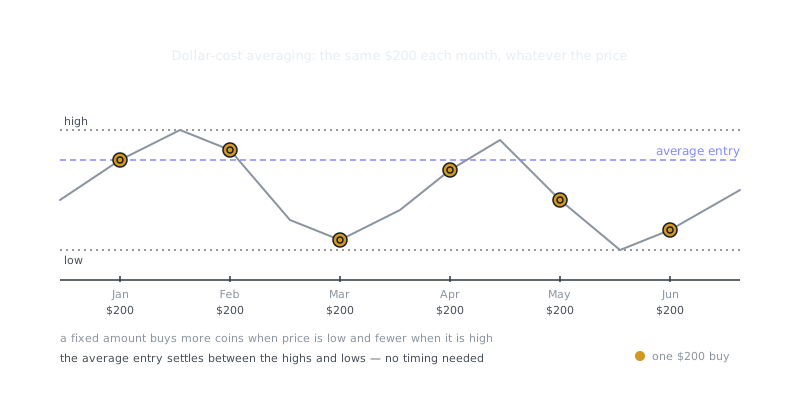
Try it: how the average entry price behaves
Drag the sliders. Buying the same amount every month means you buy more units when the price is low and fewer when it is high, so the average entry settles below the average price.
On this page
Few investment debates generate more opinions than this one. Should you invest everything at once, or spread it out over time? The honest answer is that it depends — on your psychology, your market timing, and how much pain you can stomach watching a portfolio drop.
Both approaches work. Neither is perfect. Here's what actually matters when choosing between them.
Understanding Dollar Cost Averaging
Dollar cost averaging means investing a fixed amount on a regular schedule, regardless of what the market's doing. Instead of putting $12,000 in all at once, you invest $1,000 every month for a year.
The math here does something useful automatically. When prices drop, your $1,000 buys more shares. When prices rise, it buys fewer. Over time, this naturally pulls your average cost per share below the simple average of all the prices you bought at.
DCA Mechanics in Practice
Take a concrete example: you're investing $6,000 over six months in a stock that trades at $100, $80, $90, $70, $85, and $95 in successive months.
Investing $1,000 each month gives you:
- Month 1: 10 shares at $100
- Month 2: 12.5 shares at $80
- Month 3: 11.11 shares at $90
- Month 4: 14.29 shares at $70
- Month 5: 11.76 shares at $85
- Month 6: 10.53 shares at $95
That's 70.19 total shares at an average cost of $85.47. The simple arithmetic average of those six prices is $86.67. By automatically buying more when prices were low, DCA shaved $1.20 off your average cost per share without any extra effort.
When DCA Actually Helps You
Beyond the price math, DCA does three things that matter.
It protects you emotionally during volatile markets. Putting money in gradually means you don't have to live with the regret of going all-in the week before a big drop. That psychological relief is worth something real.
It fits how most people actually earn money. If you're investing from each paycheck, you're already doing DCA. For most working people, it's not a strategy choice — it's just the natural rhythm of how income arrives.
It also pairs well with some market awareness. You don't have to invest blindly on a calendar schedule. Some investors accelerate purchases when markets look oversold and slow down when valuations seem stretched, combining DCA's discipline with a loose eye on conditions.
The Case for Lump Sum
Here's the thing about lump sum investing: historically, it wins more often than not. Vanguard studied rolling 10-year periods across multiple markets and found lump sum outperformed DCA about 68% of the time. The logic is simple — markets go up over long periods, so money invested sooner has more time to compound.
What the Math Actually Says
Imagine you have $12,000 to invest in a market returning 10% annually. Invest it all today, and the whole amount starts compounding immediately — you end up with roughly $13,200 after a year.
With DCA, your first $1,000 gets a full year in the market, but your last $1,000 only gets one month. On average, each dollar sits in cash for about 5.5 months before getting invested. That drops your expected ending value to around $12,650. The $550 gap is the real cost of sitting in cash while the market moves.
“The market can remain irrational longer than you can remain solvent.”
— John Maynard Keynes
The Downside Nobody Likes Talking About
Lump sum gets ugly when your timing is terrible. The investor who deployed everything in October 2007 watched their portfolio get cut nearly in half over the next 18 months. A DCA investor kept buying through 2008 and 2009 at rock-bottom prices.
But here's what's interesting — even that badly timed 2007 lump sum investor typically came out ahead over the full 2009-2020 bull run. Why? Because they owned more shares going into the recovery. The DCA investor accumulated fewer total shares during the decline, which sounds good until the market doubles.
How Different Market Conditions Change the Math
| Market Condition | Lump Sum Performance | DCA Performance | Winner |
|---|---|---|---|
| Steady uptrend | Strong gains from full exposure | Moderate gains, high opportunity cost | Lump Sum |
| High volatility, no trend | Moderate gains/losses | Reduced volatility, similar returns | DCA (risk-adjusted) |
| Initial decline, then recovery | Initial pain, strong eventual return | Lower average cost, strong return | DCA |
| Extended bear market | Severe drawdown | Accumulation at lower prices | DCA |
| Market top entry | Maximum regret, full downside | Partial downside protection | DCA |
Read that table carefully and you'll notice something. DCA rarely wins on raw returns — it wins on risk-adjusted returns and emotional survivability. If you can handle volatility without panic-selling, lump sum math is on your side. If a 30% drop would send you running for the exits, DCA keeps you in the game.
Hybrid Approaches Worth Considering
Most real-world lump sum decisions come from windfalls: an inheritance, a year-end bonus, selling a business, rolling over a 401(k). Treating it as a strict either/or choice misses a practical middle ground.
Compressed DCA
Instead of spreading $60,000 over 12 months, consider 2-3 months. Research suggests a 3-month DCA window captures about 90% of lump sum's outperformance while cutting maximum regret by roughly 40%. You get most of the upside with a fraction of the emotional exposure.
A reasonable approach: deploy 25-50% immediately to establish your core position, then stage the rest over the compressed window.
Condition-Based Investing
Rather than investing on fixed calendar dates, tie your schedule to market conditions. When price-to-earnings ratios fall below historical averages, invest more. When valuations look stretched above 30x earnings, slow down or hold more cash.
A rule like this makes it concrete: "I invest $2,000 monthly, but bump to $3,000 if the S&P 500 drops more than 5% from recent highs, and scale back to $1,000 when valuations look extreme." That kind of conditional structure keeps you disciplined while letting you lean into obvious opportunities.
Building Positions in Individual Stocks
Broad index funds trend upward reliably over decades. Individual stocks don't carry that same guarantee — they can drop 80% and never come back. That's where DCA earns its keep most clearly.
When you're building a position in a specific company or volatile sector, a programmatic approach can prevent you from loading up at the worst moment:
# Example position sizing rule
TOTAL_ALLOCATION=10000
WEEKLY_INVESTMENT=500
MAX_WEEKS=20

# Adjust based on technical signals
if [ RSI < 30 ]; then
  WEEKLY_INVESTMENT=750  # Oversold condition
elif [ RSI > 70 ]; then
  WEEKLY_INVESTMENT=250  # Overbought condition
fi
Mechanical rules like this remove the temptation to "feel out" entries and prevent full allocation from landing at technical extremes.
The Part That Actually Decides Everything
Here's what the data can't fully capture. An investor who goes all-in and immediately sees a 20% loss might panic and sell — locking in that loss and sitting out the recovery. The DCA investor who kept buying through the same decline often holds with more conviction because their average cost is lower and they stayed engaged rather than stunned.
Mathematically, lump sum wins most of the time. Behaviorally, the best strategy is the one you'll actually stick with. Those aren't always the same answer, and only you know which category you're in.
Frequently Asked Questions
What is the difference between dollar cost averaging and lump sum investing?
Lump sum investing means putting all your money into an asset at once, while dollar cost averaging (DCA) means spreading your investment over regular intervals — like buying $100 of stock every month. DCA reduces the risk of buying everything at a market peak, but lump sum investing tends to perform better over time in markets that trend upward.
Which strategy is better for a beginner — dollar cost averaging or lump sum?
For most beginners, dollar cost averaging is the more practical choice because it removes the pressure of trying to time the market and fits naturally with a regular paycheck. It also helps build a consistent investing habit without needing a large amount of money upfront.
Does dollar cost averaging guarantee I won't lose money?
No, DCA does not protect you from losses — if the asset you're buying consistently drops in value, you'll still lose money. What it does is lower your average purchase price during a downturn, which can reduce losses and position you for a better recovery compared to investing everything at the wrong time.
Video Resources
Sources & Further Reading
- Investopedia — Reference definitions and explainers for markets and trading.
- Investopedia: Technical Analysis — Indicator-by-indicator guides with worked examples.
- TradingView — Charting platform with community education and indicator scripts.
- CoinGecko — Price history, volume and market capitalisation data.
- BabyPips School — Free structured course on chart reading and risk management.
- Glassnode Academy — On-chain metrics explained, from active addresses to realised cap.
- Wikipedia: Technical analysis — History, methods and the academic debate around technical analysis.