Social Engineering Awareness: How to Protect Yourself from Human Hacking
Social engineering manipulates people into revealing sensitive information or taking actions that compromise security. Unlike software exploits, these attacks target human psychology — making awareness your strongest defense. Learn how to recognize and stop them.
On this page
Social engineering is the art of manipulating people into revealing confidential information or performing actions that compromise security. Unlike technical exploits that go after software vulnerabilities, social engineering targets you — the human element — which is often the most unpredictable link in any security chain. Understanding how these attacks work is the first step toward building real defenses.
What Is Social Engineering?
These attacks exploit psychological principles like trust, authority, urgency, and fear. An attacker rarely needs to break encryption or bypass firewalls when they can simply convince an employee to hand over credentials directly.
The term covers a wide range of tactics, from a phone call impersonating IT support to elaborate multi-month campaigns targeting executives. What unites them is the goal: manipulate human behavior to gain unauthorized access to systems, data, or physical spaces.
They work because they exploit how people naturally behave. We're conditioned to help colleagues, respect authority, and respond to urgency. Attackers weaponize those instincts.
Common Attack Vectors
Phishing and Its Variants
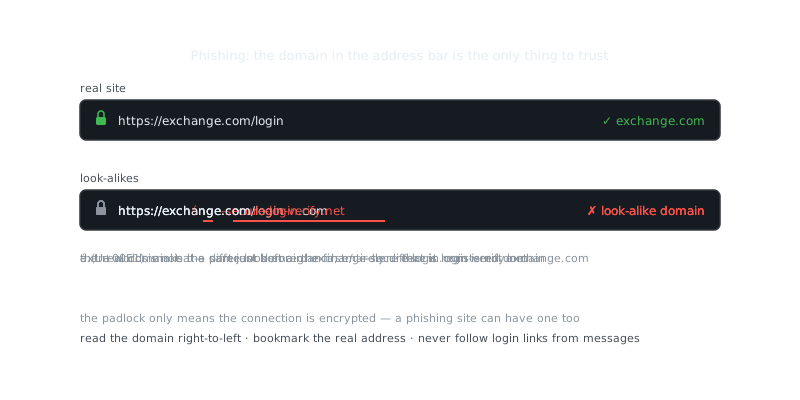
Phishing is the most common form of social engineering. An attacker sends a message — usually email — that appears to come from a trusted source, directing you to a fake site or into opening a malicious attachment.
Spear phishing targets a specific individual using personalized information gathered from LinkedIn, company websites, or prior data breaches. Whaling goes after executives specifically, often using forged legal documents or board-level communications. Vishing uses phone calls, where a caller impersonates a bank, the IRS, or internal IT support. Smishing does the same thing over SMS.
A real-world example: in 2020, attackers used vishing to social engineer Twitter employees into handing over VPN credentials, which ultimately compromised high-profile accounts including Barack Obama and Elon Musk.
Pretexting
Pretexting means creating a fabricated scenario to extract information. An attacker might pose as an auditor requesting employee records, or a vendor needing system access for "routine maintenance." The story doesn't need to be airtight — it just needs to be plausible enough that you don't question it in the moment.
Baiting and Quid Pro Quo
Baiting offers something enticing — a free USB drive left in a parking lot, or pirated software — that contains malware. Quid pro quo involves offering a service, like fake tech support, in exchange for credentials or access. Both rely on you wanting something enough to skip due diligence.
Tailgating and Physical Intrusion
Not all social engineering is digital. Tailgating means physically following an authorized person through a secured door. Attackers often dress as delivery personnel or contractors to avoid raising suspicion. It's surprisingly effective because most people don't want to be the one who challenges a stranger carrying a stack of boxes.
Psychological Principles Attackers Exploit
Knowing the psychology behind these attacks helps you recognize them in the moment.
| Principle | How It's Exploited | Example |
|---|---|---|
| Authority | People comply with perceived authority figures | "This is your IT department, we need your password immediately" |
| Urgency | Pressure reduces critical thinking | "Your account will be suspended in 24 hours" |
| Social proof | People follow the crowd | "Everyone else on your team has already submitted their credentials" |
| Reciprocity | People feel obligated to return favors | Attacker provides fake help, then asks for access |
| Liking | We trust people we like | Attacker builds rapport over weeks before making a request |
| Scarcity | Fear of missing out drives hasty action | "This is your only chance to verify before the system locks" |
Robert Cialdini's principles of influence, originally described in a marketing context, map almost perfectly onto social engineering tactics. Once you can name which principle is being triggered, you've bought yourself time to pause and verify.
Technical Defenses That Reinforce Human Awareness
Awareness alone isn't enough. Technical controls add a layer of protection that reduces the damage when manipulation does succeed.
DNS Over HTTPS (DoH)
One underused privacy measure is configuring DNS over HTTPS, which encrypts DNS queries to prevent eavesdropping and manipulation. Attackers sometimes use DNS spoofing to redirect you to phishing sites even when you type a legitimate URL. DoH cuts off that avenue.
On Linux or macOS, you can configure a system-level DoH resolver using systemd-resolved or a tool like dnscrypt-proxy:
# Install dnscrypt-proxy
sudo apt install dnscrypt-proxy

# Edit config to enable DoH
sudo nano /etc/dnscrypt-proxy/dnscrypt-proxy.toml
# dnscrypt-proxy.toml
listen_addresses = ['127.0.0.1:53']
server_names = ['cloudflare', 'google']
doh_servers = true
dnscrypt_servers = falseThis ensures DNS queries are encrypted in transit, reducing the effectiveness of phishing redirects that rely on DNS manipulation.
Anonymization with Tor
When researching threats or accessing sensitive internal resources, the Tor network provides strong anonymity by routing traffic through multiple encrypted relays. Each relay only knows the previous and next hop, so no single node can see both the origin and destination. That's useful for security researchers who need to investigate attacker infrastructure without revealing their identity or organization.
For everyday privacy during sensitive browsing, the Tor Browser is the simplest entry point. For programmatic use:
# Route curl traffic through Tor's SOCKS5 proxy
curl --socks5-hostname 127.0.0.1:9050 https://check.torproject.org/api/ip
Worth noting: Tor doesn't protect against endpoint compromise. If an attacker has already social-engineered credentials, anonymized traffic doesn't help. But it does reduce the attack surface for network-level surveillance.
Multi-Factor Authentication
MFA is the single most effective technical control against credential-based attacks. Even if you're tricked into handing over a password, a time-based OTP or hardware key prevents account compromise. Prefer hardware tokens like YubiKey over SMS-based MFA — SMS is vulnerable to SIM-swapping, which is itself a social engineering attack.
Building a Social Engineering Resistant Culture
Technical controls fail when the culture doesn't back them up. Organizations need employees who feel safe reporting suspicious interactions without fear of embarrassment.
Verification Protocols
Every organization should have a clear, simple policy: any request for credentials, financial transfers, or sensitive data made via email or phone gets verified through a separate, known-good channel. If someone calls claiming to be IT support, hang up and call IT back using the internal directory number.
That sounds obvious. But pressure and urgency make people skip verification steps. Drilled habits are more reliable than in-the-moment judgment, especially when someone is breathing down your neck.
Regular Simulated Attacks
Running phishing simulations — using tools like GoPhish — gives employees practice recognizing attacks in a low-stakes environment. The goal isn't to shame people who click. It's to identify gaps in awareness and tailor training accordingly.
# Run a GoPhish server locally for internal simulations
./gophish
# Default admin interface: https://localhost:3333
Vary the sophistication of simulations. An obvious phish teaches less than a convincing spear-phishing scenario built around real employee names and project references.
Least Privilege and Need-to-Know
Limit what any single compromised account can access. An attacker who socially engineers a help desk employee shouldn't be able to reset the CEO's credentials or reach the financial database. Least-privilege architecture contains the damage when attacks succeed — and some will.
Privacy Coins and Financial Social Engineering
Financial fraud is a major component of social engineering. Attackers impersonate executives in what's called CEO fraud or Business Email Compromise to redirect wire transfers, or they pose as vendors to update payment details. It's worth understanding privacy-focused financial tools here, since attackers sometimes demand payment in untraceable cryptocurrency.
Privacy coins like Monero (XMR) and Zcash (ZEC) offer transaction obfuscation that Bitcoin doesn't. Here's a quick comparison:
| Coin | Privacy Mechanism | Default Privacy | Traceability |
|---|---|---|---|
| Bitcoin (BTC) | None (transparent ledger) | None | High |
| Monero (XMR) | Ring signatures, stealth addresses, RingCT | Always on | Very low |
| Zcash (ZEC) | zk-SNARKs (shielded transactions) | Optional | Low (if shielded) |
| Dash (DASH) | CoinJoin mixing (PrivateSend) | Optional | Moderate |
“Privacy is not something that I'm merely entitled to, it's an absolute prerequisite.”
— Marlon Brando
Knowing this helps organizations recognize that a ransom or fraud demand in
Frequently Asked Questions
What is social engineering and how does it affect my privacy?
Social engineering is when someone manipulates you psychologically to get you to reveal personal information or take an action you normally wouldn't. Instead of hacking your accounts directly, attackers trick you into handing over passwords, account details, or access. Common examples include fake emails pretending to be your bank or phone calls from someone claiming to be tech support.
How can I tell if someone is trying to socially engineer me?
Watch for unexpected urgency, like being told you must act immediately or face consequences such as account suspension or a fine. Legitimate organizations rarely pressure you to share sensitive information on the spot or through unofficial channels like personal email or text. If something feels off, hang up or stop responding and contact the organization directly using their official website or phone number.
What personal information should I never share, even if someone seems trustworthy?
Never share your passwords, PINs, Social Security number, or one-time verification codes with anyone who contacts you, no matter how official they sound. Banks, tech companies, and government agencies will never ask for these over the phone, email, or chat. Keeping this information private is your first line of defense against identity theft and account takeover.
Video Resources
Sources & Further Reading
- CISA — US cybersecurity agency guidance for individuals and organisations.
- Krebs on Security — Investigative reporting on breaches, fraud and malware.
- Have I Been Pwned — Check whether an email or password appeared in a known breach.
- Tor Project — Official site of the Tor network and Tor Browser.
- Tor Browser Manual — Setup, security levels, bridges and troubleshooting.
- EFF Surveillance Self-Defense — Threat-model based guides from the Electronic Frontier Foundation.
- Privacy Guides — Independent recommendations for privacy-respecting tools.